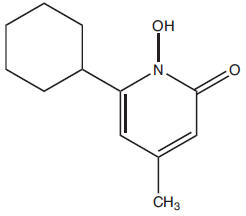
CICLOPIROX SHAMPOO USP, 0.01 120 ML
Generic: ciclopirox
CICLOPIROX SHAMPOO USP, 0.01 120 ML
Sign up to see pricing
Licensed pharmacies, clinics, doctor's offices, and veterinary practices get instant account approval
Sign Up — Instant ApprovalDrug Information
Identification
ciclopirox
Ciclopirox
Sun Pharmaceutical Industries, Inc.
HUMAN PRESCRIPTION DRUG
Administration
SHAMPOO
TOPICAL
ANDA090269
Active Ingredients
| Ingredient | Strength |
|---|---|
| CICLOPIROX | 10 mg/.96mL |
Pharmacological Class
Data sourced from openFDA / DailyMed. For full prescribing information, consult the drug label.
Wholesale compliance resources
Drug Resources
Clinical Drug Information
Indications & Usage
1 INDICATION AND USAGE Ciclopirox Shampoo 1% is indicated for the topical treatment of seborrheic dermatitis of the scalp in adults. Ciclopirox Shampoo 1% is an antifungal indicated for the topical treatment of seborrheic dermatitis of the scalp in adults. ( 1 )
Dosage & Administration
2 DOSAGE AND ADMINISTRATION Ciclopirox Shampoo 1% is not for ophthalmic, oral, or intravaginal use. Wet hair and apply approximately 1 teaspoon (5 mL) of Ciclopirox Shampoo 1% to the scalp. Up to 2 teaspoons (10 mL) may be used for long hair. Lather and leave on hair and scalp for 3 minutes. A timer may be used. Avoid contact with eyes. Rinse off. Treatment should be repeated twice per week for 4 weeks, with a minimum of 3 days between applications. If a patient with seborrheic dermatitis shows no clinical improvement after 4 weeks of treatment with Ciclopirox Shampoo 1%, the diagnosis should be reviewed. Apply approximately 1 teaspoon of Ciclopirox Shampoo 1% to the scalp twice per week for 4 weeks. ( 2 ) For topical use only. Not for ophthalmic, oral, or intravaginal use. ( 2 )
Adverse Reactions
6 ADVERSE REACTIONS The most frequently reported adverse reactions are pruritus, burning, and erythema. ( 6.1 ) To report SUSPECTED ADVERSE REACTIONS, contact Taro at 1-866-923-4914 or FDA at 1-800-FDA-1088 or http://www.fda.gov/medwatch. 6.1 Clinical Trials Experience Because clinical trials are conducted under widely varying conditions, adverse reaction rates observed in the clinical trials of a drug cannot be directly compared to rates in the clinical trials of another drug and may not reflect the rates observed in clinical practice. In 626 subjects treated with Ciclopirox Shampoo 1% twice weekly in the two pivotal clinical trials, the most frequent adverse events were increased itching in 1% of subjects, and application site reactions, such as burning, erythema, and itching, also in 1% of subjects. 6.2 Post Marketing Experience The following adverse reactions have been identified during post approval use of Ciclopirox Shampoo 1%: hair discoloration and abnormal hair texture, alopecia, irritation and rash. Because these events are reported voluntarily from a population of uncertain size, it is not possible to reliably estimate their frequency or establish a causal relationship to drug exposure.
Information for Patients
17 PATIENT COUNSELING INFORMATION See FDA-approved patient labeling (Patient Information) The patient should be instructed to: Use Ciclopirox Shampoo 1% as directed by the physician. Avoid contact with the eyes. If contact occurs, rinse thoroughly with water. Ciclopirox Shampoo 1% is for external use on the scalp only. Do not swallow. Use Ciclopirox Shampoo 1% for seborrheic dermatitis for the full treatment time even though symptoms may have improved. Notify the physician if there is no improvement after 4 weeks. Inform the physician if the area of application shows signs of increased irritation (redness, itching, burning, blistering, swelling, or oozing).
Clinical data sourced from openFDA drug labeling. For complete prescribing information, consult the full drug label.