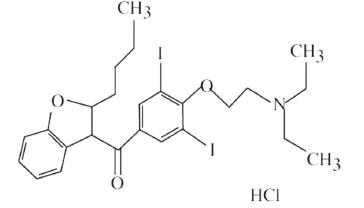
AMIODARONE HCL 50MG/ML 25X3ML VIAL
Generic: Amiodarone Hydrochloride
AMIODARONE HCL 50MG/ML 25X3ML VIAL
Sign up to see pricing
Licensed pharmacies, clinics, doctor's offices, and veterinary practices get instant account approval
Sign Up — Instant ApprovalDrug Information
Identification
Amiodarone Hydrochloride
Amiodarone Hydrochloride
Hikma Pharmaceuticals USA Inc.
HUMAN PRESCRIPTION DRUG
Administration
INJECTION, SOLUTION
INTRAVENOUS
ANDA077234
Active Ingredients
| Ingredient | Strength |
|---|---|
| AMIODARONE HYDROCHLORIDE | 50 mg/mL |
Pharmacological Class
Data sourced from openFDA / DailyMed. For full prescribing information, consult the drug label.
Wholesale compliance resources
Clinical Drug Information
Indications & Usage
1 INDICATIONS AND USAGE Amiodarone Hydrochloride Injection, USP is indicated for initiation of treatment and prophylaxis of frequently recurring ventricular fibrillation (VF) and hemodynamically unstable ventricular tachycardia (VT) in patients refractory to other therapy. Amiodarone Hydrochloride Injection, USP also can be used to treat patients with VT/VF for whom oral amiodarone is indicated, but who are unable to take oral medication. During or after treatment with Amiodarone Hydrochloride Injection, USP patients may be transferred to oral amiodarone therapy [see Dosage and Administration ( 2 )] . Use Amiodarone Hydrochloride Injection, USP for acute treatment until the patient's ventricular arrhythmias are stabilized. Most patients will require this therapy for 48 to 96 hours, but Amiodarone Hydrochloride Injection may be safely administered for longer periods if necessary. Amiodarone Hydrochloride Injection, USP is an antiarrhythmic agent indicated for initiation of treatment and prophylaxis of frequently recurring ventricular fibrillation (VF) and hemodynamically unstable ventricular tachycardia (VT) in patients refractory to other therapy. ( 1 )
Dosage & Administration
2 DOSAGE AND ADMINISTRATION Amiodarone shows considerable interindividual variation in response. Although a starting dose adequate to suppress life-threatening arrhythmias is needed, close monitoring with adjustment of dose is essential. The recommended starting dose of amiodarone is about 1000 mg over the first 24 hours of therapy, delivered by the following infusion regimen: Table 1: AMIODARONE DOSE RECOMMENDATIONS: FIRST 24 HOURS Loading infusions First Rapid: 150 mg over the FIRST 10 minutes (15 mg/min). Add 3 mL of amiodarone (150 mg) to 100 mL D 5 W (concentration = 1.5 mg/mL). Infuse 100 mL over 10 minutes. Followed by Slow: 360 mg over the NEXT 6 hours (1 mg/min). Add 18 mL of amiodarone (900 mg) to 500 mL D 5 W (concentration = 1.8 mg/mL) Maintenance infusion 540 mg over the REMAINING 18 hours (0.5 mg/min). Decrease the rate of the slow loading infusion to 0.5 mg/min. After the first 24 hours, continue the maintenance infusion rate of 0.5 mg/min (720 mg per 24 hours) utilizing a concentration of 1 to 6 mg/mL (Use a central venous catheter for amiodarone concentrations greater than 2 mg/mL). The rate of the maintenance infusion may be increased to achieve effective arrhythmia suppression. In the event of breakthrough episodes of VF or hemodynamically unstable VT, use 150 mg supplemental infusions of amiodarone (mixed in 100 mL of D 5 W and infused over 10 minutes to minimize the potential for hypotension). The first 24-hour dose may be individualized for each patient; however, in controlled clinical trials, mean daily doses above 2100 mg were associated with an increased risk of hypotension. Do not exceed an initial infusion rate of 30 mg/min. Based on the experience from clinical studies of intravenous amiodarone, a maintenance infusion of up to 0.5 mg/min can be continued for 2 to 3 weeks regardless of the patient's age, renal function, or left ventricular function. There has been limited experience in patients receiving intravenous amiodarone for longer than 3 weeks. The surface properties of solutions containing injectable amiodarone are altered such that the drop size may be reduced. This reduction may lead to underdosage of the patient by up to 30% if drop counter infusion sets are used. Amiodarone must be delivered by a volumetric infusion pump. Administer amiodarone, whenever possible, through a central venous catheter dedicated to that purpose. Use an in-line filter during administration. Intravenous amiodarone loading infusions at much higher concentrations and rates of infusion much faster than recommended have resulted in hepatocellular necrosis and acute renal failure, leading to death [see Warnings and Precautions ( 5.3 )] . Intravenous amiodarone concentrations greater than 3 mg/mL in D 5 W have been associated with a high incidence of peripheral vein phlebitis; however, concentrations of 2.5 mg/mL or less appear to be less irritating. Therefore, for infusions longer than 1 hour, do not exceed amiodarone concentrations of 2 mg/mL, unless a central venous catheter is used [see Adverse Reactions ( 6.2 )] . Amiodarone infusions exceeding 2 hours must be administered in glass or polyolefin bottles containing D 5 W. Do not use evacuated glass containers for admixing, as incompatibility with a buffer in the container may cause precipitation. Amiodarone adsorbs to polyvinyl chloride (PVC) tubing, but all of the clinical experience has been with PVC tubing and the concentrations and rates of infusion provided in DOSAGE AND ADMINISTRATION reflect dosing in these studies. Amiodarone has been found to leach out plasticizers, including DEHP [di-(2-ethylhexyl)phthalate] from intravenous tubing (including PVC tubing). The degree of leaching increases when infusing amiodarone at higher concentrations and lower flow rates than provided in DOSAGE AND ADMINISTRATION. Polysorbate 80, a component of amiodarone injection, is also known to leach DEHP from PVC [see Description ( 11 )] . Amiodarone does not need to be protected from light during administration. NOTE: Inspect parenteral drug products for particulate matter and discoloration prior to administration, whenever solution and container permit. Table 2: AMIODARONE HYDROCHLORIDE SOLUTION STABILITY Solution Concentration (mg/mL) Container Comments 5% Dextrose in Water (D 5 W) 1 to 6 PVC Physically compatible, with amiodarone loss 3 weeks Intravenous amiodarone is not intended for maintenance treatment. 400 mg The recommended starting dose is about 1000 mg over the first 24 hours of therapy, delivered by the following infusion regimen ( 2 ): -Initial Load: 150 mg per 100 mL (in D 5 W) infused over 10 minutes -Followed by: 1 mg/min for 6 hours -Followed by: 0.5 mg/min thereafter In the event of breakthrough episodes of VF or hemodynamically unstable VT ( 2 ): -Repeat the Initial Load described above as needed (infused over 10 minutes) Increase the rate of the maintenance infusion to achieve effective arrhythmia suppression. ( 2 )
Adverse Reactions
6 ADVERSE REACTIONS The most common adverse reactions (1-2%) leading to discontinuation of intravenous amiodarone therapy are hypotension, asystole/cardiac arrest/pulseless electrical activity, VT, and cardiogenic shock. ( 6 ) Other important adverse reactions are, torsade de pointes (TdP), congestive heart failure, and liver function test abnormalities. ( 6 ) To report SUSPECTED ADVERSE REACTIONS, contact Hikma Pharmaceuticals USA Inc. at 1-877-233-2001, or FDA at 1-800-FDA-1088 or www.fda.gov/medwatch. 6.1 Clinical Trials Experience Because clinical trials are conducted under widely varying conditions, adverse reaction rates observed in the clinical trials of a drug cannot be directly compared to rates in the clinical trials of another drug and may not reflect the rates observed in practice. In a total of 1836 patients in controlled and uncontrolled clinical trials, 14% of patients received intravenous amiodarone for at least one week, 5% received it for at least 2 weeks, 2% received it for at least 3 weeks, and 1% received it for more than 3 weeks, without an increased incidence of severe adverse reactions. The mean duration of therapy in these studies was 5.6 days; median exposure was 3.7 days. The most important adverse reactions were hypotension, asystole/cardiac arrest/pulseless electrical activity (PEA), cardiogenic shock, congestive heart failure, bradycardia, liver function test abnormalities, VT, and AV block. Overall, treatment was discontinued for about 9% of the patients because of adverse reactions. The most common adverse reactions leading to discontinuation of intravenous amiodarone therapy were hypotension (1.6%), asystole/cardiac arrest/PEA (1.2%), VT (1.1%), and cardiogenic shock (1%). Table 5 lists the most common (incidence ≥ 2%) adverse reactions during intravenous amiodarone therapy considered at least possibly drug-related. These data were collected in clinical trials involving 1836 patients with life-threatening VT/VF. Data from all assigned treatment groups are pooled because none of the adverse reactions appeared to be dose-related. Table 5: ADVERSE REACTIONS IN PATIENTS RECEIVING INTRAVENOUS AMIODARONE IN CONTROLLED AND OPEN-LABEL STUDIES (≥ 2% INCIDENCE) Study Event Controlled Studies (n = 814) Open-Label Studies (n = 1022) Total (n = 1836) Body as a whole Fever 24 (2.9%) 13 (1.2%) 37 (2.0%) Cardiovascular System Bradycardia 49 (6.0%) 41 (4.0%) 90 (4.9%) Congestive heart failure 18 (2.2%) 21 (2.0%) 39 (2.1%) Heart arrest 29 (3.5%) 26 (2.5%) 55 (2.9%) Hypotension 165 (20.2%) 123 (12.0%) 288 (15.6%) Ventricular tachycardia 15 (1.8%) 30 (2.9%) 45 (2.4%) Digestive System Liver function tests abnormal 35 (4.2%) 29 (2.8%) 64 (3.4%) Nausea 29 (3.5%) 43 (4.2%) 72 (3.9%) Other adverse reactions reported in less than 2% of patients receiving intravenous amiodarone in controlled and uncontrolled studies included the following: abnormal kidney function, atrial fibrillation, diarrhea, increased ALT, increased AST, lung edema, nodal arrhythmia, prolonged QT interval, respiratory disorder, shock, sinus bradycardia, Stevens-Johnson syndrome, thrombocytopenia, VF, and vomiting. 6.2 Postmarketing Experience The following adverse reactions have been identified during post-approval use of amiodarone. Because these reactions are reported voluntarily from a population of uncertain size, it is not always possible to reliably estimate their frequency or establish a causal relationship to drug exposure. Body as a Whole: anaphylactic/anaphylactoid reaction (including shock), fever Cardiovascular: hypotension (sometimes fatal), sinus arrest Dermatologic: toxic epidermal necrolysis (sometimes fatal), exfoliative dermatitis, erythema multiforme, Stevens-Johnson syndrome, skin cancer, pruritus, angioedema Endocrine: syndrome of inappropriate antidiuretic hormone secretion (SIADH) Hematologic: pancytopenia, neutropenia, hemolytic anemia, aplastic anemia, thrombocytopenia, agranulocytosis, granuloma Hepatic: hepatitis, cholestatic hepatitis, cirrhosis Injection Site Reactions: pain, erythema, edema, pigment changes, venous thombosis, phlebitis, thrombophlebitis, cellulitis, necrosis, and skin sloughing Musculoskeletal: myopathy, muscle weakness, rhabdomyolysis Nervous System: hallucination, confusional state, disorientation, and delirium, pseudotumor cerebri Pancreatic: pancreatitis Renal: renal impairment, renal insufficiency, acute renal failure Respiratory: bronchospasm, possibly fatal respiratory disorders (including distress, failure, arrest and ARDS), bronchiolitis obliterans organizing pneumonia (possibly fatal), dyspnea, cough, hemoptysis, wheezing, hypoxia, pulmonary infiltrates, and /or mass, pleuritis Thyroid: thyroid nodules/thyroid cancer Vascular: vasculitis
Information for Patients
17 PATIENT COUNSELING INFORMATION Amiodarone has the potential to cause serious side effects that limit its use to life-threatening and hemodynamically unstable cardiac arrhythmias. Advise female patients to discontinue nursing while being treated with amiodarone, as breast-feeding could expose the nursing infant to a significant dose of the drug. Recommend that patients avoid grapefruit juice, over-the-counter cough medicine (which commonly contain dextromethorphan), and St. John's Wort . Inform patients that most manufacturers of corneal refractive laser surgery devices contraindicate corneal refractive laser surgery in patients taking amiodarone. Discuss the symptoms of hypo- and hyper-thyroidism, particularly if patients will be transitioned to oral amiodarone. Manufactured by: HIKMA FARMACÊUTICA (PORTUGAL), S.A. Estrada do Rio da Mó, nº 8, 8A e 8B - Fervença, 2705 - 906 Terrugem SNT PORTUGAL Distributed by: Hikma Pharmaceuticals USA Inc. Berkeley Heights, NJ 07922 Revised: June 2020 PIN193-WES/5
Clinical data sourced from openFDA drug labeling. For complete prescribing information, consult the full drug label.