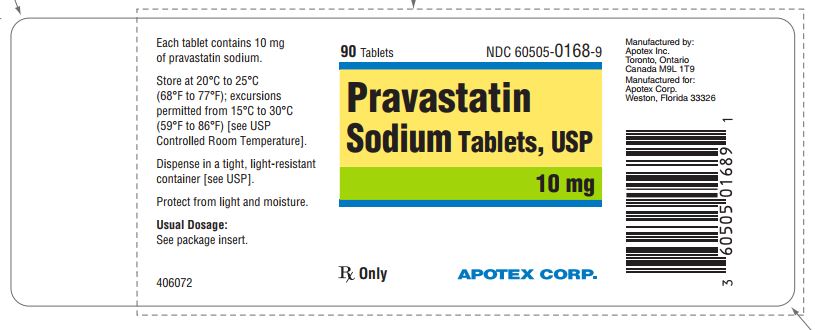
PRAVASTATIN SODIUM 10MG 500 TAB
Generic: PRAVASTATIN SODIUM
PRAVASTATIN SODIUM 10MG 500 TAB
Sign up to see pricing
Licensed pharmacies, clinics, doctor's offices, and veterinary practices get instant account approval
Sign Up — Instant ApprovalDrug Information
Identification
PRAVASTATIN SODIUM
PRAVASTATIN SODIUM
Apotex Corp.
HUMAN PRESCRIPTION DRUG
Administration
TABLET
ORAL
ANDA076341
Active Ingredients
| Ingredient | Strength |
|---|---|
| PRAVASTATIN SODIUM | 10 mg/1 |
Pharmacological Class
Data sourced from openFDA / DailyMed. For full prescribing information, consult the drug label.
Wholesale compliance resources
Drug Resources
Clinical Drug Information
Indications & Usage
1 INDICATIONS AND USAGE Pravastatin sodium tablets are indicated: To reduce the risk of myocardial infarction, myocardial revascularization procedures, and cardiovascular mortality in adults with elevated low-density lipoprotein cholesterol (LDL-C) without clinically evident coronary heart disease (CHD). To reduce the risk of coronary death, myocardial infarction, myocardial revascularization procedures, stroke or transient ischemic attack, and slow the progression of coronary atherosclerosis in adults with clinically evident CHD. As an adjunct to diet to reduce LDL-C in adults with primary hyperlipidemia. As an adjunct to diet to reduce LDL-C in pediatric patients ages 8 years and older with heterozygous familial hypercholesterolemia (HeFH). As an adjunct to diet for the treatment of adults with: Primary dysbetalipoproteinemia. Hypertriglyceridemia. Pravastatin sodium tablets are an HMG-CoA reductase inhibitor (statin) indicated ( 1 ): To reduce the risk of myocardial infarction, myocardial revascularization procedures, and cardiovascular mortality in adults with elevated low-density lipoprotein cholesterol (LDL-C) without clinically evident coronary heart disease (CHD). To reduce the risk of coronary death, myocardial infarction, myocardial revascularization procedures, stroke or transient ischemic attack, and slow the progression of coronary atherosclerosis in adults with clinically evident CHD. As an adjunct to diet to reduce LDL-C in adults with primary hyperlipidemia. As an adjunct to diet to reduce LDL-C in pediatric patients ages 8 years and older with heterozygous familial hypercholesterolemia (HeFH). As an adjunct to diet for the treatment of adults with: Primary dysbetalipoproteinemia. Hypertriglyceridemia.
Dosage & Administration
2 DOSAGE AND ADMINISTRATION Take orally once daily at any time of the day, with or without food ( 2.1 ). For patients that require a high-intensity statin or are unable to achieve their LDL-C goal receiving pravastatin sodium tablets 80 mg daily, prescribe alternative LDL-C-lowering treatment ( 2.1 ). Assess LDL-C when clinically appropriate, as early as 4 weeks after initiating pravastatin sodium tablets, and adjust the dosage if necessary ( 2.1 ). Adults: recommended starting dosage is pravastatin sodium tablets 40 mg to 80 mg once daily. ( 2.2 ) Pediatric Patients ( 2.3 ): aged 8 to 13 years, the recommended dosage is 20 mg once daily. aged 14 to 18 years, the recommended starting dosage is 40 mg once daily. Severe renal impairment: recommended starting dosage is pravastatin sodium 10 mg once daily. Use another pravastatin sodium product to initiate dosing. Recommended maximum pravastatin sodium tablets dosage is 40 mg once daily. ( 2.4 ) See full prescribing information for dosage modifications due to drug interactions ( 2.5 , 7 ). 2.1 Important Dosage and Administration Information Take pravastatin sodium tablets orally once daily as a single dose at any time of the day, with or without food. For patients that require a high-intensity statin or are unable to achieve their LDL-C goal receiving pravastatin sodium tablets 80 mg daily, prescribe alternative LDL-C-lowering treatment. Assess LDL-C when clinically appropriate, as early as 4 weeks after initiating pravastatin sodium tablets, and adjust the dosage if necessary. 2.2 Recommended Dosage in Adult Patients The recommended starting dosage is pravastatin sodium tablets 40 mg to 80 mg once daily. 2.3 Recommended Dosage in Pediatric Patients 8 Years of Age and Older with HeFH In pediatric patients aged 8 to 13 years, the recommended dosage is pravastatin sodium tablets 20 mg once daily. In pediatric patients aged 14 to 18 years, the recommended starting dosage is pravastatin sodium tablets 40 mg once daily. 2.4 Recommended Dosage in Patients with Renal Impairment In patients with severe renal impairment, the recommended starting dosage is pravastatin sodium 10 mg once daily. The maximum recommended dosage of pravastatin sodium tablets in patients with severe renal impairment is 40 mg once daily [see Clinical Pharmacology ( 12.3 )]. The recommended dosage of pravastatin sodium tablets for patients with mild or moderate renal impairment is the same as patients with normal renal function. 2.5 Dosage and Administration Modifications Due to Drug Interactions In patients taking a bile acid sequestrant, administer pravastatin sodium tablets at least 1 hour before or 4 hours after the bile acid sequestrant [see Drug Interactions ( 7.2 )]. Concomitant use of pravastatin sodium tablets with the following drugs requires dosage modifications of pravastatin sodium tablet s [see Warnings and Precautions ( 5.1 ) and Drug Interactions (7.1)]: Cyclosporine In patients taking cyclosporine, the recommended starting dosage is pravastatin sodium 10 mg once daily. The maximum recommended dosage of pravastatin sodium tablets in patients taking cyclosporine is 20 mg once daily. Clarithromycin and Erythromycin The maximum recommended dosage is pravastatin sodium tablets 40 mg once daily .
Adverse Reactions
6 ADVERSE REACTIONS The following important adverse reactions are described below and elsewhere in the labeling: Myopathy and Rhabdomyolysis [see Warnings and Precautions ( 5.1 )] Immune-Mediated Necrotizing Myopathy [see Warnings and Precautions ( 5.2 )] Hepatic Dysfunction [see Warnings and Precautions ( 5.3 )] Increases in HbA1c and Fasting Serum Glucose Levels [see Warnings and Precautions ( 5.4 )] In short-term clinical trials, the most commonly reported adverse reactions (≥2% and greater than placebo) were: musculoskeletal pain, nausea/vomiting, upper respiratory infection, diarrhea, and headache. ( 6.1 ) To report SUSPECTED ADVERSE REACTIONS, contact Apotex at 1-800-706-5575 or FDA at 1-800-FDA-1088 or www.fda.gov/medwatch. 6.1 Clinical Trials Experience Because clinical studies are conducted under widely varying conditions, adverse reaction rates observed in the clinical studies of a drug cannot be directly compared to rates in the clinical studies of another drug and may not reflect the rates observed in practice. In pravastatin placebo-controlled clinical trials, 1,313 patients (age range 20 to 76 years, 32% women, 93.5% White, 5% Black, 0.9% Hispanic, 0.4% Asian, 0.2% Other) with a median treatment duration of 14 weeks, 3.3% of patients on pravastatin and 1.2% patients on placebo discontinued due to adverse reactions (regardless of causality). The most common adverse reactions that led to treatment discontinuation and occurred at an incidence greater than placebo were: hepatic transaminase elevations, nausea, anxiety/depression, and dizziness. Adverse reactions (regardless of causality) reported in ≥2% of pravastatin-treated patients in placebo-controlled trials of up to 8 months duration are identified in Table 1: Table 1: Adverse Reactions in ≥ 2% of Patients Treated with Pravastatin (Any Dose) and at an Incidence Greater Than Placebo in Short-Term Placebo-Controlled Trials % Placebo N=411 % Any Dose N=902 Nausea/Vomiting 7.1 7.4 Diarrhea 5.6 6.7 Headache 4.6 6.3 Upper Respiratory Infection 5.8 5.9 Angina Pectoris 3.4 4.5 Rash 1.4 4.5 CPK Increased 3.6 4.1 Dizziness 3.4 3.5 ALT Increased 1.2 2.9 Chest Pain 1.9 2.7 Cough 1.7 2.5 Myalgia 1.2 2.3 Influenza 0.7 2.0 g-GT Increased 1.2 2.0 Adverse Reactions (regardless of causality) The safety and tolerability of pravastatin at a dose of 80 mg in 2 controlled trials with a mean exposure of 8.6 months was similar to that of pravastatin at lower doses except that 4 out of 464 patients taking 80 mg of pravastatin had a single elevation of CK >10 times ULN compared to 0 out of 115 patients taking 40 mg of pravastatin. In pravastatin placebo-controlled clinical trials, 21,483 patients (age range 24 to 75 years, 10.3% women, 52.3% White, 0.8% Black, 0.5% Hispanic, 0.1% Asian, 0.1% Other, 46.1% not recorded) had a median treatment duration of 261 weeks. Adverse reactions (regardless of causality) were pooled from 7 double-blind, placebo-controlled trials (West of Scotland Coronary Prevention Study [WOS]; Cholesterol and Recurrent Events study [CARE]; Long-term Intervention with Pravastatin in Ischemic Disease study [LIPID]; Pravastatin Limitation of Atherosclerosis in the Coronary Arteries study [PLAC I]; Pravastatin, Lipids and Atherosclerosis in the Carotids study [PLAC II]; Regression Growth Evaluation Statin Study [REGRESS]; and Kuopio Atherosclerosis Prevention Study [KAPS]) involving a total of 10,764 patients treated with pravastatin 40 mg and 10,719 patients treated with placebo. Patients were exposed to pravastatin for a mean of 4 to 5.1 years in WOS, CARE, and LIPID and 1.9 to 2.9 years in PLAC I, PLAC II, KAPS, and REGRESS. Adverse reactions (regardless of causality) occurring in ≥5% of patients treated with pravastatin in these studies are identified in Table 2: Table 2: Adverse Reaction s in ≥ 5% of Patients Treated with Pravastatin 40 mg and at an Incidence Greater than Placebo in Long-Term Placebo-Controlled Trials Placebo (N=10,719) % of patients Pravastatin (N=10,764) % of patients Musculoskeletal Pain 24.4 24.9 Upper Respiratory Tract Infection 20.2 21.2 Musculoskeletal Traumatism 9.6 10.2 Chest Pain 9.8 10.0 Influenza 9.0 9.2 Fatigue 7.8 8.4 Cough 7.4 8.2 Dizziness 6.6 7.3 Rash (including dermatitis) 7.1 7.2 Sinus Abnormality 6.7 7.0 Muscle Cramp 4.6 5.1 Adverse Reactions (regardless of causality) No new adverse reactions were identified in a study of pediatric patients with HeFH. Laboratory Abnormalities Increases in ALT, AST values and CK have been observed. Transient, asymptomatic eosinophilia has been reported. Eosinophil counts usually returned to normal despite continued therapy. Anemia, thrombocytopenia, and leukopenia have been reported with statins. 6.2 Postmarketing Experience The following adverse reactions have been identified during postapproval use of pravastatin. Because these reactions are reported voluntarily from a population of uncertain size, it is not always possible to reliably estimate their frequency or establish a causal relationship to drug exposure. Musculoskeletal: myopathy, rhabdomyolysis, tendon disorder, polymyositis, immune-mediated necrotizing myopathy associated with statin use. Nervous System: dysfunction of certain cranial nerves (including alteration of taste, impairment of extraocular movement, facial paresis), peripheral nerve palsy. Rare postmarketing reports of cognitive impairment (e.g., memory loss, forgetfulness, amnesia, memory impairment, confusion) associated with statin use. Cognitive impairment was generally nonserious, and reversible upon statin discontinuation, with variable times to symptom onset (1 day to years) and symptom resolution (median of 3 weeks). There have been rare reports of new-onset or exacerbation of myasthenia gravis, including ocular myasthenia, and reports of recurrence when the same or a different statin was administered. Hypersensitivity: anaphylaxis, angioedema, lupus erythematosus-like syndrome, polymyalgia rheumatica, dermatomyositis, vasculitis, purpura, hemolytic anemia, positive ANA, ESR increase, arthritis, arthralgia, asthenia, photosensitivity, chills, malaise, toxic epidermal necrolysis, erythema multiforme (including Stevens-Johnson syndrome). Gastrointestinal: abdominal pain, constipation, pancreatitis, hepatitis (including chronic active hepatitis), cholestatic jaundice, fatty change in liver, cirrhosis, fulminant hepatic necrosis, hepatoma, fatal and non-fatal hepatic failure. Dermatologic: a variety of skin changes (e.g., nodules, discoloration, dryness of mucous membranes, changes to hair/nails), lichen planus. Renal: urinary abnormality (including dysuria, frequency, nocturia). Respiratory: dyspnea, interstitial lung disease. Psychiatric: nightmare. Reproductive: gynecomastia. Laboratory Abnormalities: liver function test abnormalities, thyroid function abnormalities.
Information for Patients
17 PATIENT COUNSELING INFORMATION Myopathy and Rhabdomyolysis Advise patients that pravastatin sodium tablets may cause myopathy and rhabdomyolysis. Inform patients that the risk is increased when taking certain types of medication and they should discuss all medication, both prescription and over the counter, with their healthcare provider. Instruct patients to promptly report any unexplained muscle pain, tenderness or weakness particularly if accompanied by malaise or fever [see Warnings and Precautions ( 5.1 ), Drug Interactions ( 7.1 )] . Hepatic Dysfunction Inform patients that pravastatin sodium tablets may cause liver enzyme elevations and possibly liver failure. Advise patients to promptly report fatigue, anorexia, right upper abdominal discomfort, dark urine or jaundice [see Warnings and Precautions ( 5.3 )]. Increases in HbA1c and Fasting Serum Glucose Levels Inform patients that increases in HbA1c and fasting serum glucose levels may occur with pravastatin sodium tablets. Encourage patients to optimize lifestyle measures, including regular exercise, maintaining a healthy body weight, and making healthy food choices [see Warnings and Precautions ( 5.4 )]. Pregnancy Advise pregnant patients and patients who may become pregnant of the potential risk to a fetus. Advise patients to inform their healthcare provider of a known or suspected pregnancy to discuss if pravastatin sodium tablets should be discontinued [see Use in Specific Populations ( 8.1 )] . Lactation Advise patients that breastfeeding is not recommended during treatment with pravastatin sodium tablets [see Use in Specific Populations ( 8.2 )] . APOTEX INC. PRAVASTATIN SODIUM TABLETS, USP 10 mg, 20 mg, 40 mg and 80 mg Manufactured by Manufactured for Apotex Inc. Apotex Corp. Toronto, Ontario Weston, Florida Canada M9L 1T9 USA, 33326 Rev. 14
Clinical data sourced from openFDA drug labeling. For complete prescribing information, consult the full drug label.