CLOPIDOGREL 75 MG 90 TAB
Generic: Clopidogrel Bisulfate
CLOPIDOGREL 75 MG 90 TAB
Sign up to see pricing
Licensed pharmacies, clinics, doctor's offices, and veterinary practices get instant account approval
Sign Up — Instant ApprovalDrug Information
Identification
Clopidogrel Bisulfate
Clopidogrel Bisulfate
Sun Pharmaceutical Industries, Inc.
HUMAN PRESCRIPTION DRUG
Administration
TABLET, FILM COATED
ORAL
ANDA090494
Active Ingredients
| Ingredient | Strength |
|---|---|
| CLOPIDOGREL BISULFATE | 75 mg/1 |
Pharmacological Class
Data sourced from openFDA / DailyMed. For full prescribing information, consult the drug label.
Wholesale compliance resources
Drug Resources
Clinical Drug Information
Indications & Usage
1 INDICATIONS AND USAGE Clopidogrel is a P2Y 12 platelet inhibitor indicated for: Acute coronary syndrome - For patients with non-ST-segment elevation ACS [unstable angina (UA)/non-ST-elevation myocardial infarction (NSTEMI)], clopidogrel tablets have been shown to reduce the rate of myocardial infarction (MI) and stroke. ( 1.1 ) - For patients with ST-elevation myocardial infarction (STEMI), clopidogrel tablets have been shown to reduce the rate of MI and stroke. ( 1.1 ) Recent MI, recent stroke, or established peripheral arterial disease. Clopidogrel tablets have been shown to reduce the rate of MI and stroke. ( 1.2 ) 1.1 Acute Coronary Syndrome (ACS) Clopidogrel tablets are indicated to reduce the rate of myocardial infarction (MI) and stroke in patients with non-ST-segment elevation ACS (unstable angina [UA]/non-ST-elevation myocardial infarction [NSTEMI]), including patients who are to be managed medically and those who are to be managed with coronary revascularization. Clopidogrel tablets should be administered in conjunction with aspirin. Clopidogrel tablets are indicated to reduce the rate of myocardial infarction and stroke in patients with acute ST-elevation myocardial infarction (STEMI) who are to be managed medically. Clopidogrel tablets should be administered in conjunction with aspirin. 1.2 Recent MI, Recent Stroke, or Established Peripheral Arterial Disease In patients with established peripheral arterial disease or with a history of recent myocardial infarction (MI) or recent stroke clopidogrel tablets are indicated to reduce the rate of MI and stroke.
Dosage & Administration
2 DOSAGE AND ADMINISTRATION Acute coronary syndrome ( 2.1 ) - Initiate clopidogrel tablets with a single 300 mg oral loading dose and then continue at 75 mg once daily. - Initiating clopidogrel tablets without a loading dose will delay establishment of an antiplatelet effect by several days. Recent MI, recent stroke, or established peripheral arterial disease: 75 mg once daily orally without a loading dose. ( 2.2 ) 2.1 Acute Coronary Syndrome In patients who need an antiplatelet effect within hours, initiate clopidogrel tablets with a single 300 mg oral loading dose and then continue at 75 mg once daily. Initiating clopidogrel tablets without a loading dose will delay establishment of an antiplatelet effect by several days [see Clinical Pharmacology ( 12.3 ) and Clinical Studies ( 14.1 )] . 2.2 Recent MI, Recent Stroke, or Established Peripheral Arterial Disease 75 mg once daily orally without a loading dose [see Clinical Pharmacology ( 12.3 ) and Clinical Studies ( 14.2 )] .
Adverse Reactions
6 ADVERSE REACTIONS The following serious adverse reactions are discussed below and elsewhere in the labeling: Bleeding [see Warnings and Precautions (5.2) ] Thrombotic thrombocytopenic purpura [see Warnings and Precautions (5.4) ] Bleeding, including life-threatening and fatal bleeding, is the most commonly reported adverse reaction. ( 6.1 ) To report SUSPECTED ADVERSE REACTIONS, contact Sun Pharmaceutical Industries, Inc. at 1-800-818-4555 or FDA at 1-800-FDA-1088 or www.fda.gov/medwatch. 6.1 Clinical Trials Experience Because clinical trials are conducted under widely varying conditions and durations of follow-up, adverse reaction rates observed in the clinical trials of a drug cannot be directly compared to rates in the clinical trials of another drug and may not reflect the rates observed in practice. Clopidogrel has been evaluated for safety in more than 54,000 patients, including over 21,000 patients treated for one year or more. The clinically important adverse reactions observed in trials comparing clopidogrel plus aspirin to placebo plus aspirin and trials comparing clopidogrel alone to aspirin alone are discussed below. Bleeding CURE In CURE, clopidogrel use with aspirin was associated with an increase in major bleeding (primarily gastrointestinal and at puncture sites) compared to placebo with aspirin (see Table 1). The incidence of intracranial hemorrhage (0.1%) and fatal bleeding (0.2%) were the same in both groups. Other bleeding events that were reported more frequently in the clopidogrel group were epistaxis, hematuria, and bruise. The overall incidence of bleeding is described in Table 1. Table 1: CURE Incidence of Bleeding Complications (% patients) Event Clopidogrel (+ aspirin) (n=6,259) Placebo (+ aspirin) (n=6,303) Major bleeding Life-threatening and other major bleeding. 3.7 2.7 Life-threatening bleeding 2.2 1.8 Fatal 0.2 0.2 5 g/dL hemoglobin drop 0.9 0.9 Requiring surgical intervention 0.7 0.7 Hemorrhagic strokes 0.1 0.1 Requiring inotropes 0.5 0.5 Requiring transfusion (≥4 units) 1.2 1.0 Other major bleeding 1.6 1.0 Significantly disabling 0.4 0.3 Intraocular bleeding with significant loss of vision 0.05 0.03 Requiring 2 to 3 units of blood 1.3 0.9 Minor bleeding Led to interruption of study medication. 5.1 2.4 COMMIT In COMMIT, similar rates of major bleeding were observed in the clopidogrel and placebo groups, both of which also received aspirin (see Table 2). Table 2: Incidence of Bleeding Events in COMMIT (% patients) Type of Bleeding Clopidogrel(+ aspirin) (n=22,961) Placebo (+ aspirin) (n=22,891) p-value Major Major bleeds were cerebral bleeds or non-cerebral bleeds thought to have caused death or that required transfusion. noncerebral or cerebral bleeding Major noncerebral Fatal Hemorrhagic stroke Fatal 0.6 0.4 0.2 0.2 0.2 0.5 0.3 0.2 0.2 0.2 0.59 0.48 0.90 0.91 0.81 Other noncerebral bleeding (nonmajor) 3.6 3.1 0.005 Any noncerebral bleeding 3.9 3.4 0.004 CAPRIE (clopidogrel vs Aspirin) In CAPRIE, gastrointestinal hemorrhage occurred at a rate of 2% in those taking clopidogrel versus 2.7% in those taking aspirin; bleeding requiring hospitalization occurred in 0.7% and 1.1%, respectively. The incidence of intracranial hemorrhage was 0.4% for clopidogrel compared to 0.5% for aspirin. Other bleeding events that were reported more frequently in the clopidogrel group were epistaxis and hematoma. Other Adverse Events In CURE and CHARISMA, which compared clopidogrel plus aspirin to aspirin alone, there was no difference in the rate of adverse events (other than bleeding) between clopidogrel and placebo. In CAPRIE, which compared clopidogrel to aspirin, pruritus was more frequently reported in those taking clopidogrel. No other difference in the rate of adverse events (other than bleeding) was reported. 6.2 Postmarketing Experience The following adverse reactions have been identified during postapproval use of clopidogrel. Because these reactions are reported voluntarily from a population of an unknown size, it is not always possible to reliably estimate their frequency or establish a causal relationship to drug exposure. Hemorrhages, including those with fatal outcome, have been reported in patients treated with clopidogrel. Blood and lymphatic system disorders : Agranulocytosis, aplastic anemia/pancytopenia, thrombotic thrombocytopenic purpura (TTP), acquired hemophilia A Gastrointestinal disorders: Colitis (including ulcerative or lymphocytic colitis), pancreatitis, stomatitis, gastric/duodenal ulcer, diarrhea General disorders and administration site condition : Fever Hepatobiliary disorders: Acute liver failure, hepatitis (noninfectious), abnormal liver function test Immune system disorders: Hypersensitivity reactions, anaphylactoid reactions, serum sickness, insulin autoimmune syndrome, which can lead to severe hypoglycemia Musculoskeletal, connective tissue and bone disorders: Myalgia, arthralgia, arthritis Nervous system disorders : Taste disorders, headache, ageusia Psychiatric disorders: Confusion, hallucinations Respiratory, thoracic and mediastinal disorders: Bronchospasm, interstitial pneumonitis, eosinophilic pneumonia Renal and urinary disorders: Increased creatinine levels Skin and subcutaneous tissue disorders: Maculopapular, erythematous or exfoliative rash, urticaria, bullous dermatitis, eczema, toxic epidermal necrolysis, Stevens-Johnson syndrome, acute generalized exanthematous pustulosis (AGEP), angioedema, drug-induced hypersensitivity syndrome, drug rash with eosinophilia and systemic symptoms (DRESS), erythema multiforme, lichen planus, generalized pruritus Vascular disorders: Vasculitis, hypotension
Information for Patients
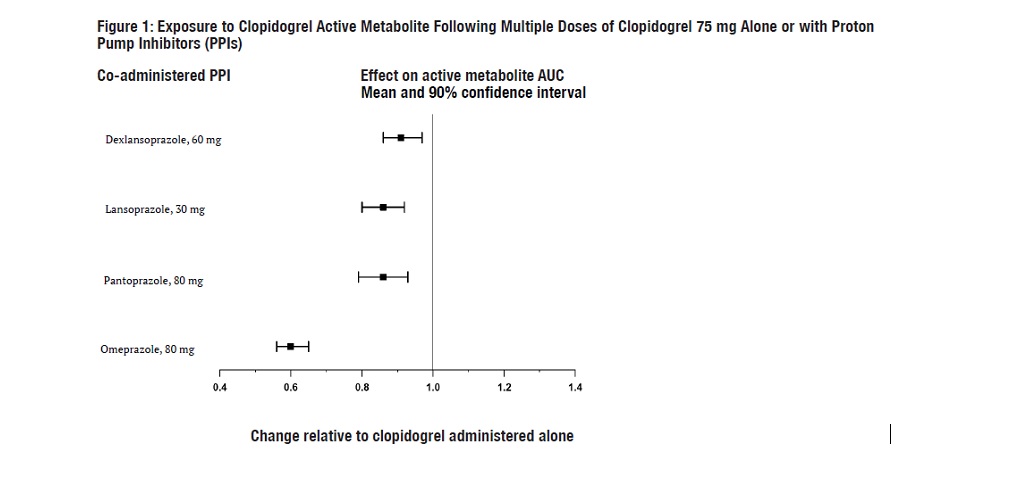
17 PATIENT COUNSELING INFORMATION Advise patients to read FDA approved patient labeling (Medication Guide). Discontinuation Advise patients not to discontinue clopidogrel tablets without first discussing it with the healthcare provider who prescribed it [see Warnings and Precautions ( 5.3 )] . Bleeding Advise patients that they: will bruise and bleed more easily will take longer than usual to stop bleeding must report any unanticipated, prolonged, or excessive bleeding, or blood in their stool or urine [see Warnings and Precautions ( 5.2 )] Thrombotic Thrombocytopenic Purpura Instruct patients to get prompt medical attention if they experience symptoms of TTP that cannot otherwise be explained [see Warnings and Precautions ( 5.4 )] . Invasive Procedures Advise patients to inform physicians and dentists that they are taking clopidogrel tablets before any surgery or dental procedure [see Warnings and Precautions ( 5.2 , 5.3 )] . Proton Pump Inhibitors Advise patients not to take omeprazole or esomeprazole while taking clopidogrel tablets. Dexlansoprazole, lansoprazole, and pantoprazole had less pronounced effects on the antiplatelet activity of clopidogrel tablets than did omeprazole or esomeprazole [see Drug Interactions ( 7.1 )] .
Clinical data sourced from openFDA drug labeling. For complete prescribing information, consult the full drug label.