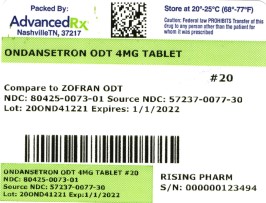
ONDANSETRON ODT 4 MG 3X10TAB (5SQ)
Generic: Ondansetron
ONDANSETRON ODT 4 MG 3X10TAB (5SQ)
Sign up to see pricing
Licensed pharmacies, clinics, doctor's offices, and veterinary practices get instant account approval
Sign Up — Instant ApprovalDrug Information
Identification
Ondansetron
Ondansetron
Glenmark Pharmaceuticals Inc., USA
HUMAN PRESCRIPTION DRUG
Administration
TABLET, ORALLY DISINTEGRATING
ORAL
ANDA078152
Active Ingredients
| Ingredient | Strength |
|---|---|
| ONDANSETRON | 4 mg/1 |
Pharmacological Class
Data sourced from openFDA / DailyMed. For full prescribing information, consult the drug label.
Wholesale compliance resources
Drug Resources
Clinical Drug Information
Indications & Usage
1 INDICATIONS AND USAGE Ondansetron is indicated for the prevention of nausea and vomiting associated with: • highly emetogenic cancer chemotherapy, including cisplatin greater than or equal to 50 mg/m 2 • initial and repeat courses of moderately emetogenic cancer chemotherapy • radiotherapy in patients receiving either total body irradiation, single high-dose fraction to the abdomen, or daily fractions to the abdomen Ondansetron is also indicated for the prevention of postoperative nausea and/or vomiting. Ondansetron is a 5-HT 3 receptor antagonist indicated for the prevention of: • nausea and vomiting associated with highly emetogenic cancer chemotherapy, including cisplatin greater than or equal to 50 mg/m 2 . ( 1 ) • nausea and vomiting associated with initial and repeat courses of moderately emetogenic cancer chemotherapy. ( 1 ) • nausea and vomiting associated with radiotherapy in patients receiving either total body irradiation, single high-dose fraction to the abdomen, or daily fractions to the abdomen. ( 1 ) • postoperative nausea and/or vomiting. ( 1 )
Dosage & Administration
2 DOSAGE AND ADMINISTRATION • See full prescribing information for the recommended dosage in adults and pediatrics. ( 2 ) • Patients with severe hepatic impairment: do not exceed a total daily dose of 8 mg. ( 2.2 , 8.6 ) 2.1 Recommended Dosage The recommended dosage regimens for adult and pediatric patients are described in Table 1 and Table 2, respectively. Corresponding doses of ondansetron tablets, and ondansetron orally disintegrating tablets may be used interchangeably. Table 1: Adult Recommended Dosage Regimen for Prevention of Nausea and Vomiting Indication Dosage Regimen Highly Emetogenic Cancer Chemotherapy A single 24-mg dose administered 30 minutes before the start of single-day highly emetogenic chemotherapy, including cisplatin greater than or equal to 50 mg/m 2 . Moderately Emetogenic Cancer Chemotherapy 8 mg administered 30 minutes before the start of chemotherapy, with a subsequent 8-mg dose 8 hours after the first dose. Then administer 8 mg twice a day (every 12 hours) for 1 to 2 days after completion of chemotherapy. Radiotherapy For total body irradiation: 8 mg administered 1 to 2 hours before each fraction of radiotherapy each day. For single high-dose fraction radiotherapy to the abdomen: 8 mg administered 1 to 2 hours before radiotherapy, with subsequent 8-mg doses every 8 hours after the first dose for 1 to 2 days after completion of radiotherapy. For daily fractionated radiotherapy to the abdomen: 8 mg administered 1 to 2 hours before radiotherapy, with subsequent 8-mg doses every 8 hours after the first dose for each day radiotherapy is given. Postoperative 16 mg administered 1 hour before induction of anesthesia. Table 2: Pediatric Recommended Dosage Regimen for Prevention of Nausea and Vomiting Indication Dosage Regimen Moderately Emetogenic Cancer Chemotherapy 12 to 17 years of age: 8 mg administered 30 minutes before the start of chemotherapy, with a subsequent 8-mg dose 8 hours after the first dose. Then administer 8 mg twice a day (every 12 hours) for 1 to 2 days after completion of chemotherapy. 4 to 11 years of age: 4 mg administered 30 minutes before the start of chemotherapy, with a subsequent 4-mg dose 4 and 8 hours after the first dose. Then administer 4 mg three times a day for 1 to 2 days after completion of chemotherapy. 2.2 Dosage in Hepatic Impairment In patients with severe hepatic impairment (Child-Pugh score of 10 or greater), do not exceed a total daily dose of 8 mg [see Use in Specific Populations ( 8.6 ), Clinical Pharmacology ( 12.3 )] . 2.3 Administration Instructions for Ondansetron Orally Disintegrating Tablets Do not attempt to push ondansetron orally disintegrating tablets through the foil backing. With dry hands, PEEL BACK the foil backing of 1 blister and GENTLY remove the tablet. IMMEDIATELY place the ondansetron orally disintegrating tablet on top of the tongue where it will dissolve in seconds, then swallow with saliva. Administration with liquid is not necessary.
Adverse Reactions
6 ADVERSE REACTIONS The following clinically significant adverse reactions are described elsewhere in the labeling: • Hypersensitivity Reactions [see Warnings and Precautions ( 5.1 )] • QT Prolongation [see Warnings and Precautions ( 5.2 )] • Serotonin Syndrome [see Warnings and Precautions ( 5.3 )] • Myocardial Ischemia [see Warnings and Precautions ( 5.4 )] • Masking of Progressive Ileus and Gastric Distension [see Warnings and Precautions ( 5.5 )] The most common adverse reactions in adults for the: • prevention of chemotherapy-induced (≥5%) are: headache, malaise/fatigue, constipation, diarrhea. ( 6.1 ) • prevention of radiation-induced nausea and vomiting (≥2%) are: headache, constipation, and diarrhea. ( 6.1 ) • prevention of postoperative nausea and vomiting (≥9%) are: headache and hypoxia. ( 6.1 ) To report SUSPECTED ADVERSE REACTIONS, contact Glenmark Pharmaceuticals Inc., USA at 1 (888) 721-7115 or FDA at 1-800-FDA-1088 or www.fda.gov/medwatch. 6.1 Clinical Trials Experience Because clinical trials are conducted under widely varying conditions, adverse reaction rates observed in the clinical trials of a drug cannot be directly compared with rates in the clinical trials of another drug and may not reflect the rates observed in practice. The following adverse reactions have been reported in clinical trials of patients treated with ondansetron, the active ingredient of ondansetron. A causal relationship to therapy with ondansetron was unclear in many cases. Prevention of Chemotherapy ‑ Induced Nausea and Vomiting The most common adverse reactions reported in greater than or equal to 4% of 300 adults receiving a single 24-mg dose of ondansetron orally in 2 trials for the prevention of nausea and vomiting associated with highly emetogenic chemotherapy (cisplatin greater than or equal to 50 mg/m 2 ) were: headache (11%) and diarrhea (4%). The most common adverse reactions reported in 4 trials in adults for the prevention of nausea and vomiting associated with moderately emetogenic chemotherapy (primarily cyclophosphamide-based regimens) are shown in Table 3. Table 3: Most Common Adverse Reactions in Adults 1 for the Prevention of Nausea and Vomiting Associated With Moderately Emetogenic Chemotherapy [Primarily Cyclophosphamide-based Regimens] Adverse Reaction Ondansetron 8 mg Twice Daily (n = 242) Placebo (n = 262) Headache 58 (24%) 34 (13%) Malaise/Fatigue 32 (13%) 6 (2%) Constipation 22 (9%) 1 (<1%) Diarrhea 15 (6%) 10 (4%) 1 Reported in greater than or equal to 5% of patients treated with ondansetron and at a rate that exceeded placebo. Less Common Adverse Reactions Central Nervous System: Extrapyramidal reactions (less than 1% of patients). Hepatic: Aspartate transaminase (AST) and/or alanine transaminase (ALT) values exceeded twice the upper limit of normal in approximately 1% to 2% of 723 patients receiving ondansetron and cyclophosphamide‑based chemotherapy in US clinical trials. The increases were transient and did not appear to be related to dose or duration of therapy. On repeat exposure, similar transient elevations in transaminase values occurred in some courses, but symptomatic hepatic disease did not occur. The role of cancer chemotherapy in these biochemical changes is unclear. Liver failure and death has been reported in cancer patients receiving concurrent medications, including potentially hepatotoxic cytotoxic chemotherapy and antibiotics. The etiology of the liver failure is unclear. Integumentary: Rash (approximately 1% of patients). Other (less than 2%): Anaphylaxis, bronchospasm, tachycardia, angina, hypokalemia, electrocardiographic alterations, vascular occlusive events, and grand mal seizures. Except for bronchospasm and anaphylaxis, the relationship to ondansetron is unclear. Prevention of Radiation ‑ Induced Nausea and Vomiting The most common adverse reactions (greater than or equal to 2%) reported in patients receiving ondansetron and concurrent radiotherapy were similar to those reported in patients receiving ondansetron and concurrent chemotherapy and were headache, constipation, and diarrhea. Prevention of Postoperative Nausea and/or Vomiting The most common adverse reactions reported in adults in trial(s) of prevention of postoperative nausea and vomiting are shown in Table 4. In these trial(s), patients were receiving multiple concomitant perioperative and postoperative medications in both treatment groups. Table 4: Most Common Adverse Reactions in Adults 1 for the Prevention of Postoperative Nausea and Vomiting Adverse Reaction Ondansetron 16 mg as a Single Dose (n = 550) Placebo (n = 531) Headache 49 (9%) 27 (5%) Hypoxia 49 (9%) 35 (7%) Pyrexia 45 (8%) 34 (6%) Dizziness 36 (7%) 34 (6%) Gynecological disorder 36 (7%) 33 (6%) Anxiety/Agitation 33 (6%) 29 (5%) Urinary retention 28 (5%) 18 (3%) Pruritus 27 (5%) 20 (4%) 1 Reported in greater than or equal to 5% of patients treated with ondansetron and at a rate that exceeded placebo. In a crossover study with 25 subjects, headache was reported in 6 subjects administered ondansetron orally disintegrating tablets with water (24%) as compared with 2 subjects administered ondansetron orally disintegrating tablets without water (8%). 6.2 Postmarketing Experience The following adverse reactions have been identified during postapproval use of ondansetron. Because these reactions are reported voluntarily from a population of uncertain size, it is not always possible to reliably estimate their frequency or establish a causal relationship to drug exposure. Cardiovascular Arrhythmias (including ventricular and supraventricular tachycardia, premature ventricular contractions, and atrial fibrillation), bradycardia, electrocardiographic alterations (including second‑degree heart block, QT/QTc interval prolongation, and ST segment depression), palpitations, and syncope. Rarely and predominantly with intravenous ondansetron, transient ECG changes, including QT interval prolongation have been reported. Myocardial ischemia was reported predominately with intravenous administration [see Warnings and Precautions ( 5.4 )] . General Flushing : Rare cases of hypersensitivity reactions, sometimes severe (e.g., anaphylactic reactions, angioedema, bronchospasm, shortness of breath, hypotension, laryngeal edema, stridor) have also been reported. Laryngospasm, shock, and cardiopulmonary arrest have occurred during allergic reactions in patients receiving injectable ondansetron. Hepatobiliary Liver enzyme abnormalities. Lower Respiratory Hiccups. Neurology Oculogyric crisis, appearing alone, as well as with other dystonic reactions. Skin Urticaria, Stevens-Johnson syndrome, and toxic epidermal necrolysis. Eye Disorders Cases of transient blindness, predominantly during intravenous administration, have been reported. These cases of transient blindness were reported to resolve within a few minutes up to 48 hours.
Information for Patients
17 PATIENT COUNSELING INFORMATION Hypersensitivity Reactions Inform patients that ondansetron may cause hypersensitivity reactions, some as severe as anaphylaxis and bronchospasm. Instruct patients to immediately report any signs and symptoms of hypersensitivity reactions, including fever, chills, rash, or breathing problems to their healthcare provider [see Warnings and Precautions ( 5.1 )] . QT Prolongation Inform patients that ondansetron may cause serious cardiac arrhythmias, such as QT prolongation. Instruct patients to tell their healthcare provider right away if they perceive a change in their heart rate, if they feel lightheaded, or if they have a syncopal episode [ see Warnings and Precautions ( 5.2 ) ]. Drug Interactions 1. Instruct the patient to report the use of all medications, especially apomorphine, to their healthcare provider. Concomitant use of apomorphine and ondansetron may cause a significant drop in blood pressure and loss of consciousness. 2. Advise patients of the possibility of serotonin syndrome with concomitant use of ondansetron and another serotonergic agent, such as medications to treat depression and migraines. Advise patients to seek immediate medical attention if the following symptoms occur: changes in mental status, autonomic instability, neuromuscular symptoms with or without gastrointestinal symptoms [ see Warnings and Precautions ( 5.3 ) ]. Myocardial Ischemia Inform patients that ondansetron may cause myocardial ischemia. Advise patients to seek immediate medical help if any symptoms suggestive of a myocardial ischemia occur, such as sudden chest pain or chest tightness [ see Warnings and Precautions ( 5.4 ) ]. Masking of Progressive Ileus and Gastric Distension Inform patients following abdominal surgery or those with chemotherapy‑induced nausea and vomiting that ondansetron may mask signs and symptoms of bowel obstruction. Instruct patients to immediately report any signs or symptoms consistent with a potential bowel obstruction to their healthcare provider [ see Warnings and Precautions ( 5.5 ) ]. Administration of Ondansetron Orally Disintegrating Tablets Instruct patients not to remove ondansetron orally disintegrating tablets from the blister until just prior to dosing. • Do not attempt to push ondansetron orally disintegrating tablets through the foil backing. • With dry hands, peel back the foil backing of 1 blister and gently remove the tablet. • Immediately place the ondansetron orally disintegrating tablet on top of the tongue where it will dissolve in seconds, then swallow with saliva. • Administration with liquid is not necessary. • Peelable illustrated stickers are affixed to the product carton that can be provided with the prescription to ensure proper use and handling of the product. Distributed by: Glenmark Pharmaceuticals Inc., USA Elmwood Park, NJ 07407 Questions? 1 (888) 721-7115 www.glenmarkpharma-us.com August 2025 logo1
Clinical data sourced from openFDA drug labeling. For complete prescribing information, consult the full drug label.