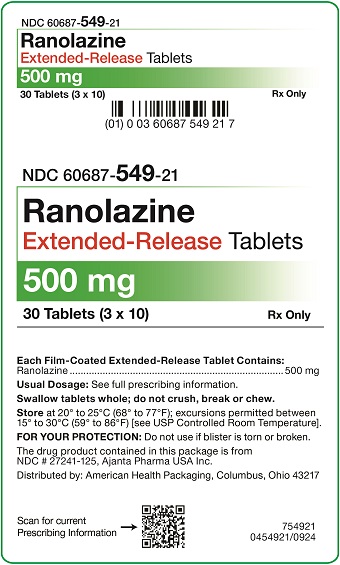
RANOLAZINE ER 500MG 60 TAB
Generic: Ranolazine
RANOLAZINE ER 500MG 60 TAB
Sign up to see pricing
Licensed pharmacies, clinics, doctor's offices, and veterinary practices get instant account approval
Sign Up — Instant ApprovalDrug Information
Identification
Ranolazine
Ranolazine
Lifestar Pharma LLC
HUMAN PRESCRIPTION DRUG
Administration
TABLET, FILM COATED, EXTENDED RELEASE
ORAL
ANDA212284
Active Ingredients
| Ingredient | Strength |
|---|---|
| RANOLAZINE | 500 mg/1 |
Pharmacological Class
Data sourced from openFDA / DailyMed. For full prescribing information, consult the drug label.
Wholesale compliance resources
Drug Resources
Clinical Drug Information
Indications & Usage
1 INDICATIONS AND USAGE Ranolazine extended-release tablets are indicated for the treatment of chronic angina. Ranolazine extended-release tablets may be used with beta-blockers, nitrates, calcium channel blockers, anti- platelet therapy, lipid-lowering therapy, ACE inhibitors, and angiotensin receptor blockers. Ranolazine extended-release tablets are antianginal indicated for the treatment of chronic angina.
Dosage & Administration
2 DOSAGE AND ADMINISTRATION 500 mg twice daily and increase to 1000 mg twice daily, based on clinical symptoms ( 2.1 ) 2.1 Dosing Information Initiate ranolazine extended-release tablets dosing at 500 mg twice daily and increase to 1000 mg twice daily, as needed, based on clinical symptoms. Take ranolazine extended-release tablets with or without meals. Swallow ranolazine extended-release tablets whole; do not crush, break, or chew. The maximum recommended daily dose of ranolazine extended-release tablets is 1000 mg twice daily. If a dose of ranolazine extended-release tablets is missed, take the prescribed dose at the next scheduled time; do not double the next dose. 2.2 Dose Modification Dose adjustments may be needed when ranolazine extended-release tablets are taken in combination with certain other drugs [see Drug Interactions (7.1) ] . Limit the maximum dose of ranolazine extended-release tablets to 500 mg twice daily in patients on moderate CYP3A inhibitors such as diltiazem, verapamil, and erythromycin. Use of ranolazine extended-release tablets with strong CYP3A inhibitors is contraindicated [see Contraindications (4) , Drug Interactions (7.1) ]. Use of P-gp inhibitors, such as cyclosporine, may increase exposure to ranolazine extended-release tablets. Titrate ranolazine extended-release tablets based on clinical response [see Drug Interactions (7.1) ].
Adverse Reactions
6 ADVERSE REACTIONS Most common adverse reactions (>4% and more common than with placebo) are dizziness, headache, constipation, nausea. (6.1) To report SUSPECTED ADVERSE REACTIONS, contact Lifestar Pharma LLC at 1-888-995-4337 or FDA at 1-800-FDA-1088 or www.fda.gov/medwatch. 6.1 Clinical Trial Experience Because clinical trials are conducted under widely varying conditions, adverse reaction rates observed in the clinical trials of a drug cannot be directly compared to rates in the clinical trials of another drug and may not reflect the rates observed in practice. A total of 2018 patients with chronic angina were treated with ranolazine in controlled clinical trials. Of the patients treated with ranolazine extended-release tablets, 1026 were enrolled in three double- blind, placebo-controlled, randomized studies (CARISA, ERICA, MARISA) of up to 12 weeks' duration. In addition, upon study completion, 1251 patients received treatment with ranolazine extended-release tablets in open-label, long-term studies; 1227 patients were exposed to ranolazine extended-release tablets for more than 1 year, 613 patients for more than 2 years, 531 patients for more than 3 years, and 326 patients for more than 4 years. At recommended doses, about 6% of patients discontinued treatment with ranolazine extended-release tablets because of an adverse event in controlled studies in angina patients compared to about 3% on placebo.The most common adverse events that led to discontinuation more frequently on ranolazine extended-release tablets than placebo were dizziness (1.3% versus 0.1%), nausea (1% versus 0%), asthenia, constipation, and headache (each about 0.5% versus 0%). Doses above 1000 mg twice daily are poorly tolerated. In controlled clinical trials of angina patients, the most frequently reported treatment-emergent adverse reactions (>4% and more common on ranolazine extended-release tablets than on placebo) were dizziness (6.2%), headache (5.5%), constipation (4.5%), and nausea (4.4%). Dizziness may be dose-related. In open-label, long-term treatment studies, a similar adverse reaction profile was observed. The following additional adverse reactions occurred at an incidence of 0.5 to 4.0% in patients treated with ranolazine extended-release tablets and were more frequent than the incidence observed in placebo-treated patients: Cardiac Disorders – bradycardia, palpitations Ear and Labyrinth Disorders – tinnitus, vertigo Eye Disorders – blurred vision Gastrointestinal Disorders – abdominal pain, dry mouth, vomiting, dyspepsia General Disorders and Administrative Site Adverse Events – asthenia, peripheral edema Metabolism and Nutrition Disorders – anorexia Nervous System Disorders – syncope (vasovagal) Psychiatric Disorders – confusional state Renal and Urinary Disorders – hematuria Respiratory , Thoracic, and Mediastinal Disorders – dyspnea Skin and Subcutaneous Tissue Disorders – hyperhidrosis Vascular Disorders – hypotension, orthostatic hypotension Other (<0.5%) but potentially medically important adverse reactions observed more frequently with ranolazine extended-release tablets than placebo treatment in all controlled studies included: angioedema, renal failure, eosinophilia, chromaturia, blood urea increased, hypoesthesia, paresthesia, tremor, pulmonary fibrosis, thrombocytopenia, leukopenia, and pancytopenia. A large clinical trial in acute coronary syndrome patients was unsuccessful in demonstrating a benefit for ranolazine extended-release tablets, but there was no apparent proarrhythmic effect in these high-risk patients [see Clinical Studies (14.2) ] . Laboratory Abnormalities Ranolazine extended-release tablets produces elevations of serum creatinine by 0.1 mg/dL, regardless of previous renal function, likely because of inhibition of creatinine's tubular secretion. In general, the elevation has a rapid onset, shows no signs of progression during long-term therapy, is reversible after discontinuation of ranolazine extended-release tablets, and is not accompanied by changes in BUN. In healthy volunteers, ranolazine extended-release tablets 1000 mg twice daily had no effect upon the glomerular filtration rate. More marked and progressive increases in serum creatinine, associated with increases in BUN or potassium, indicating acute renal failure, have been reported after initiation of ranolazine extended-release tablets in patients with severe renal impairment [see Warnings and Precautions (5.2) , Use in Specific Populations (8.7) ] . 6.2 Postmarketing Experience The following adverse reactions have been identified during postapproval use of ranolazine extended-release tablets. Because these reactions are reported voluntarily from a population of uncertain size, it is not always possible to reliably estimate their frequency or establish a causal relationship to drug exposure: Nervous System Disorders – Abnormal coordination, myoclonus, paresthesia, tremor, and other serious neurologic adverse events have been reported to occur, sometimes concurrently, in patients taking ranolazine. The onset of events was often associated with an increase in ranolazine dose or exposure. Many patients reported symptom resolution following drug discontinuation or dose decrease. Metabolism and Nutrition Disorders – Cases of hypoglycemia have been reported in diabetic patients on antidiabetic medication. Psychiatric Disorders – hallucination Renal and Urinary Disorders – dysuria, urinary retention Skin and Subcutaneous Tissue Disorders – angioedema, pruritus, rash
Information for Patients
17 PATIENT COUNSELING INFORMATION Advise the patient to read the FDA-approved patient labeling (Patient Information). Inform patients that ranolazine extended-release tablets will not abate an acute angina episode. Strong CY3PA Inhibitors, CYP3A Inducers, Liver Cirrhosis Inform patients that ranolazine extended-release tablets should not be used with drugs that are strong CYP3A inhibitors (e.g., ketoconazole, clarithromycin, nefazodone, ritonavir) [( see Contraindications (4) , Drug Interactions (7.1) ]. Inform patients that ranolazine extended-release tablets should not be used with drugs that are inducers of CYP3A (e.g., rifampin, rifabutin, rifapentine, barbiturates, carbamazepine, phenytoin, St. John's wort) [( see Contraindications (4) , Drug Interactions (7.1) ]. Inform patients that ranolazine extended-release tablets should not be used in patients with liver cirrhosis [( see Contraindications (4) , Use in Specific Populations (8.6) ]. Moderate CYP3A Inhibitors, P-gp Inhibitors, Grapefruit Products Advise patients to inform their physician if they are receiving drugs that are moderate CYP3A inhibitors (e.g., diltiazem, verapamil, erythromycin) [ see Drug Interactions (7) ]. Advise patients to inform their physician if they are receiving drugs that are P-gp inhibitors (e.g., cyclosporine) [ see Drug Interactions (7) ]. Advise patients to limit grapefruit juice or grapefruit products when taking ranolazine extended-release tablets [ see Drug Interactions (7) ]. QT Interval Prolongation Inform patients that ranolazine extended-release tablets may produce changes in the electrocardiogram (QTc interval prolongation) [ see Warnings and Precautions (5.1) ]. Advise patients to inform their physician of any personal or family history of QTc prolongation, congenital long QT syndrome, or if they are receiving drugs that prolong the QTc interval such as Class Ia (e.g., quinidine) or Class III (e.g., dofetilide, sotalol, amiodarone) antiarrhythmic agents, erythromycin, and certain antipsychotics (e.g., thioridazine, ziprasidone) [ see Warnings and Precautions (5.1) ]. Use in Patients with Renal Impairment Patients with severe renal impairment may be at risk of renal failure while on ranolazine extended-release tablets. Advise patients to inform their physician if they have impaired renal function before or while taking ranolazine extended-release tablets [see Warnings and Precautions (5.2) ]. Dizziness, Fainting Inform patients that ranolazine extended-release tablets may cause dizziness and lightheadedness. Patients should know how they react to ranolazine extended-release tablets before they operate an automobile or machinery, or engage in activities requiring mental alertness or coordination [ see Adverse Reactions (6.1) ]. Advise patients to contact their physician if they experience fainting spells while taking ranolazine extended-release tablets. Administration Instruct patients to swallow ranolazine extended-release tablets whole, with or without meals, and not to crush, break, or chew tablets. Inform patients that if a dose is missed, to take the usual dose at the next scheduled time. The next dose should not be doubled. Inform patients that doses of ranolazine extended-release tablets higher than 1000 mg twice daily should not be used [ see Dosage and Administration (2) ]. Advise patients to inform their physician of any other medications taken concurrently with ranolazine extended-release tablets, including over-the-counter medications.
Clinical data sourced from openFDA drug labeling. For complete prescribing information, consult the full drug label.