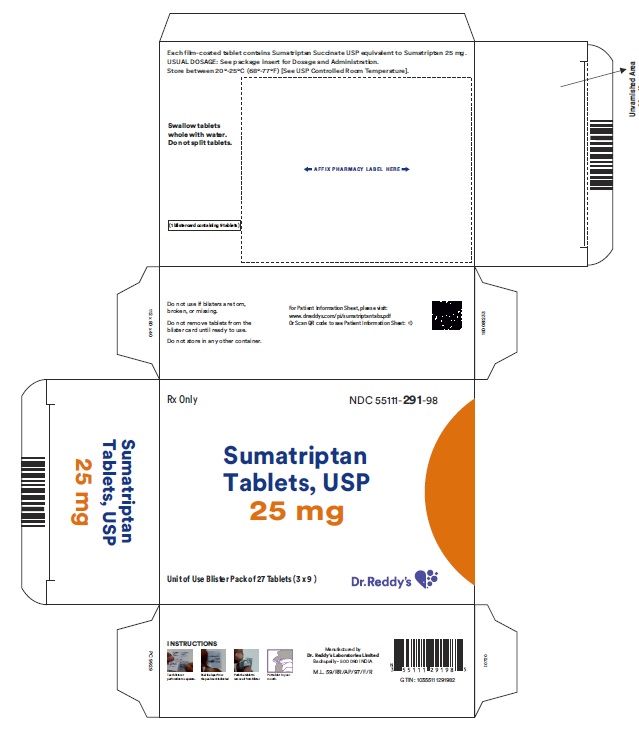
SUMATRIPTAN SUCCINATE 100 MG 9 TAB
Generic: sumatriptan succinate
SUMATRIPTAN SUCCINATE 100 MG 9 TAB
Sign up to see pricing
Licensed pharmacies, clinics, doctor's offices, and veterinary practices get instant account approval
Sign Up — Instant ApprovalDrug Information
Identification
sumatriptan succinate
sumatriptan succinate
Sun Pharmaceutical Industries, Inc.
HUMAN PRESCRIPTION DRUG
Administration
TABLET, FILM COATED
ORAL
ANDA078295
Active Ingredients
| Ingredient | Strength |
|---|---|
| SUMATRIPTAN SUCCINATE | 100 mg/1 |
Pharmacological Class
Data sourced from openFDA / DailyMed. For full prescribing information, consult the drug label.
Wholesale compliance resources
Drug Resources
Clinical Drug Information
Indications & Usage
1 INDICATIONS AND USAGE Sumatriptan succinate tablets are indicated for the acute treatment of migraine with or without aura in adults. Limitations of Use: Use only if a clear diagnosis of migraine headache has been established. If a patient has no response to the first migraine attack treated with sumatriptan succinate tablets, reconsider the diagnosis of migraine before sumatriptan succinate tablets are administered to treat any subsequent attacks. Sumatriptan succinate tablets are not indicated for the prevention of migraine attacks. Safety and effectiveness of sumatriptan succinate tablets have not been established for cluster headache. Sumatriptan succinate is a serotonin (5-HT 1B/1D ) receptor agonist (triptan) indicated for acute treatment of migraine with or without aura in adults. ( 1 ) Limitations of Use: Use only if a clear diagnosis of migraine headache has been established. ( 1 ) Not indicated for the prophylactic therapy of migraine attacks. ( 1 ) Not indicated for the treatment of cluster headache. ( 1 )
Dosage & Administration
2 DOSAGE AND ADMINISTRATION Single dose of 25 mg, 50 mg, or 100 mg tablet. ( 2.1 ) A second dose should only be considered if some response to the first dose was observed. Separate doses by at least 2 hours. ( 2.1 ) Maximum dose in a 24-hour period: 200 mg. ( 2.1 ) Maximum single dose should not exceed 50 mg in patients with mild to moderate hepatic impairment. ( 2.2 ) 2.1 Dosing Information The recommended dose of sumatriptan succinate tablets is 25 mg, 50 mg, or 100 mg. Doses of 50 mg and 100 mg may provide a greater effect than the 25 mg dose, but doses of 100 mg may not provide a greater effect than the 50 mg dose. Higher doses may have a greater risk of adverse reactions [see Clinical Studies ( 14 )]. If the migraine has not resolved by 2 hours after taking sumatriptan succinate tablets, or returns after a transient improvement, a second dose may be administered at least 2 hours after the first dose. The maximum daily dose is 200 mg in a 24-hour period. Use after sumatriptan injection If the migraine returns following an initial treatment with sumatriptan injection, additional single sumatriptan succinate tablets (up to 100 mg/day) may be given with an interval of at least 2 hours between tablet doses. The safety of treating an average of more than 4 headaches in a 30-day period has not been established. 2.2 Dosing in Patients with Hepatic Impairment If treatment is deemed advisable in the presence of mild to moderate hepatic impairment, the maximum single dose should not exceed 50 mg [see Use in Specific Populations ( 8.6 ), Clinical Pharmacology ( 12.3 )] .
Adverse Reactions
6 ADVERSE REACTIONS The following adverse reactions are discussed in more detail in other sections of the prescribing information: Myocardial ischemia, myocardial infarction, and Prinzmetal’s angina [see Warnings and Precautions ( 5.1 )] Arrhythmias [see Warnings and Precautions ( 5.2 )] Chest, throat, neck, and/or jaw pain/tightness/pressure [see Warnings and Precautions ( 5.3 )] Cerebrovascular events [see Warnings and Precautions ( 5.4 )] Other vasospasm reactions [see Warnings and Precautions ( 5.5 )] Medication overuse headache [see Warnings and Precautions ( 5.6 )] Serotonin syndrome [see Warnings and Precautions ( 5.7 )] Increase in blood pressure [see Warnings and Precautions ( 5.8 )] Hypersensitivity reactions [see Contraindications ( 4 ), Warnings and Precautions ( 5.9 )] Seizures [see Warnings and Precautions ( 5.10 )] Most common adverse reactions (≥2% and >placebo) were paresthesia, warm/cold sensation, chest pain/tightness/pressure and/or heaviness, neck/throat/jaw pain/tightness/pressure, other sensations of pain/pressure/tightness/heaviness, vertigo, and malaise/fatigue. ( 6.1 ) To report SUSPECTED ADVERSE REACTIONS, contact Sun Pharmaceutical Industries, Inc. at 1-800-818-4555 or FDA at 1-800-FDA-1088 or www.fda.gov/medwatch . 6.1 Clinical Trials Experience Because clinical trials are conducted under widely varying conditions, adverse reaction rates observed in the clinical trials of a drug cannot be directly compared with rates in the clinical trials of another drug and may not reflect the rates observed in practice. Table 1 lists adverse reactions that occurred in placebo-controlled clinical trials in patients who took at least 1 dose of study drug. Only treatment-emergent adverse reactions that occurred at a frequency of 2% or more in any group treated with sumatriptan succinate tablets and that occurred at a frequency greater than the placebo group are included in Table 1. Table 1. Adverse Reactions Reported by at Least 2% of Patients Treated with Sumatriptan Succinate Tablets and at a Greater Frequency than Placebo Adverse Reaction Percent of Patients Reporting Sumatriptan Succinate Tablets 25 mg (n = 417) Sumatriptan Succinate Tablets 50 mg (n = 771) Sumatriptan Succinate Tablets 100 mg (n = 437) Placebo (n = 309) Atypical sensations 5 6 6 4 Paresthesia (all types) 3 5 3 2 Sensation warm/cold 3 2 3 2 Pain and other pressure sensations 6 6 8 4 Chest - pain/tightness/ pressure and/or heaviness 1 2 2 1 Neck/throat/jaw - pain/ tightness/pressure <1 2 3 <1 Pain - location specified 2 1 1 1 Other - pressure/tightness/ heaviness 1 1 3 2 Neurological Vertigo <1 <1 2 <1 Other Malaise/fatigue 2 2 3 <1 The incidence of adverse reactions in controlled clinical trials was not affected by gender or age of the patients. There were insufficient data to assess the impact of race on the incidence of adverse reactions. 6.2 Postmarketing Experience The following adverse reactions have been identified during postapproval use of sumatriptan succinate tablets, sumatriptan nasal spray, and sumatriptan injection. Because these reactions are reported voluntarily from a population of uncertain size, it is not always possible to reliably estimate their frequency or establish a causal relationship to drug exposure. These reactions have been chosen for inclusion due to either their seriousness, frequency of reporting, or causal connection to sumatriptan succinate or a combination of these factors. Cardiovascular Hypotension, palpitations. Neurological Dystonia, tremor.
Information for Patients
17 PATIENT COUNSELING INFORMATION Advise the patient to read the FDA-approved patient labeling (Patient Information). Risk of Myocardial Ischemia and/or Infarction, Prinzmetal’s Angina, Other Vasospasm-Related Events, Arrhythmias, and Cerebrovascular Events Inform patients that sumatriptan succinate tablets may cause serious cardiovascular side effects such as myocardial infarction or stroke. Although serious cardiovascular events can occur without warning symptoms, patients should be alert for the signs and symptoms of chest pain, shortness of breath, irregular heartbeat, significant rise in blood pressure, weakness, and slurring of speech, and should ask for medical advice if any indicative sign or symptoms are observed. Apprise patients of the importance of this follow-up [see Warnings and Precautions ( 5.1 , 5.2 , 5.4 , 5.5 , 5.8 )] . Anaphylactic/Anaphylactoid Reactions Inform patients that anaphylactic/anaphylactoid reactions have occurred in patients receiving sumatriptan succinate tablets. Such reactions can be life-threatening or fatal. In general, anaphylactic reactions to drugs are more likely to occur in individuals with a history of sensitivity to multiple allergens [see Contraindications ( 4 ), Warnings and Precautions ( 5.9 )] . Concomitant Use with Other Triptans or Ergot Medications Inform patients that use of sumatriptan succinate tablets within 24 hours of another triptan or an ergot-type medication (including dihydroergotamine or methysergide) is contraindicated [see Contraindications ( 4 ), Drug Interactions ( 7.1 , 7.3 )] . Serotonin Syndrome Caution patients about the risk of serotonin syndrome with the use of sumatriptan succinate tablets or other triptans, particularly during combined use with SSRIs, SNRIs, TCAs, and MAO inhibitors [see Warnings and Precautions ( 5.7 ), Drug Interactions ( 7.4 )]. Medication Overuse Headache Inform patients that use of acute migraine drugs for 10 or more days per month may lead to an exacerbation of headache and encourage patients to record headache frequency and drug use (e.g., by keeping a headache diary) [see Warnings and Precautions ( 5.6 )] . Pregnancy Advise patients to notify their healthcare provider if they become pregnant during treatment or plan to become pregnant [see Use in Specific Populations (8.1)]. Lactation Advise patients to notify their healthcare provider if they are breastfeeding or plan to breastfeed [see Use in Specific Populations (8.2)]. Ability to Perform Complex Tasks Treatment with sumatriptan succinate tablets may cause somnolence and dizziness; instruct patients to evaluate their ability to perform complex tasks after administration of sumatriptan succinate tablets. Dispense with Patient Information available at: https://www.sunpharma.com/usa/products
Clinical data sourced from openFDA drug labeling. For complete prescribing information, consult the full drug label.