FINASTERIDE 1MG 90 TAB
Generic: Finasteride
FINASTERIDE 1MG 90 TAB
Sign up to see pricing
Licensed pharmacies, clinics, doctor's offices, and veterinary practices get instant account approval
Sign Up — Instant ApprovalDrug Information
Identification
Finasteride
Finasteride
Ascend Laboratories, LLC
HUMAN PRESCRIPTION DRUG
Administration
TABLET, COATED
ORAL
ANDA207750
Active Ingredients
| Ingredient | Strength |
|---|---|
| FINASTERIDE | 1 mg/1 |
Pharmacological Class
Data sourced from openFDA / DailyMed. For full prescribing information, consult the drug label.
Wholesale compliance resources
Drug Resources
Clinical Drug Information
Indications & Usage
1 INDICATIONS AND USAGE Finasteride tablets is indicated for the treatment of male pattern hair loss (androgenetic alopecia) in MEN ONLY . Efficacy in bitemporal recession has not been established. Finasteride tablets is not indicated for use in women. Finasteride tablets is a 5α-reductase inhibitor indicated for the treatment of male pattern hair loss (androgenetic alopecia) in MEN ONLY ( 1 ). Finasteride tablets is not indicated for use in women ( 1 , 4 , 5.1 ).
Dosage & Administration
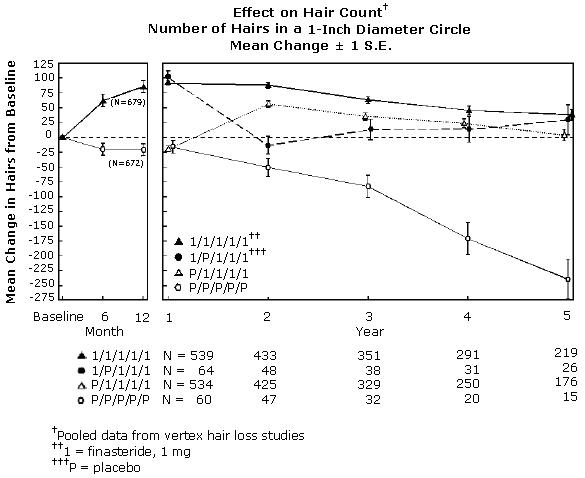
2 DOSAGE AND ADMINISTRATION Finasteride tablets may be administered with or without meals. The recommended dose of finasteride tablets, USP 1 mg is one tablet (1 mg) taken once daily. In general, daily use for three months or more is necessary before benefit is observed. Continued use is recommended to sustain benefit, which should be re-evaluated periodically. Withdrawal of treatment leads to reversal of effect within 12 months. Finasteride tablets may be administered with or without meals (2). One tablet ( 1 mg ) taken once daily ( 2 ). In general, daily use for three months or more is necessary before benefit is observed ( 2 ).
Adverse Reactions
6 ADVERSE REACTIONS The most common adverse reactions, reported in ≥1% of patients treated with finasteride tablets and greater than in patients treated with placebo are: decreased libido, erectile dysfunction and ejaculation disorder ( 6.1 ). To report SUSPECTED ADVERSE REACTIONS, contact Ascend Laboratories, LLC at 1-877-272-7901 or FDA at 1-800-FDA-1088 or www.fda.gov/medwatch . 6.1 Clinical Trials Experience Because clinical trials are conducted under widely varying conditions, adverse reaction rates observed in the clinical trials of a drug cannot be directly compared to rates in the clinical trials of another drug and may not reflect the rates observed in clinical practice. Clinical Studies for finasteride tablets 1 mg in the Treatment of Male Pattern Hair Loss In three controlled clinical trials for finasteride tablets of 12-month duration, 1.4% of patients taking finasteride tablets (n=945) were discontinued due to adverse experiences that were considered to be possibly, probably or definitely drug-related (1.6% for placebo; n=934). Clinical adverse experiences that were reported as possibly, probably or definitely drug-related in > 1% of patients treated with finasteride tablets or placebo are presented in Table 1. TABLE 1: Drug-Related Adverse Experiences for Finasteride tablets 1 mg (finasteride 1 mg) in Year 1 (%) MALE PATTERN HAIR LOSS Finasteride N=945 Placebo N=934 Decreased Libido 1.8 1.3 Erectile Dysfunction 1.3 0.7 Ejaculation Disorder (Decreased Volume of Ejaculate) 1.2 (0.8) 0.7 (0.4) Discontinuation due to drug-related sexual adverse experiences 1.2 0.9 Integrated analysis of clinical adverse experiences showed that during treatment with finasteride tablets, 36 (3.8%) of 945 men had reported one or more of these adverse experiences as compared to 20 (2.1%) of 934 men treated with placebo (p=0.04). Resolution occurred in men who discontinued therapy with finasteride tablets due to these side effects and in most of those who continued therapy. The incidence of each of the above adverse experiences decreased to 1% and greater than placebo over the 4 years of the study. In years 2 to 4 of the study, there was no significant difference between treatment groups in the incidences of impotence, decreased libido and ejaculation disorder. TABLE 2: Drug-Related Adverse Experiences for finasteride tablets 5 mg BENIGN PROSTATIC HYPERPLASIA Year 1 (%) Years 2, 3 and 4* (%) Finasteride 5 mg Placebo Finasteride 5 mg Placebo Impotence 8.1 3.7 5.1 5.1 Decreased Libido 6.4 3.4 2.6 2.6 Decreased Volume of Ejaculate 3.7 0.8 1.5 0.5 Ejaculation Disorder 0.8 0.1 0.2 0.1 Breast Enlargement 0.5 0.1 1.8 1.1 Breast Tenderness 0.4 0.1 0.7 0.3 Rash 0.5 0.2 0.5 0.1 *Combined Years 2 to 4 N = 1,524 and 1,516, finasteride vs placebo, respectively The adverse experience profiles in the 1-year, placebo-controlled, Phase III BPH studies and the 5-year open extensions with finasteride tablets 5 mg and PLESS were similar. There is no evidence of increased sexual adverse experiences with increased duration of treatment with finasteride tablets 5 mg. New reports of drug-related sexual adverse experiences decreased with duration of therapy. During the 4- to 6-year placebo- and comparator-controlled Medical Therapy of Prostatic Symptoms (MTOPS) study that enrolled 3,047 men, there were 4 cases of breast cancer in men treated with finasteride tablets 5 mg but no cases in men not treated with finasteride tablets 5 mg. During the 4-year placebo-controlled PLESS study that enrolled 3,040 men, there were 2 cases of breast cancer in placebo-treated men, but no cases were reported in men treated with finasteride tablets 5 mg. During the 7-year placebo-controlled Prostate Cancer Prevention Trial (PCPT) that enrolled 18,882 men, there was 1 case of breast cancer in men treated with finasteride tablets, and 1 case of breast cancer in men treated with placebo. The relationship between long-term use of finasteride and male breast neoplasia is currently unknown. The PCPT trial was a 7-year randomized, double-blind, placebo-controlled trial that enrolled 18,882 healthy men ≥55 years of age with a normal digital rectal examination and a PSA ≤3.0 ng/mL. Men received either finasteride tablets 5 mg (finasteride 5 mg) or placebo daily. Patients were evaluated annually with PSA and digital rectal exams. Biopsies were performed for elevated PSA, an abnormal digital rectal exam, or the end of study. The incidence of Gleason score 8 to 10 prostate cancer was higher in men treated with finasteride (1.8%) than in those treated with placebo (1.1%). In a 4-year placebo-controlled clinical trial with another 5α-reductase inhibitor [AVODART (dutasteride)], similar results for Gleason score 8 to 10 prostate cancer were observed (1% dutasteride vs 0.5% placebo). The clinical significance of these findings with respect to use of finasteride tablets by men is unknown. No clinical benefit has been demonstrated in patients with prostate cancer treated with finasteride tablets. Finasteride tablets is not approved to reduce the risk of developing prostate cancer. Sexual Function Questionnaire A sexual function questionnaire was self-administered by patients participating in the two vertex baldness trials to detect more subtle changes in sexual function. At Month 12, statistically significant differences in favor of placebo were found in 3 of 4 domains (sexual interest, erections, and perception of sexual problems). However, no significant difference was seen in the question on overall satisfaction with sex life. In one of the two vertex baldness studies, patients were questioned on non-scalp body hair growth. Finasteride tablets did not appear to affect non-scalp body hair. 6.2 Postmarketing Experience The following adverse reactions have been identified during post approval use of finasteride tablets. Because these reactions are reported voluntarily from a population of uncertain size, it is not always possible to reliably estimate their frequency or establish a causal relationship to drug exposure: Hypersensitivity Reaction: hypersensitivity reactions such as rash, pruritus, urticaria, and angioedema (including swelling of the lips, tongue, throat, and face); Reproductive System: sexual dysfunction that continued after discontinuation of treatment, including erectile dysfunction, libido disorders, ejaculation disorders, and orgasm disorders; male infertility and/or poor seminal quality (normalization or improvement of seminal quality has been reported after discontinuation of finasteride); testicular pain; hematospermia. Neoplasms: male breast cancer; Breast disorders: breast tenderness and enlargement; Nervous System/Psychiatric: depression, suicidal ideation and behavior.
Information for Patients
17 PATIENT COUNSELING INFORMATION Advise the patient to read the FDA-approved patient labeling (Patient Information). Exposure of Women — Risk to Male Fetus Physicians should inform patients that women who are pregnant or may potentially be pregnant should not handle crushed or broken finasteride tablets because of the possibility of absorption of finasteride and the subsequent potential risk to a male fetus. Finasteride tablets are coated and will prevent contact with the active ingredient during normal handling, provided that the tablets have not been broken or crushed. If a woman who is pregnant or may potentially be pregnant comes in contact with crushed or broken finasteride tablets, the contact area should be washed immediately with soap and water [see Contraindications (4) , Warnings and Precautions (5.1) , Use in Specific Populations (8.1) and How Supplied/Storage and Handling (16) ]. Increased Risk of High-Grade Prostate Cancer Patients should be informed that there was an increase in high-grade prostate cancer in men treated with 5α-reductase inhibitors indicated for BPH treatment, compared to those treated with placebo in studies looking at the use of these drugs to prevent prostate cancer [see Warnings and Precautions (5.3) and Adverse Reactions (6.1) ]. Sexual Adverse events Physicians should inform the patients that finasteride tablets may cause symptoms of sexual dysfunction such as decreased libido, erectile dysfunction, and ejaculation disorder, including decreased ejaculate volume. Additional Instructions Physicians should instruct their patients to promptly report any changes in their breasts such as lumps, pain or nipple discharge. Breast changes including breast enlargement, tenderness and neoplasm have been reported [ see Adverse Reactions (6.1) ]. Physicians should instruct their patients to read the patient package insert before starting therapy with finasteride tablets and to read it again each time the prescription is renewed so that they are aware of current information for patients regarding finasteride tablets. The trademarks depicted herein are owned by their respective companies. For Patient Information, please visit: http://www.ascendlaboratories.com/pti/finasteridetab1mg.pdf Manufactured by: Alkem Laboratories Ltd., Mumbai - 400 013, INDIA. Distributed by: Ascend Laboratories, LLC Bedminster, NJ 07921 Revised: January 2025 PT 2307-06
Clinical data sourced from openFDA drug labeling. For complete prescribing information, consult the full drug label.