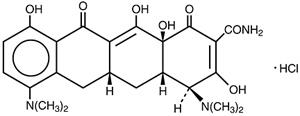
MINOCYCLINE HYDROCHLORIDE ER TABS 45 MG 30CT
Generic: Minocycline Hydrochloride
MINOCYCLINE HYDROCHLORIDE ER TABS 45 MG 30CT
Sign up to see pricing
Licensed pharmacies, clinics, doctor's offices, and veterinary practices get instant account approval
Sign Up — Instant ApprovalDrug Information
Identification
Minocycline Hydrochloride
Minocycline Hydrochloride
Ascend Laboratories, LLC
HUMAN PRESCRIPTION DRUG
Administration
TABLET, FILM COATED, EXTENDED RELEASE
ORAL
ANDA204453
Active Ingredients
| Ingredient | Strength |
|---|---|
| MINOCYCLINE HYDROCHLORIDE | 45 mg/1 |
Pharmacological Class
Data sourced from openFDA / DailyMed. For full prescribing information, consult the drug label.
Wholesale compliance resources
Clinical Drug Information
Indications & Usage
1 INDICATIONS & USAGE Minocycline hydrochloride extended-release tablets is indicated to treat inflammatory lesions of non-nodular moderate to severe acne vulgaris in patients 12 years of age and older. Limitations of Use Minocycline hydrochloride extended-release tablets did not demonstrate any effect on non-inflammatory acne lesions. This formulation of minocycline has not been evaluated in the treatment of infections [see Clinical Studies ( 14 )]. To reduce the development of drug-resistant bacteria as well as to maintain the effectiveness of other antibacterial drugs, use minocycline hydrochloride extended-release tablets only as indicated [see Warnings and Precautions ( 5.12 )]. Minocycline hydrochloride extended-release tablets is a tetracycline-class drug indicated to treat inflammatory lesions of non-nodular moderate to severe acne vulgaris in patients 12 years of age and older. ( 1 ) Limitations of Use This formulation of minocycline has not been evaluated in the treatment of infections. To reduce the development of drug-resistant bacteria and to maintain the effectiveness of other antibacterial drugs, use minocycline hydrochloride extended-release tablets only as indicated. ( 1 )
Dosage & Administration
2 DOSAGE & ADMINISTRATION The recommended dosage of minocycline hydrochloride extended-release tablets is approximately 1 mg/kg once daily for 12 weeks. Table 1 provides the recommended minocycline hydrochloride extended-release tablets dosage based upon weight ranges. Table 1: Dosing Table for Minocycline hydrochloride extended-release tablets Patient's Weight(kg) Recommended Dosage (mg/day) 45 to 49 45 50 to 59 55 60 to 71 65 72 to 84 80 85 to 96 90 97 to 110 105 111 to 125 115 126 to 136 135 Higher dosages have not shown to be of additional benefit in the treatment of inflammatory lesions of acne and may be associated with more acute vestibular adverse reactions. Swallow tablets whole. Do not chew, crush, or split the extended-release tablets. Administer minocycline hydrochloride extended-release tablets with or without food [see Clinical Pharmacology ( 12.3 )]. Ingestion of food along with minocycline hydrochloride extended-release tablets may help reduce the risk of esophageal irritation and ulceration. In patients with renal impairment, decrease the daily dosage by either reducing the recommended individual doses and/or by extending the time intervals between doses [see Warnings and Precautions ( 5.9 )]. The recommended dosage of Minocycline hydrochloride extended-release tablets is approximately 1 mg/kg once daily for 12 weeks. ( 2 )
Adverse Reactions
6 ADVERSE REACTIONS The following clinically significant adverse reactions are described elsewhere in the labeling: Serious Skin/Hypersensitivity Reactions [see Warnings and Precautions ( 5.1 )] Clostridioides difficile -Associated Diarrhea (Antibiotic-Associated Colitis) [see Warnings and Precautions ( 5.4 )] Hepatotoxicity [see Warnings and Precautions ( 5.5 )] Central Nervous System Effects [see Warnings and Precautions ( 5.6 )] Idiopathic Intracranial Hypertension [see Warnings and Precautions ( 5.7 )] The most commonly observed adverse reactions (incidence ≥ 5%) are headache, fatigue, dizziness, and pruritus. ( 6.1 ) To report SUSPECTED ADVERSE REACTIONS, contact Ascend Laboratories, LLC at 1-877-272-7901 or FDA at 1-800-FDA-1088 or www.fda.gov/medwatch . 6.1 Clinical Trials Experience Because clinical trials are conducted under widely varying conditions, adverse reaction rates observed in the clinical trials of a drug cannot be directly compared to rates in the clinical trials of another drug and may not reflect the rates observed in practice. The following table summarizes selected adverse reactions reported in clinical trials at a rate of ≥1% for minocycline hydrochloride extended-release tablets and higher than placebo. Table 2: Selected Treatment-Emergent Adverse Reactions in at Least 1% of Clinical Trial Subjects and Higher than Placebo Adverse Reactions Minocycline Hydrochloride Extended-Release Tablets (1 mg/kg) N = 674 (%) PLACEBO N = 364 (%) At least one treatment-emergent event 379 (56) 197 (54) Fatigue 62 (9) 24 (7) Dizziness 59 (9) 17 (5) Pruritus 31 (5) 16 (4) Malaise 26 (4) 9 (3) Somnolence 13 (2) 3 (1) Urticaria 10 (2) 1 (0) Tinnitus 10 (2) 5 (1) Arthralgia 9 (1) 2 (0) Vertigo 8 (1) 3 (1) 6.2 Postmarketing Experience The following adverse reactions have been reported with minocycline hydrochloride use in a variety of indications. Because these reactions are reported voluntarily from a population of uncertain size, it is not always possible to reliably estimate their frequency or establish a causal relationship to drug exposure. Skin and hypersensitivity reactions: anaphylaxis, angioedema, DRESS syndrome, erythema multiforme, Stevens- Johnson syndrome, acute febrile neutrophilic dermatosis (Sweet’s syndrome), fixed drug eruptions, balanitis, anaphylactoid purpura, photosensitivity, pigmentation of skin and mucous membranes. Autoimmune conditions: polyarthralgia, pericarditis, exacerbation of systemic lupus, pulmonary infiltrates with eosinophilia, lupus-like syndrome. Central nervous system: idiopathic intracranial hypertension, bulging fontanels in infants, decreased hearing. Endocrine: brown-black microscopic thyroid discoloration, abnormal thyroid function. Oncology: thyroid cancer. Oral: glossitis, dysphagia, tooth discoloration. Gastrointestinal: enterocolitis, pancreatitis, hepatitis, liver failure. Renal: acute renal failure. Hematology: hemolytic anemia, thrombocytopenia, eosinophilia.
Information for Patients
17 PATIENT COUNSELING INFORMATION Advise the patient to read the FDA-approved patient labeling (Patient Information). Patients taking minocycline hydrochloride extended-release tablets should receive the following information and instructions: Administration Instructions Minocycline hydrochloride extended-release tablets should be taken exactly as directed. Advise patients to swallow minocycline hydrochloride extended-release tablets whole and not to chew, crush, or split the tablets [see Dosage and Administration ( 2 )] . Serious Skin/Hypersensitivity Reactions Inform patients that serious skin reactions have occurred with the minocycline use in patients with acne. Advise patients to discontinue use of minocycline hydrochloride extended-release tablets and contact their healthcare provider immediately at the first evidence of skin erythema [see Warnings and Precautions ( 5.1 )] . Tooth Discoloration and Enamel Hypoplasia Advise patients that minocycline hydrochloride extended-release tablets use in pregnancy may cause permanent tooth discoloration of deciduous teeth. Advise patients to discontinue minocycline hydrochloride extended-release tablets during pregnancy and to inform their healthcare provider right away if they become pregnant during treatment [see Warnings and Precautions ( 5.2 ), Use in Specific Populations ( 8.1 )] . Advise caregivers of pediatric patients that minocycline hydrochloride extended-release tablets use may cause permanent discoloration of deciduous and permanent teeth [see Warnings and Precautions ( 5.2 ), Use in Specific Populations ( 8.4 )] . Inhibition of Bone Growth Advise patients that minocycline hydrochloride extended-release tablets use in pregnancy may cause inhibition of fetal bone growth. Advise patients to discontinue minocycline hydrochloride extended-release tablets during pregnancy and to inform their healthcare provider right away if they become pregnant during treatment [see Warnings and Precautions ( 5.3 ), Use in Specific Populations ( 8.1 )]. Clostridioides difficile- Associated Diarrhea (Antibiotic-Associated Colitis) Advise patients that Clostridioides difficile- associated diarrhea (antibiotic-associated colitis) can occur with minocycline therapy, including SOLODYN. If patients develop watery or bloody stools, advise patients to seek medical attention [see Warnings and Precautions ( 5.4 )] . Hepatotoxicity Inform patients about the possibility of hepatotoxicity. Advise patients to seek medical advice if they experience signs or symptoms of hepatotoxicity, including loss of appetite, tiredness, diarrhea, jaundice, bleeding easily, confusion, and sleepiness [see Warnings and Precautions ( 5.5 )] . Central Nervous System Effects Inform patients that central nervous system adverse reactions including dizziness or vertigo have been reported with oral minocycline therapy. Caution patients about driving vehicles or using hazardous machinery if they experience such symptoms while on minocycline hydrochloride extended-release tablets [see Warnings and Precautions ( 5.6 )] . Idiopathic Intracranial Hypertension Inform patients that idiopathic intracranial hypertension can occur with minocycline therapy. Advise patients to seek medical attention if they develop unusual headache, visual symptoms, such as blurred vision, diplopia, and vision loss [see Warnings and Precautions ( 5.7 )] . Autoimmune Syndromes Inform patients that autoimmune syndromes, including drug-induced lupus-like syndrome, autoimmune hepatitis, vasculitis, and serum sickness have been observed with tetracycline-class drugs, including minocycline. Symptoms may be manifested by arthralgia, fever, rash, and malaise. Advise patients who experience such symptoms to immediately discontinue minocycline hydrochloride extended-release tablets and seek medical help [see Warnings and Precautions ( 5.8 )] . Photosensitivity Inform patients that photosensitivity manifested by an exaggerated sunburn reaction has been observed in some individuals taking tetracyclines, including minocycline. Advise patients to minimize or avoid exposure to natural or artificial sunlight (i.e., tanning beds or UVA/B treatment) while using minocycline hydrochloride extended-release tablets. Instruct patients to use sunscreen and wear protective clothing (e.g., hat) over treated areas when exposure to sun cannot be avoided [see Warnings and Precautions ( 5.10 )] . Tissue Hyperpigmentation Inform patients that minocycline hydrochloride extended-release tablets may cause discoloration of skin, scars, teeth, or gums [see Warnings and Precautions ( 5.11 )] . Lactation Advise patients that minocycline hydrochloride extended-release tablets therapy is not recommended during breast feeding for 4 days after the final dose [see Use in Specific Populations ( 8.2 )] . Manufactured by: Alkem Laboratories Ltd., Mumbai - 400 013, INDIA. Distributed by: Ascend Laboratories, LLC Bedminster, NJ 07921
Clinical data sourced from openFDA drug labeling. For complete prescribing information, consult the full drug label.