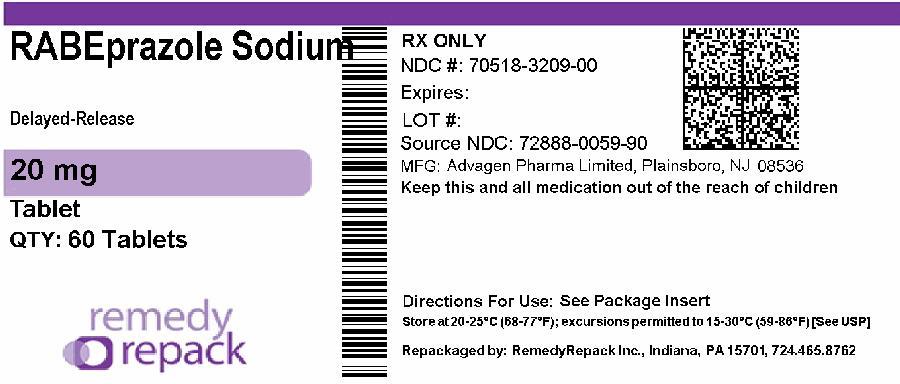
RABEPRAZOLE SODIUM DR TABS 20 MG 30CT
Generic: Rabeprazole Sodium
RABEPRAZOLE SODIUM DR TABS 20 MG 30CT
Sign up to see pricing
Licensed pharmacies, clinics, doctor's offices, and veterinary practices get instant account approval
Sign Up — Instant ApprovalDrug Information
Identification
Rabeprazole Sodium
Rabeprazole Sodium
Ascend Laboratories, LLC
HUMAN PRESCRIPTION DRUG
Administration
TABLET, DELAYED RELEASE
ORAL
ANDA208644
Active Ingredients
| Ingredient | Strength |
|---|---|
| RABEPRAZOLE SODIUM | 20 mg/1 |
Pharmacological Class
Data sourced from openFDA / DailyMed. For full prescribing information, consult the drug label.
Wholesale compliance resources
Drug Resources
Clinical Drug Information
Indications & Usage
1 INDICATIONS AND USAGE Rabeprazole sodium delayed-release tablets is a proton pump inhibitor (PPI) indicated in adults for: · Healing of Erosive or Ulcerative Gastroesophageal Reflux Disease (GERD) ( 1.1 ). · Maintenance of Healing of Erosive or Ulcerative GERD ( 1.2 ). · Treatment of Symptomatic GERD ( 1.3 ). · Healing of Duodenal Ulcers ( 1.4 ). · Helicobacter pylori Eradication to Reduce Risk of Duodenal Ulcer Recurrence ( 1.5 ). · Treatment of Pathological Hypersecretory Conditions, Including Zollinger-Ellison Syndrome ( 1.6 ). In adolescent patients 12 years of age and older for: · Short-term Treatment of Symptomatic GERD ( 1.7 ) 1.1 Healing of Erosive or Ulcerative GERD in Adults Rabeprazole sodium delayed-release tablets are indicated for short-term (4 to 8 weeks) treatment in the healing and symptomatic relief of erosive or ulcerative gastroesophageal reflux disease (GERD). For those patients who have not healed after 8 weeks of treatment, an additional 8-week course of rabeprazole sodium delayed-release tablets may be considered. 1.2 Maintenance of Healing of Erosive or Ulcerative GERD in Adults Rabeprazole sodium delayed-release tablets are indicated for maintaining healing and reduction in relapse rates of heartburn symptoms in patients with erosive or ulcerative gastroesophageal reflux disease (GERD Maintenance). Controlled studies do not extend beyond 12 months. 1.3 Treatment of Symptomatic GERD in Adults Rabeprazole sodium delayed-release tablets are indicated for the treatment of daytime and nighttime heartburn and other symptoms associated with GERD in adults for up to 4 weeks. 1.4 Healing of Duodenal Ulcers in Adults Rabeprazole sodium delayed-release tablets are indicated for short-term (up to four weeks) treatment in the healing and symptomatic relief of duodenal ulcers. Most patients heal within four weeks. 1.5 Helicobacter pylori Eradication to Reduce the Risk of Duodenal Ulcer Recurrence in Adults Rabeprazole sodium delayed-release tablets, in combination with amoxicillin and clarithromycin as a three drug regimen, are indicated for the treatment of patients with H. pylori infection and duodenal ulcer disease (active or history within the past 5 years) to eradicate H. pylori . Eradication of H. pylori has been shown to reduce the risk of duodenal ulcer recurrence. In patients who fail therapy, susceptibility testing should be done. If resistance to clarithromycin is demonstrated or susceptibility testing is not possible, alternative antimicrobial therapy should be instituted [ see Clinical Pharmacology (12.2) and the full prescribing information for clarithromycin]. 1.6 Treatment of Pathological Hypersecretory Conditions, Including Zollinger-Ellison Syndrome in Adults Rabeprazole sodium delayed-release tablets are indicated for the long-term treatment of pathological hypersecretory conditions, including Zollinger-Ellison syndrome. 1.7 Treatment of Symptomatic GERD in Adolescent Patients 12 Years of Age and Older Rabeprazole sodium delayed-release tablets are indicated for the treatment of symptomatic GERD in adolescents 12 years of age and above for up to 8 weeks.
Dosage & Administration
2 DOSAGE AND ADMINISTRATION Table 1 shows the recommended dosage of rabeprazole sodium delayed-release tablets in adults and adolescent patients 12 years of age and older. The use of rabeprazole sodium delayed-release tablets is not recommended for use in pediatric patients 1 year to less than 12 years of age because the lowest available tablet strength (20 mg) exceeds the recommended dose for these patients. Use another rabeprazole formulation for pediatric patients 1 year to less than 12 years of age. Table 1: Recommended Dosage and Duration of Rabeprazole sodium delayed-release tablets in Adults and Adolescents 12 Years of Age and Older Indication Dosage of Rabeprazole sodium delayed-release tablets Treatment Duration Adults Healing of Erosive or Ulcerative Gastroesophageal Reflux Disease (GERD) 20 mg once daily 4 to 8 weeks* Maintenance of Healing of Erosive or Ulcerative GERD 20 mg once daily Controlled studies do not extend beyond 12 months Symptomatic GERD in Adults 20 mg once daily Up to 4 weeks** Healing of Duodenal Ulcers 20 mg once daily after the morning meal Up to 4 weeks*** Helicobacter pylori Eradication to Reduce the Risk of Duodenal Ulcer Recurrence Rabeprazole Sodium Delayed-Release Tablets 20 mg Amoxicillin 1,000 mg Clarithromycin 500 mg Take all three medications twice daily with morning and evening meals; it is important that patients comply with the full 7-day regimen [see Clinical Studies ( 14.5 )] 7 days Pathological Hypersecretory Conditions, Including Zollinger-Ellison Syndrome Starting dose 60 mg once daily then adjust to patient needs; some patients require divided doses Dosages of 100 mg once daily and 60 mg twice daily have been administered As long as clinically indicated Some patients with Zollinger-Ellison syndrome have been treated continuously for up to one year Adolescents 12 Years of Age and Older Symptomatic GERD 20 mg once daily Up to 8 weeks * For those patients who have not healed after 8 weeks of treatment, an additional 8-week course of rabeprazole sodium delayed-release tablets may be considered. ** If symptoms do not resolve completely after 4 weeks, an additional course of treatment may be considered. *** Most patients heal within 4 weeks; some patients may require additional therapy to achieve healing. Administration Instructions • Swallow rabeprazole sodium delayed-release tablets whole. Do not chew, crush, or split tablets. • For the treatment of duodenal ulcers take rabeprazole sodium delayed-release tablets after a meal. • For Helicobacter pylori eradication take rabeprazole sodium delayed-release tablets with food. • For all other indications rabeprazole sodium delayed-release tablets can be taken with or without food. Take a missed dose as soon as possible. If it is almost time for the next dose, skip the missed dose and go back to the normal schedule. Do not take two doses at the same time. Indication Recommended Dosage (2) Healing of Erosive or Ulcerative Gastroesophageal Reflux Disease (GERD) 20 mg once daily for 4 to 8 weeks Maintenance of Healing of Erosive or Ulcerative GERD* studied for 12 months 20 mg once daily* Symptomatic GERD in Adults 20 mg once daily for 4 weeks Healing of Duodenal Ulcers 20 mg once daily after morning meal for up to 4 weeks Helicobacter pylori Eradication to Reduce the Risk of Duodenal Ulcer Recurrence Three Drug Regimen: All three medications should be taken twice daily with morning and evening meals for 7 days Rabeprazole sodium delayed-release Tablets 20 mg Amoxicillin 1,000 mg Clarithromycin 500 mg Pathological Hypersecretory Conditions, Including Zollinger-Ellison Syndrome Starting dose 60 mg once daily then adjust to patient needs Symptomatic GERD in Adolescents 12 Years of Age and Older 20 mg once daily for up to 8 weeks Administration Instructions ( 2 ): Swallow Rabeprazole delayed-release tablets whole. Do not chew, crush or split the tablets. For the treatment of duodenal ulcers take Rabeprazole delayed-release tablets after a meal. For Helicobacter pylori eradication take Rabeprazole delayed-release tablets with food. For all other indications Rabeprazole delayed-release tablets can be taken with or without food.
Adverse Reactions
6 ADVERSE REACTIONS The following serious adverse reactions are described below and elsewhere in labeling: Acute Tubulointerstitial Nephritis [see Warnings and Precautions ( 5.3 )] Clostridium difficile-Associated Diarrhea [see Warnings and Precautions ( 5.4 )] Bone Fracture [see Warnings and Precautions ( 5.5 )] Cutaneous and Systemic Lupus Erythematosus [see Warnings and Precautions ( 5.7 )] Cyanocobalamin (Vitamin B-12) Deficiency [see Warnings and Precautions ( 5.8) ] Hypomagnesemia and Mineral Metabolism [see Warnings and Precautions ( 5.9 )] Fundic Gland Polyps [see Warnings and Precautions ( 5.11 )] Most common adverse reactions in adults (>2%) are pain, pharyngitis, flatulence, infection, and constipation ( 6.1 ). Most common adverse reactions in adolescents (≥2%) are headache, diarrhea, nausea, vomiting, and abdominal pain ( 6.1 ). To report SUSPECTED ADVERSE REACTIONS, contact Ascend Laboratories, LLC at 1- 877-272-7901 or FDA at 1-800-FDA-1088 or www.fda.gov/medwatch 6.1 Clinical Studies Experience Because clinical trials are conducted under varying conditions, adverse reaction rates observed in the clinical trials of a drug cannot be directly compared to rates in the clinical trials of another drug and may not reflect the rates observed in practice. Adults The data described below reflect exposure to rabeprazole sodium delayed-release tablets in 1,064 adult patients exposed for up to 8 weeks. The studies were primarily placebo-and active-controlled trials in adult patients with Erosive or Ulcerative Gastroesophageal Reflux Disease (GERD), Duodenal Ulcers and Gastric Ulcers. The population had a mean age of 53 years (range 18 to 89 years) and had a ratio of approximately 60% male: 40% female. The racial distribution was 86% Caucasian, 8% African American, 2% Asian, and 5% other. Most patients received either 10 mg, 20 mg or 40 mg per day of rabeprazole sodium delayed-release tablets. An analysis of adverse reactions appearing in ≥2% of patients treated with rabeprazole sodium delayed-release tablets (n=1,064) and with a greater frequency than placebo (n=89) in controlled North American and European acute treatment trials, revealed the following adverse reactions: pain (3% vs. 1%), pharyngitis (3% vs. 2%), flatulence (3% vs. 1%), infection (2% vs. 1%), and constipation (2% vs. 1%). Three long-term maintenance studies consisted of a total of 740 adult patients; at least 54% of adult patients were exposed to rabeprazole sodium delayed-release tablets for 6 months and at least 33% were exposed for 12 months. Of the 740 adult patients, 247 (33%) and 241 (33%) patients received 10 mg and 20 mg of rabeprazole sodium delayed-release tablets, respectively, while 169 (23%) patients received placebo and 83 (11%) received omeprazole. The safety profile of rabeprazole in the maintenance studies in adults was consistent with what was observed in the acute studies. Less common adverse reactions seen in controlled clinical trials (<2% of patients treated with rabeprazole sodium delayed-release tablets and greater than placebo) and for which there is a possibility of a causal relationship to rabeprazole, include the following: headache, abdominal pain, diarrhea, dry mouth, dizziness, peripheral edema, hepatic enzyme increase, hepatitis, hepatic encephalopathy, myalgia, and arthralgia. Combination Treatment with Amoxicillin and Clarithromycin: In clinical trials using combination therapy with rabeprazole plus amoxicillin and clarithromycin (RAC), no adverse reactions unique to this drug combination were observed. In the U.S. multicenter study, the most frequently reported drug related adverse reactions for patients who received RAC therapy for 7 or 10 days were diarrhea (8% and 7%) and taste perversion (6% and 10%), respectively. No clinically significant laboratory abnormalities particular to the drug combinations were observed. For more information on adverse reactions or laboratory changes with amoxicillin or clarithromycin, refer to their respective prescribing information, Adverse Reactions section. Pediatrics In a multicenter, open-label study of adolescent patients 12 to 16 years of age with a clinical diagnosis of symptomatic GERD or endoscopically proven GERD, the adverse event profile was similar to that of adults. The adverse reactions reported without regard to relationship to rabeprazole sodium delayed-release tablets that occurred in ≥2% of 111 patients were headache (9.9%), diarrhea (4.5%), nausea (4.5%), vomiting (3.6%), and abdominal pain (3.6%). The related reported adverse reactions that occurred in ≥2% of patients were headache (5.4%) and nausea (1.8%). There were no adverse reactions reported in this study that were not previously observed in adults. 6.2 Postmarketing Experience The following adverse reactions have been identified during post approval use of rabeprazole. Because these reactions are reported voluntarily from a population of uncertain size, it is not always possible to reliably estimate their frequency or establish a causal relationship to drug exposure: Blood and Lymphatic System Disorders: agranulocytosis, hemolytic anemia, leukopenia, pancytopenia, thrombocytopenia Ear and Labyrinth Disorders: vertigo Eye Disorders: blurred vision Gastrointestinal Disorders: fundic gland polyps General Disorders and Administration Site Conditions: sudden death Hepatobiliary Disorders: jaundice Immune System Disorders: anaphylaxis, angioedema, systemic lupus erythematosus, Stevens-Johnson syndrome, toxic epidermal necrolysis (some fatal),DRESS, AGEP Infections and Infestations: Clostridium difficile -associated diarrhea Investigations: Increases in prothrombin time/INR (in patients treated with concomitant warfarin), TSH elevations Metabolism and Nutrition Disorders: hyperammonemia, hypomagnesemia, hypocalcemia, hypokalemia [Warnings and Precautions 5.8], hyponatremia Musculoskeletal System Disorders: bone fracture, rhabdomyolysis Nervous System Disorders: coma Psychiatric Disorders: delirium, disorientation Renal and Genitourinary Disorders : interstitial nephritis, erectile dysfunction Respiratory, Thoracic and Mediastinal Disorders: interstitial pneumonia Skin and Subcutaneous Tissue Disorders: severe dermatologic reactions including bullous and other drug eruptions of the skin, cutaneous lupus erythematosus, erythema multiforme
Information for Patients
17 PATIENT COUNSELING INFORMATION Advise the patient to read the FDA-approved patient labeling (Medication Guide). Acute Tubulointerstitial Nephritis Advise the patient or caregiver to call the patient’s healthcare provider immediately if they experience signs and/or symptoms associated with -acute tubulointerstitial nephritis [see Warnings and Precautions ( 5.3 )] . Clostridium difficile -Associated Diarrhea Advise the patient or caregiver to immediately call the patient’s healthcare provider if they experience diarrhea that does not improve [see Warnings and Precautions ( 5.4 )] . Bone Fracture Advise the patient or caregiver to report any fractures, especially of the hip, wrist or spine, to the patient’s healthcare provider [see Warnings and Precautions ( 5.5 )] . Severe Cutaneous Adverse Reactions Advise the patient or caregiver to discontinue rabeprazole sodium delayed-release tablets and report any signs and symptoms of a severe cutaneous adverse reaction or other sign of hypersensitivity to the healthcare provider [see Warnings and Precautions ( 5.6 )] . Cutaneous and Systemic Lupus Erythematosus Advise the patient or caregiver to immediately call the patient’s healthcare provider for any new or worsening of symptoms associated with cutaneous or systemic lupus erythematosus [see Warnings and Precautions ( 5.6 )] . Cyanocobalamin (Vitamin B-12) Deficiency Advise the patient or caregiver to report any clinical symptoms that may be associated with cyanocobalamin deficiency to the patient’s healthcare provider if they have been receiving rabeprazole sodium delayed-release tablets for longer than 3 years [see Warnings and Precautions ( 5.7 )] . Hypomagnesemia and Mineral Metabolism Advise the patient or caregiver to report any clinical symptoms that may be associated with hypomagnesemia, hypocalcemia, hypokalemia and hyponatremia to the patient’s healthcare provider, if they have been receiving rabeprazole sodium delayed-release tablets for at least 3 months [see Warnings and Precautions ( 5.8 )] . Drug Interactions Advise patients to report to their healthcare provider if they are taking rilpivirine-containing products [see Contraindications ( 4 )], warfarin, digoxin or high-dose methotrexate [see Warnings and Precautions ( 5.2 , 5.8 , 5.9 )] . Administration • Swallow rabeprazole sodium delayed-release tablets whole. Do not chew, crush or split the tablets. • For the treatment of duodenal ulcers take rabeprazole sodium delayed-release tablets after a meal. • For Helicobacter pylori eradication take rabeprazole sodium delayed-release tablets with food. • For all other indications rabeprazole sodium delayed-release tablets can be taken with or without food. • Take a missed dose as soon as possible. If it is almost time for the next dose, skip the missed dose and go back to the normal schedule. Do not take two doses at the same time. Manufactured by: Alkem Laboratories Ltd., INDIA. Distributed by: Ascend Laboratories, LLC Parsippany, NJ 07054 Revised: August , 2023 All brand names are the trademarks of their respective owners. Dispense with Medication Guide available at: www.ascendlaboratories.com/mg/rabeprazoledrtabs.pdf PT 2191-07
Clinical data sourced from openFDA drug labeling. For complete prescribing information, consult the full drug label.