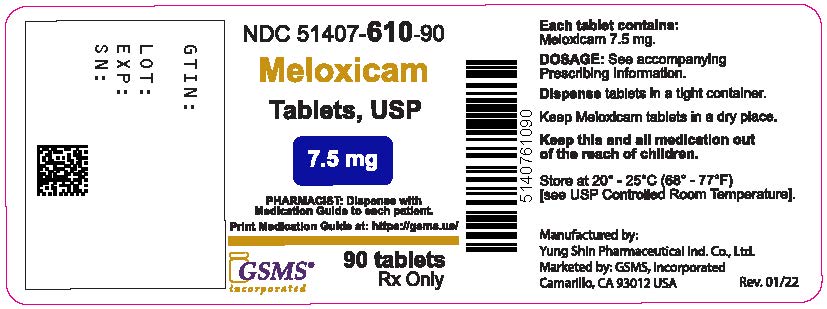
MELOXICAM 15MG 100 TAB
Generic: meloxicam
MELOXICAM 15MG 100 TAB
Sign up to see pricing
Licensed pharmacies, clinics, doctor's offices, and veterinary practices get instant account approval
Sign Up — Instant ApprovalDrug Information
Identification
meloxicam
meloxicam
Unichem Pharmaceuticals (USA), Inc.
HUMAN PRESCRIPTION DRUG
Administration
TABLET
ORAL
ANDA077927
Active Ingredients
| Ingredient | Strength |
|---|---|
| MELOXICAM | 15 mg/1 |
Pharmacological Class
Data sourced from openFDA / DailyMed. For full prescribing information, consult the drug label.
Wholesale compliance resources
Drug Resources
Clinical Drug Information
Indications & Usage
1 INDICATIONS AND USAGE Meloxicam tablets are a non-steroidal anti-inflammatory drug indicated for: Osteoarthritis (OA) ( 1.1 ) Rheumatoid Arthritis (RA) ( 1.2 ) Juvenile Rheumatoid Arthritis (JRA) in patients who weigh ≥60 kg ( 1.3 ) 1.1 Osteoarthritis (OA) Meloxicam tablets are indicated for relief of the signs and symptoms of osteoarthritis [ see Clinical Studies ( 14.1 ) ]. 1.2 Rheumatoid Arthritis (RA) Meloxicam tablets are indicated for relief of the signs and symptoms of rheumatoid arthritis [ see Clinical Studies ( 14.1 ) ]. 1.3 Juvenile Rheumatoid Arthritis (JRA) Pauciarticular and Polyarticular Course Meloxicam tablets are indicated for relief of the signs and symptoms of pauciarticular or polyarticular course Juvenile Rheumatoid Arthritis in patients who weigh ≥60 kg [ see Dosage and Administration ( 2.4 ) and Clinical Studies ( 14.2 ) ].
Dosage & Administration
2 DOSAGE AND ADMINISTRATION Use the lowest effective dosage for the shortest duration consistent with individual patient treatment goals ( 2.1 ) OA ( 2.2 ) and RA ( 2.3 ): Starting dose: 7.5 mg once daily Dose may be increased to 15 mg once daily JRA ( 2.4 ): 7.5 mg once daily in children ≥60 kg Meloxicam Tablets are not interchangeable with approved formulations of oral meloxicam even if the total milligram strength is the same ( 2.6 ) 2.1 General Dosing Instructions Carefully consider the potential benefits and risks of Meloxicam tablets and other treatment options before deciding to use Meloxicam tablets. Use the lowest effective dosage for the shortest duration consistent with individual patient treatment goals [see Warnings and Precautions ( 5 )]. After observing the response to initial therapy with Meloxicam tablets, adjust the dose to suit an individual patient's needs. In adults, the maximum recommended daily oral dose of Meloxicam tablets is 15 mg regardless of formulation. In patients with hemodialysis, a maximum daily dosage of 7.5 mg is recommended [see Use in Specific Populations ( 8.7 ) and Clinical Pharmacology ( 12.3 )]. Meloxicam tablets may be taken without regard to timing of meals. 2.2 Osteoarthritis For the relief of the signs and symptoms of osteoarthritis the recommended starting and maintenance oral dose of Meloxicam tablets is 7.5 mg once daily. Some patients may receive additional benefit by increasing the dose to 15 mg once daily. 2.3 Rheumatoid Arthritis For the relief of the signs and symptoms of rheumatoid arthritis, the recommended starting and maintenance oral dose of Meloxicam tablets is 7.5 mg once daily. Some patients may receive additional benefit by increasing the dose to 15 mg once daily. 2.4 Juvenile Rheumatoid Arthritis (JRA) Pauciarticular and Polyarticular Course For the treatment of juvenile rheumatoid arthritis, the recommended oral dose of Meloxicam tablets is 7.5 mg once daily in children who weigh ≥60 kg. There was no additional benefit demonstrated by increasing the dose above 7.5 mg in clinical trials. Meloxicam tablets should not be used in children who weigh <60 kg. 2.5 Renal Impairment The use of Meloxicam tablets in subjects with severe renal impairment is not recommended. In patients on hemodialysis, the maximum dosage of Meloxicam tablets is 7.5 mg per day [ see Clinical Pharmacology ( 12.3 ) ]. 2.6 Non-Interchangeability with Other Formulations of Meloxicam Meloxicam tablets have not shown equivalent systemic exposure to other approved formulations of oral meloxicam. Therefore, Meloxicam tablets are not interchangeable with other formulations of oral meloxicam product even if the total milligram strength is the same. Do not substitute similar dose strengths of Meloxicam tablets with other formulations of oral meloxicam product.
Adverse Reactions
6 ADVERSE REACTIONS Most common (≥5% and greater than placebo) adverse events in adults are diarrhea, upper respiratory tract infections, dyspepsia, and influenza-like symptoms ( 6.1 ) Adverse events observed in pediatric studies were similar in nature to the adult clinical trial experience ( 6.1 ) To report SUSPECTED ADVERSE REACTIONS, contact Unichem Pharmaceuticals (USA), Inc. at 1-866-562-4616 or FDA at 1-800-FDA-1088 or www.fda.gov/medwatch . The following adverse reactions are discussed in greater detail in other sections of the labeling: Cardiovascular Thrombotic Events [ see Boxed Warning and Warnings and Precautions ( 5.1 ) ] GI Bleeding, Ulceration, and Perforation [ see Boxed Warning and Warnings and Precautions ( 5.2 ) ] Hepatotoxicity [ see Warnings and Precautions ( 5.3 ) ] Hypertension [ see Warnings and Precautions ( 5.4 ) ] Heart Failure and Edema [ see Warnings and Precautions ( 5.5 ) ] Renal Toxicity and Hyperkalemia [ see Warnings and Precautions ( 5.6 ) ] Anaphylactic Reactions [ see Warnings and Precautions ( 5.7 ) ] Serious Skin Reactions [ see Warnings and Precautions ( 5.9 ) ] Drug Reaction with Eosinophilia and Systemic Symptoms (DRESS) [ see Warnings and Precautions ( 5.10 ) ] Fetal Toxicity [ see Warnings and Precautions ( 5.11 ) ] Hematologic Toxicity [ see Warnings and Precautions ( 5.12 ) ] 6.1 Clinical Trials Experience Because clinical trials are conducted under widely varying conditions, adverse reaction rates observed in the clinical trials of a drug cannot be directly compared to rates in the clinical trials of another drug and may not reflect the rates observed in practice. Adults Osteoarthritis and Rheumatoid Arthritis The Meloxicam Phase 2/3 clinical trial database includes 10,122 OA patients and 1012 RA patients treated with Meloxicam 7.5 mg/day, 3505 OA patients and 1351 RA patients treated with Meloxicam 15 mg/day. Meloxicam at these doses was administered to 661 patients for at least 6 months and to 312 patients for at least one year. Approximately 10,500 of these patients were treated in ten placebo- and/or active-controlled osteoarthritis trials and 2363 of these patients were treated in ten placebo- and/or active-controlled rheumatoid arthritis trials. Gastrointestinal (GI) adverse events were the most frequently reported adverse events in all treatment groups across Meloxicam trials. A 12-week multicenter, double-blind, randomized trial was conducted in patients with osteoarthritis of the knee or hip to compare the efficacy and safety of Meloxicam with placebo and with an active control. Two 12-week multicenter, double-blind, randomized trials were conducted in patients with rheumatoid arthritis to compare the efficacy and safety of Meloxicam with placebo. Table 1a depicts adverse events that occurred in ≥2% of the Meloxicam treatment groups in a 12-week placebo- and active-controlled osteoarthritis trial. Table 1b depicts adverse events that occurred in ≥2% of the Meloxicam treatment groups in two 12-week placebo-controlled rheumatoid arthritis trials. Table 1a Adverse Events (%) Occurring in ≥2% of Meloxicam Patients in a 12-Week Osteoarthritis Placebo- and Active-Controlled Trial Placebo Meloxicam 7 . 5 mg daily Meloxicam 15 mg daily Diclofenac 100 mg daily No . of Patients 157 154 156 153 Gastrointestinal 17.2 20.1 17.3 28.1 Abdominal pain 2.5 1.9 2.6 1.3 Diarrhea 3.8 7.8 3.2 9.2 Dyspepsia 4.5 4.5 4.5 6.5 Flatulence 4.5 3.2 3.2 3.9 Nausea 3.2 3.9 3.8 7.2 Body as a Whole Accident household 1.9 4.5 3.2 2.6 Edema 1 2.5 1.9 4.5 3.3 Fall 0.6 2.6 0.0 1.3 Influenza-like symptoms 5.1 4.5 5.8 2.6 Central and Peripheral Nervous System Dizziness 3.2 2.6 3.8 2.0 Headache 10.2 7.8 8.3 5.9 Respiratory Pharyngitis 1.3 0.6 3.2 1.3 Upper respiratory tract infection 1.9 3.2 1.9 3.3 Skin Rash 2 2.5 2.6 0.6 2.0 Table 1b Adverse Events (%) Occurring in ≥2% of Meloxicam Patients in two 12-Week Rheumatoid Arthritis Placebo- Controlled Trials Placebo Meloxicam 7 . 5 mg daily Meloxicam 15 mg daily No . of Patients 469 481 477 Gastrointestinal Disorders 14.1 18.9 16.8 Abdominal pain NOS MedDRA preferred term: nausea, abdominal pain NOS, influenza-like illness, headaches NOS, and rash NOS 0.6 2.9 2.3 Dyspeptic signs and symptoms MedDRA high level term (preferred terms): dyspeptic signs and symptoms (dyspepsia, dyspepsia aggravated, eructation, gastrointestinal irritation), upper respiratory tract infections-pathogen unspecified (laryngitis NOS, pharyngitis NOS, sinusitis NOS), joint related signs and symptoms (arthralgia, arthralgia aggravated, joint crepitation, joint effusion, joint swelling) 3.8 5.8 4.0 Nausea 2.6 3.3 3.8 General Disorders and Administration Site Conditions Influenza-like illness 2.1 2.9 2.3 Infection and Infestations Upper Respiratory tract infections-pathogen class unspecified 4.1 7.0 6.5 Musculoskeletal and Connective Tissue Disorders Joint related signs and symptoms 1.9 1.5 2.3 Nervous System Disorders Headaches NOS 6.4 6.4 5.5 Skin and Subcutaneous Tissue Disorders Rash NOS 1.7 1.0 2.1 The adverse events that occurred with Meloxicam in ≥2% of patients treated short-term (4 to 6 weeks) and long-term (6 months) in active-controlled osteoarthritis trials are presented in Table 2. Table 2 Adverse Events (%) Occurring in ≥2% of Meloxicam Patients in 4 to 6 Weeks and 6 Month Active-Controlled Osteoarthritis Trials 4 - 6 Weeks Controlled Trials 6 Month Controlled Trials Meloxicam 7 . 5 mg daily Meloxicam 15 mg daily Meloxicam 7 . 5 mg daily Meloxicam 15 mg daily No . of Patients 8955 256 169 306 Gastrointestinal 11.8 18.0 26.6 24.2 Abdominal pain 2.7 2.3 4.7 2.9 Constipation 0.8 1.2 1.8 2.6 Diarrhea 1.9 2.7 5.9 2.6 Dyspepsia 3.8 7.4 8.9 9.5 Flatulence 0.5 0.4 3.0 2.6 Nausea 2.4 4.7 4.7 7.2 Vomiting 0.6 0.8 1.8 2.6 Body as a Whole Accident household 0.0 0.0 0.6 2.9 Edema WHO preferred terms edema, edema dependent, edema peripheral, and edema legs combined 0.6 2.0 2.4 1.6 Pain 0.9 2.0 3.6 5.2 Central and Peripheral Nervous System Dizziness 1.1 1.6 2.4 2.6 Headache 2.4 2.7 3.6 2.6 Hematologic Anemia 0.1 0.0 4.1 2.9 Musculoskeletal Arthralgia 0.5 0.0 5.3 1.3 Back pain 0.5 0.4 3.0 0.7 Psychiatric Insomnia 0.4 0.0 3.6 1.6 Respiratory Coughing 0.2 0.8 2.4 1.0 Upper respiratory tract infection 0.2 0.0 8.3 7.5 Skin Pruritus 0.4 1.2 2.4 0.0 Rash WHO preferred terms rash, rash erythematous, and rash maculo-papular combined 0.3 1.2 3.0 1.3 Urinary Micturition frequency 0.1 0.4 2.4 1.3 Urinary tract infection 0.3 0.4 4.7 6.9 Higher doses of Meloxicam (22.5 mg and greater) have been associated with an increased risk of serious GI events; therefore, the daily dose of Meloxicam should not exceed 15 mg. Pediatrics Pauciarticular and Polyarticular Course Juvenile Rheumatoid Arthritis (JRA) Three hundred and eighty-seven patients with pauciarticular and polyarticular course JRA were exposed to Meloxicam with doses ranging from 0.125 to 0.375 mg/kg per day in three clinical trials. These studies consisted of two 12-week multicenter, double-blind, randomized trials (one with a 12-week open-label extension and one with a 40-week extension) and one 1-year open-label PK study. The adverse events observed in these pediatric studies with Meloxicam were similar in nature to the adult clinical trial experience, although there were differences in frequency. In particular, the following most common adverse events, abdominal pain, vomiting, diarrhea, headache, and pyrexia, were more common in the pediatric than in the adult trials. Rash was reported in seven (<2%) patients receiving Meloxicam. No unexpected adverse events were identified during the course of the trials. The adverse events did not demonstrate an age or gender-specific subgroup effect. The following is a list of adverse drug reactions occurring in <2% of patients receiving Meloxicam in clinical trials involving approximately 16,200 patients. Body as a Whole allergic reaction, face edema, fatigue, fever, hot flushes, malaise, syncope, weight decrease, weight increase Cardiovascular angina pectoris, cardiac failure, hypertension, hypotension, myocardial infarction, vasculitis Central and Peripheral Nervous System convulsions, paresthesia, tremor, vertigo Gastrointestinal colitis, dry mouth, duodenal ulcer, eructation, esophagitis, gastric ulcer, gastritis, gastroesophageal reflux, gastrointestinal hemorrhage, hematemesis, hemorrhagic duodenal ulcer, hemorrhagic gastric ulcer, intestinal perforation, melena, pancreatitis, perforated duodenal ulcer, perforated gastric ulcer, stomatitis ulcerative Heart Rate and Rhythm arrhythmia, palpitation, tachycardia Hematologic leukopenia, purpura, thrombocytopenia Liver and Biliary System ALT increased, AST increased, bilirubinemia, GGT increased, hepatitis Metabolic and Nutritional dehydration Psychiatric abnormal dreaming, anxiety, appetite increased, confusion, depression, nervousness, somnolence Respiratory asthma, bronchospasm, dyspnea Skin and Appendages alopecia, angioedema, bullous eruption, photosensitivity reaction, pruritus, sweating increased, urticaria Special Senses abnormal vision, conjunctivitis, taste perversion, tinnitus Urinary System albuminuria, BUN increased, creatinine increased, hematuria, renal failure 6.2 Post Marketing Experience The following adverse reactions have been identified during post approval use of Meloxicam. Because these reactions are reported voluntarily from a population of uncertain size, it is not always possible to reliably estimate their frequency or establish a causal relationship to drug exposure. Decisions about whether to include an adverse event from spontaneous reports in labeling are typically based on one or more of the following factors: (1) seriousness of the event, (2) number of reports, or (3) strength of causal relationship to the drug. Adverse reactions reported in worldwide post marketing experience or the literature include: acute urinary retention; agranulocytosis; alterations in mood (such as mood elevation); anaphylactoid reactions including shock; erythema multiforme; exfoliative dermatitis; interstitial nephritis; jaundice; liver failure; Stevens-Johnson syndrome; fixed drug eruption (FDE); toxic epidermal necrolysis, and infertility female.
Information for Patients
17 PATIENT COUNSELING INFORMATION Advise the patient to read the FDA-approved patient labeling (Medication Guide) that accompanies each prescription dispensed. Additional Medication Guides can be obtained by calling Unichem at 1-866-562-4616. Inform patients, families or their caregivers of the following information before initiating therapy with an NSAID and periodically during the course of ongoing therapy. Cardiovascular Thrombotic Events Advise patients to be alert for the symptoms of cardiovascular thrombotic events, including chest pain, shortness of breath, weakness, or slurring of speech, and to report any of these symptoms to their healthcare provider immediately [see Warnings and Precautions ( 5.1 )]. Gastrointestinal Bleeding, Ulceration, and Perforation Advise patients to report symptoms of ulcerations and bleeding, including epigastric pain, dyspepsia, melena, and hematemesis to their healthcare provider. In the setting of concomitant use of low-dose aspirin for cardiac prophylaxis, inform patients of the increased risk for the signs and symptoms of GI bleeding [see Warnings and Precautions ( 5.2 )]. Hepatotoxicity Inform patients of the warning signs and symptoms of hepatotoxicity (e.g., nausea, fatigue, lethargy, diarrhea, pruritus, jaundice, right upper quadrant tenderness, and "flu-like" symptoms). If these occur, instruct patients to stop Meloxicam tablets and seek immediate medical therapy [ see Warnings and Precautions ( 5.3 ) ]. Heart Failure and Edema Advise patients to be alert for the symptoms of congestive heart failure including shortness of breath, unexplained weight gain, or edema and to contact their healthcare provider if such symptoms occur [ see Warnings and Precautions ( 5.5 ) ]. Anaphylactic Reactions Inform patients of the signs of an anaphylactic reaction (e.g., difficulty breathing, swelling of the face or throat). Instruct patients to seek immediate emergency help if these occur [ see Contraindications ( 4 ) and Warnings and Precautions ( 5.7 ) ]. Serious Skin Reactions including DRESS Advise patients to stop taking Meloxicam tablets immediately if they develop any type of rash or fever and to contact their healthcare provider as soon as possible [ see Warnings and Precautions ( 5.9 , 5.10 ) ]. Female Fertility Advise females of reproductive potential who desire pregnancy that NSAIDs, including Meloxicam tablets, may be associated with a reversible delay in ovulation [ see Use in Specific Populations ( 8.3 ) ]. Fetal Toxicity Inform pregnant women to avoid use of Meloxicam tablets and other NSAIDs starting at 30 weeks gestation because of the risk of the premature closing of the fetal ductus arteriosus If treatment with Meloxicam tablets is needed for a pregnant woman between about 20 to 30 weeks gestation, advise her that she may need to be monitored for oligohydramnios, if treatment continues for longer than 48 hours [ see Warnings and Precautions ( 5.11 ) and Use in Specific Populations ( 8.1 ) ]. Avoid Concomitant Use of NSAIDs Inform patients that the concomitant use of Meloxicam tablets with other NSAIDs or salicylates (e.g., diflunisal, salsalate) is not recommended due to the increased risk of gastrointestinal toxicity, and little or no increase in efficacy [ see Warnings and Precautions ( 5.2 ) and Drug Interactions ( 7 ) ]. Alert patients that NSAIDs may be present in "over the counter" medications for treatment of colds, fever, or insomnia. Use of NSAIDs and Low-Dose Aspirin Inform patients not to use low-dose aspirin concomitantly with Meloxicam tablets until they talk to their healthcare provider [ see Drug Interactions ( 7 ) ]. For current prescribing information, call Unichem at 1-866-562-4616. Manufactured by: UNICHEM LABORATORIES LTD. Pilerne Ind. Estate, Pilerne, Bardez, Goa 403511, India Manufactured for: East Brunswick, NJ 08816 12-R-07/2024 13015145 Unichem Logo
Clinical data sourced from openFDA drug labeling. For complete prescribing information, consult the full drug label.