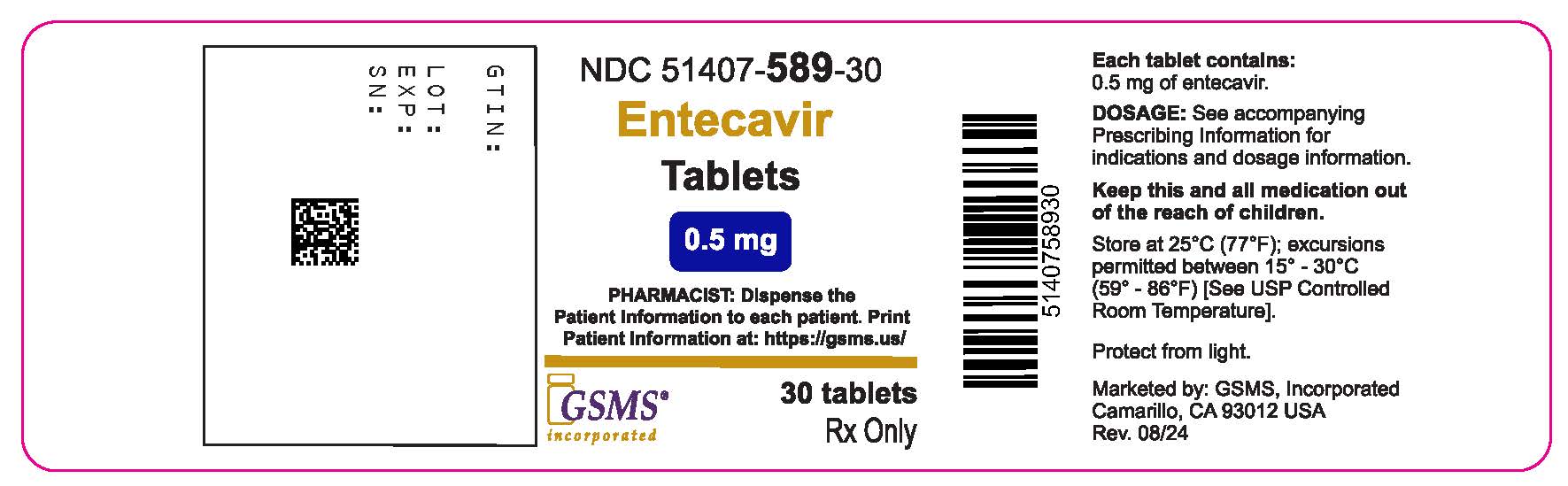
ENTECAVIR TABS 0.5 MG 30CT
Generic: Entecavir
ENTECAVIR TABS 0.5 MG 30CT
Sign up to see pricing
Licensed pharmacies, clinics, doctor's offices, and veterinary practices get instant account approval
Sign Up — Instant ApprovalDrug Information
Identification
Entecavir
Entecavir
Camber Pharmaceuticals, Inc.
HUMAN PRESCRIPTION DRUG
Administration
TABLET
ORAL
ANDA205740
Active Ingredients
| Ingredient | Strength |
|---|---|
| ENTECAVIR ANHYDROUS | .5 mg/1 |
Pharmacological Class
Data sourced from openFDA / DailyMed. For full prescribing information, consult the drug label.
Wholesale compliance resources
Drug Resources
Clinical Drug Information
Indications & Usage
1 INDICATIONS AND USAGE Entecavir tablets are indicated for the treatment of chronic hepatitis B virus infection in adults and pediatric patients 2 years of age and older with evidence of active viral replication and either evidence of persistent elevations in serum aminotransferases (ALT or AST) or histologically active disease. Entecavir is a hepatitis B virus nucleoside analogue reverse transcriptase inhibitor indicated for the treatment of chronic hepatitis B virus infection in adults and children at least 2 years of age with evidence of active viral replication and either evidence of persistent elevations in serum aminotransferases (ALT or AST) or histologically active disease. (1)
Dosage & Administration
2 DOSAGE AND ADMINISTRATION • Nucleoside-inhibitor-treatment-naïve with compensated liver disease (greater than or equal to 16 years old): 0.5 mg once daily. (2.2) • Nucleoside-inhibitor-treatment-naïve and lamivudine-experienced pediatric patients at least 2 years of age and weighing at least 10 kg: dosing is based on weight. (2.3) • Lamivudine-refractory or known lamivudine or telbivudine resistance substitutions (greater than or equal to 16 years old): 1 mg once daily. (2.2) • Decompensated liver disease (adults): 1 mg once daily. (2.2) • Renal impairment: Dosage adjustment is recommended if creatinine clearance is less than 50 mL/min. (2.4) • Entecavir tablets should be administered on an empty stomach. (2.1) 2.1 Timing of Administration Entecavir tablets should be administered on an empty stomach (at least 2 hours after a meal and 2 hours before the next meal). 2.2 Recommended Dosage in Adults Compensated Liver Disease The recommended dose of entecavir tablets for chronic hepatitis B virus infection in nucleoside-inhibitor-treatment-naïve adults and adolescents 16 years of age and older is 0.5 mg once daily. The recommended dose of entecavir tablets in adults and adolescents (at least 16 years of age) with a history of hepatitis B viremia while receiving lamivudine or known lamivudine or telbivudine resistance substitutions rtM204I/V with or without rtL180M, rtL80I/V, or rtV173L is 1 mg once daily. Decompensated Liver Disease The recommended dose of entecavir tablets for chronic hepatitis B virus infection in adults with decompensated liver disease is 1 mg once daily. 2.3 Recommended Dosage in Pediatric Patients Table 1 describes the recommended dose of entecavir tablets for pediatric patients 2 years of age or older and weighing at least 10 kg. The oral solution should be used for patients with body weight up to 30 kg. Table 1: Dosing Schedule for Pediatric Patients Recommended Once-Daily Dose of Oral Solution (mL) Body Weight (kg) Treatment-Na ï ve Patients a Lamivudine-Experienced Patients b 10 to 11 3 6 greater than 11 to 14 4 8 greater than 14 to 17 5 10 greater than 17 to 20 6 12 greater than 20 to 23 7 14 greater than 23 to 26 8 16 greater than 26 to 30 9 18 greater than 30 10 20 a Children with body weight greater than 30 kg should receive 10 mL (0.5 mg) of oral solution or one 0.5 mg tablet once daily. b Children with body weight greater than 30 kg should receive 20 mL (1 mg) of oral solution or one 1 mg tablet once daily. 2.4 Renal Impairment In adult subjects with renal impairment, the apparent oral clearance of entecavir decreased as creatinine clearance decreased [see Clinical Pharmacology ( 12.3 )]. Dosage adjustment is recommended for patients with creatinine clearance less than 50 mL/min, including patients on hemodialysis or continuous ambulatory peritoneal dialysis (CAPD), as shown in Table 2. The once-daily dosing regimens are preferred. Table 2: Recommended Dosage of Entecavir Tablets in Adult Patients with Renal Impairment Creatinine Clearance (mL/min) Usual Dose (0.5 mg) Lamivudine-Refractory or Decompensated Liver Disease (1 mg) 50 or greater 0.5 mg once daily 1 mg once daily 30 to less than 50 0.5 mg every 48 hours 0.5 mg once daily O r 1 mg every 48 hours 10 to less than 30 0.5 mg every 72 hours 1 mg every 72 hours Less than 10 Hemodialysis b or CAPD 0.5 mg every 7 days 1 mg every 7 days b If administered on a hemodialysis day, administer entecavir tablets after the hemodialysis session. Although there are insufficient data to recommend a specific dose adjustment of entecavir tablets in pediatric patients with renal impairment, a reduction in the dose or an increase in the dosing interval similar to adjustments for adults should be considered. 2.5 Hepatic Impairment No dosage adjustment is necessary for patients with hepatic impairment. 2.6 Duration of Therapy The optimal duration of treatment with entecavir tablets for patients with chronic hepatitis B virus infection and the relationship between treatment and long-term outcomes such as cirrhosis and hepatocellular carcinoma are unknown.
Adverse Reactions
6 ADVERSE REACTIONS The following adverse reactions are discussed in other sections of the labeling: • Exacerbations of hepatitis after discontinuation of treatment [see Boxed Warning, Warnings and Precautions ( 5.1 )]. • Lactic acidosis and severe hepatomegaly with steatosis [see Boxed Warning, Warnings and Precautions ( 5.3 )]. • In adults, the most common adverse reactions (≥3%, all severity grades) are headache, fatigue, dizziness, and nausea. The adverse reactions observed in pediatric patients were consistent with those observed in adults. (6.1) To report SUSPECTED ADVERSE REACTIONS, contact Hetero Labs Limited at 1-866-495-1995 or FDA at 1-800-FDA-1088 or www.fda.gov/medwatch 6.1 Clinical Trial Experience in Adults Because clinical trials are conducted under widely varying conditions, adverse reaction rates observed in the clinical trials of a drug cannot be directly compared to rates in the clinical trials of another drug and may not reflect the rates observed in practice. Clinical Trial Experience in Adults Compensated Liver Disease Assessment of adverse reactions is based on four studies (AI463014, AI463022, AI463026, and AI463027) in which 1720 subjects with chronic hepatitis B virus infection and compensated liver disease received double-blind treatment with entecavir 0.5 mg/day (n=679), entecavir 1 mg/day (n=183), or lamivudine (n=858) for up to 2 years. Median duration of therapy was 69 weeks for entecavir-treated subjects and 63 weeks for lamivudine-treated subjects in Studies AI463022 and AI463027 and 73 weeks for entecavir-treated subjects and 51 weeks for lamivudine-treated subjects in Studies AI463026 and AI463014. The safety profiles of entecavir and lamivudine were comparable in these studies. The most common adverse reactions of any severity (≥3%) with at least a possible relation to study drug for entecavir-treated subjects were headache, fatigue, dizziness, and nausea. The most common adverse reactions among lamivudine-treated subjects were headache, fatigue, and dizziness. One percent of entecavir-treated subjects in these four studies compared with 4% of lamivudine-treated subjects discontinued for adverse events or abnormal laboratory test results. Clinical adverse reactions of moderate-severe intensity and considered at least possibly related to treatment occurring during therapy in four clinical studies in which entecavir was compared with lamivudine are presented in Table 3. Table 3 : Clinical Adverse Reactions a of Moderate-Severe Intensity (Grades 2–4) Reported in Four Entecavir Clinical Trials Through 2 Years Nucleoside-Inhibitor-Naïv e b Lamivudine-Ref r actory c B ody System/ Adverse Reaction Entecavir 0.5 mg n=679 Lamivudine 100 mg n=668 Entecavir 1 mg n=183 Lamivudine 100 mg n=190 Any Grade 2–4 adverse reaction a 15% 18% 22% 23% Gastrointestinal Diarrhea 10 x ULN and >2 x 2% 4% 2% 11% baseline ALT >5 x ULN 11% 16% 12% 24% Albumin 2.5 x ULN 2% 2% 3% 2% Lipase > 2.1 x ULN 7% 6% 7% 7% Creatinine >3 x ULN 0 0 0 0 Confirmed creatinine increase 1% 1% 2% 1% > 0.5 mg/dL Hyperglycemia, fasting > 250 mg/dL 2% 1% 3% 1% Glycosuria e 4% 3% 4% 6% Hematuria f 9% 10% 9% 6% Platelets 10 x ULN and >2 x baseline. b Studies AI463022 and AI463027. c Includes Study AI463026 and the entecavir 1 mg and lamivudine treatment arms of Study AI463014, a Phase 2 multinational, randomized, double-blind study of three doses of entecavir (0.1, 0.5, and 1 mg) once daily versus continued lamivudine 100 mg once daily for up to 52 weeks in subjects who experienced recurrent viremia on lamivudine therapy. d Includes hematology, routine chemistries, renal and liver function tests, pancreatic enzymes, and urinalysis. e Grade 3 = 3+, large, ≥500 mg/dL; Grade 4 = 4+, marked, severe. f Grade 3 = 3+, large; Grade 4 = ≥4+, marked, severe, many. ULN=upper limit of normal. Among entecavir-treated subjects in these studies, on-treatment ALT elevations greater than 10 times the upper limit of normal (ULN) and greater than 2 times baseline generally resolved with continued treatment. A majority of these exacerbations were associated with a ≥2 log 10 /mL reduction in viral load that preceded or coincided with the ALT elevation. Periodic monitoring of hepatic function is recommended during treatment. Exacerbations of Hepatitis After Discontinuation of Treatment An exacerbation of hepatitis or ALT flare was defined as ALT greater than 10 times ULN and greater than 2 times the subject’s reference level (minimum of the baseline or last measurement at end of dosing). For all subjects who discontinued treatment (regardless of reason), Table 5 presents the proportion of subjects in each study who experienced post-treatment ALT flares. In these studies, a subset of subjects was allowed to discontinue treatment at or after 52 weeks if they achieved a protocol-defined response to therapy. If entecavir is discontinued without regard to treatment response, the rate of post-treatment flares could be higher. [See Warnings and Precautions ( 5.1 ).] Table 5: Exacerbations of Hepatitis During Off-Treatment Follow-up, Subjects in Studies AI463022, AI463027, and AI463026 Subje c t s with ALT Elevations >10 x ULN and >2 x Reference a Entecavir L amivudine Nucleoside-inhibitor-naïve HBeAg-positive 4/174 (2%) 13/147 (9%) HBeAg-negative 24/302 (8%) 30/270 (11%) Lamivudine-refractory 6/52 (12%) 0/16 a Reference is the minimum of the baseline or last measurement at end of dosing. Median time to off-treatment exacerbation was 23 weeks for entecavir-treated subjects and 10 weeks for lamivudine-treated subjects. Decompensated Liver Disease Study AI463048 was a randomized, open-label study of entecavir 1 mg once daily versus adefovir dipivoxil 10 mg once daily given for up to 48 weeks in adult subjects with chronic HBV infection and evidence of hepatic decompensation, defined as a Child-Turcotte-Pugh (CTP) score of 7 or higher [see Clinical Studies ( 14.1 )]. Among the 102 subjects receiving entecavir, the most common treatment-emergent adverse events of any severity, regardless of causality, occurring through Week 48 were peripheral edema (16%), ascites (15%), pyrexia (14%), hepatic encephalopathy (10%), and upper respiratory infection (10%). Clinical adverse reactions not listed in Table 3 that were observed through Week 48 include blood bicarbonate decreased (2%) and renal failure (2 x baseline and >10 x ULN) through Week 48. Eleven of 102 (11%) subjects treated with entecavir and 11/89 (13%) subjects treated with adefovir dipivoxil had a confirmed increase in serum creatinine of 0.5 mg/dL through Week 48. HIV/HBV Co-infected The safety profile of entecavir 1 mg (n=51) in HIV/HBV co-infected subjects enrolled in Study AI463038 was similar to that of placebo (n=17) through 24 weeks of blinded treatment and similar to that seen in non-HIV infected subjects [see Warnings and Precautions ( 5.2 )]. Liver Transplant Recipients Among 65 subjects receiving entecavir in an open-label, post-liver transplant trial [see Use in Specific Populations ( 8.8 )], the frequency and nature of adverse events were consistent with those expected in patients who have received a liver transplant and the known safety profile of entecavir. Clinical Trial Experience in Pediatric Subjects The safety of entecavir in pediatric subjects 2 to less than 18 years of age is based on two clinical trials in subjects with chronic HBV infection (one Phase 2 pharmacokinetic trial [AI463028] and one Phase 3 trial [AI463189]). These trials provide experience in 168 HBeAg-positive subjects treated with entecavir for a median duration of 72 weeks. The adverse reactions observed in pediatric subjects who received treatment with entecavir were consistent with those observed in clinical trials of entecavir in adults. Adverse drug reactions reported in greater than 1% of pediatric subjects included abdominal pain, rash events, poor palatability (“product taste abnormal”), nausea, diarrhea, and vomiting. 6.2 Postmarketing Experience Data from Long-Term Observational Study Study AI463080 was a randomized, global, observational, open-label Phase 4 study to assess long-¬term risks and benefits of entecavir (0.5 mg/day or 1 mg/day) treatment as compared to other standard-of-care HBV nucleos(t)ide analogues in subjects with chronic HBV infection. A total of 12,378 patients were treated with entecavir (n=6,216) or other HBV nucleos(t)ide treatment [non-entecavir (ETV)] (n=6,162). Patients were evaluated at baseline and subsequently every 6 months for up to 10 years. The principal clinical outcome events assessed during the study were overall malignant neoplasms, liver-related HBV disease progression, HCC, non-HCC malignant neoplasms, and death. The study showed that entecavir was not significantly associated with an increased risk of malignant neoplasms compared to other standard-of-care HBV nucleos(t)ides, as assessed by either the composite endpoint of overall malignant neoplasms or the individual endpoint of non-HCC malignant neoplasms. The most commonly reported malignancy in both the entecavir and non-ETV groups was HCC followed by gastrointestinal malignancies. The data also showed that long-term entecavir use was not associated with a lower occurrence of HBV disease progression or a lower rate of death overall compared to other HBV nucleos(t)ides. The principal clinical outcome event assessments are shown in Table 6. Table 6: Principal Analyses of Time to Adjudicated Events – Randomized Treated Subjects Endpoint c Number of Subjects with Events Hazard Ratio [Entecavir:Non-ETV] (CI a ) Entecavir N=6,216 Non-ETV N=6,162 Primary Endpoints Overall malignant neoplasm 331 337 0.93 (0.800, 1.084) Liver-related HBV disease progression 350 375 0.89 (0.769, 1.030) Death 238 264 0.85 (0.713, 1.012) Secondary Endpoints Non-HCC malignant neoplasm 95 81 1.10 (0.817, 1.478) HCC 240 b 263 0.87 (0.727, 1.032) Analyses were stratified by geographic region and prior HBV nucleos(t)ide experience. a 95.03% CI for overall malignant neoplasm, death, and liver-related HBV disease progression; 95% CI for non-HCC malignant neoplasm and HCC. b One subject had a pre-treatment HCC event and was excluded from the analysis. c Overall malignant neoplasm is a composite event of HCC or non-HCC malignant neoplasm. Liver-related HBV disease progression is a composite event of liver-related death, HCC, or non-HCC HBV disease progression. CI = confidence interval; N = total number of subjects. Limitations of the study included population changes over the long-term follow-up period and more frequent post-randomization treatment changes in the non-ETV group. In addition, the study was underpowered to demonstrate a difference in the non-HCC malignancy rate because of the lower than expected background rate. Adverse Reactions from Postmarketing Spontaneous Reports The following adverse reactions have been reported during postmarketing use of entecavir. Because these reactions were reported voluntarily from a population of unknown size, it is not possible to reliably estimate their frequency or establish a causal relationship to entecavir exposure. Immune system disorders: Anaphylactoid reaction. Metabolism and nutrition disorders: Lactic acidosis. Hepatobiliary disorders: Increased transaminases. Skin and subcutaneous tissue disorders: Alopecia, rash.
Information for Patients
17 PATIENT COUNSELING INFORMATION See FDA-approved patient labeling (Patient Information). Severe Acute Exacerbation of Hepatitis after Discontinuation of Treatment Inform patients that discontinuation of anti-hepatitis B therapy, including entecavir, may result in severe acute exacerbations of hepatitis B. Advise the patient to not discontinue entecavir without first informing their healthcare provider [see Warnings and Precautions ( 5.1 )]. Risk of Development of HIV-1 Resistance in Patients with HIV-1 Coinfection Inform patients that if they have or develop HIV infection and are not receiving effective HIV treatment, entecavir may increase the risk of development of resistance to HIV medication [see Warnings and Precautions ( 5.2 )]. Lactic Acidosis and Severe Hepatomegaly Lactic acidosis and severe hepatomegaly with steatosis, including fatal cases, have been reported with use of drugs similar to entecavir. Advise patients to contact their healthcare provider immediately and stop entecavir if they develop clinical symptoms suggestive of lactic acidosis or pronounced hepatotoxicity [see Warnings and Precautions ( 5.3 )]. Missed Dosage Inform patients that it is important to take entecavir on a regular dosing schedule on an empty stomach (at least 2 hours after a meal and 2 hours before the next meal) and to avoid missing doses as it can result in development of resistance [see Dosage and Administration ( 2.1 )]. Treatment Duration Advise patients that in the treatment of chronic hepatitis B, the optimal duration of treatment is unknown. The relationship between response and long-term prevention of outcomes such as hepatocellular carcinoma is not known. Instructions for Use Inform patients using the oral solution to hold the dosing spoon in a vertical position and fill it gradually to the mark corresponding to the prescribed dose. Rinsing of the dosing spoon with water is recommended after each daily dose. Some patients may find it difficult to accurately measure the prescribed dose using the provided dosing spoon; therefore, patients/caregivers should refer to the steps in the Patient Information section that demonstrate the correct technique of using the provided dosing spoon to measure the prescribed entecavir dose. Pregnancy Registry Advise patients that there is a pregnancy exposure registry that monitors pregnancy outcomes in women exposed to entecavir during pregnancy [see Use in Specific Populations ( 8.1 )]. Manufactured for: Camber Pharmaceuticals, Inc. Piscataway, NJ 08854. By: HETERO TM Hetero Labs Limited, Unit V, Polepally, Jadcherla, Mahabubnagar-509 301, India. Revised: 09/2020 logo1
Clinical data sourced from openFDA drug labeling. For complete prescribing information, consult the full drug label.