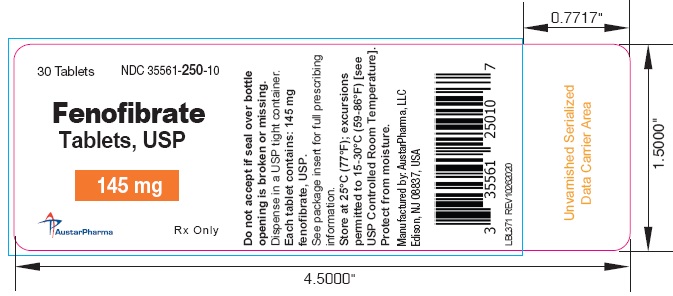
FENOFIBRATE TABS 48 MG 90CT
Generic: Fenofibrate
FENOFIBRATE TABS 48 MG 90CT
Sign up to see pricing
Licensed pharmacies, clinics, doctor's offices, and veterinary practices get instant account approval
Sign Up — Instant ApprovalDrug Information
Identification
Fenofibrate
Fenofibrate
Camber Pharmaceuticals, Inc.
HUMAN PRESCRIPTION DRUG
Administration
TABLET, FILM COATED
ORAL
ANDA204598
Active Ingredients
| Ingredient | Strength |
|---|---|
| FENOFIBRATE | 48 mg/1 |
Pharmacological Class
Data sourced from openFDA / DailyMed. For full prescribing information, consult the drug label.
Wholesale compliance resources
Drug Resources
Clinical Drug Information
Indications & Usage
1 INDICATIONS AND USAGE Fenofibratetablets are indicated as adjunctive therapy to diet: • to reduce triglyceride (TG) levels in adultswith severe hypertriglyceridemia (TG greater than or equal to 500 mg/dL). • to reduce elevated low-density lipoprotein cholesterol (LDL-C) in adults with primary hyperlipidemia when use of recommended LDL-C lowering therapy is notpossible. Limitations of Use • Markedlyelevated levels of serum TG (e.g. > 2,000 mg/dL) may increase the risk of developing pancreatitis. The effect of fenofibrate therapy on reducing this risk has not been determined [see Warnings and Precautions ( 5.7 )]. • Fenofibrate did not reducecoronary heart disease morbidity and mortality in two large, randomized controlled trials of patients with type 2 diabetes mellitus [see Warnings and Precautions ( 5.1 ) and ClinicalStudies ( 14.4 )]. Fenofibrate tablets are a peroxisome proliferator-activated receptor (PPAR) alpha agonist indicated as an adjunct to diet: • to reduce triglyceride (TG) levels in adults with severe hypertriglyceridemia (TG greater than or equal to 500 mg/dL) ( 1 ). • to reduce elevated low-density lipoprotein cholesterol (LDL-C) in adults with primary hyperlipidemia when use of recommended LDL-C lowering therapy is not possible ( 1 ). Limitations of Use: • Markedly elevated levels of serum TG (e.g., >2,000 mg/dL) may increase the risk of developing pancreatitis. The effect of fenofibrate therapy on reducing this risk has not been determined ( 1 ). • Fenofibrate did not reduce coronary heart disease morbidity and mortality in two large, randomized controlled trials of patients with type 2 diabetes mellitus ( 1 ).
Dosage & Administration
2 DOSAGE AND ADMINISTRATION • Severe hypertriglyceridemia: 48 to 145 mg orally once daily; the dosage should be adjusted according to patient response ( 2.2 ). • Primary hyperlipidemia: 145 mg orally once daily ( 2.2 ). • Administer as a single dose, at any time of day, with or without food ( 2.2 ). • Assess TG when clinically appropriate, as early as 4 to 8 weeks after initiating fenofibrate tablets. Discontinue fenofibrate tablets in patients who do not have an adequate response after 2 months of treatment ( 2.2 ). • Renal impairment: Initial dosage of 48 mg orally once daily ( 2.3 ). • Geriatric patients: Select the dosage on the basis of renal function ( 2.4 ). 2.1 Prior to Initiation of Fenofibrate Tablets • Assess lipid levels before initiating therapy. Identify other causes (e.g., diabetes mellitus, hypothyroidism, or medications) of high TG levels and manage as appropriate. • Patients should be placed on an appropriate lipid-lowering diet before receiving fenofibrate tablets, and should continue this diet during treatment with fenofibrate tablets. •In patients with diabetes and fasting chylomicronemia, improve glycemic control prior to considering starting fenofibrate tablets. 2.2 Recommended Dosage and Administration • Severe hypertriglyceridemia: o The recommended dosage of fenofibrate tablets is 48 mg or 145 mg orally once daily. o Dosage should be individualized according to patient response, and should be adjusted if necessary following repeat lipid determinations at 4 to 8 week intervals. • Primary hyperlipidemia: o The recommended dosage of fenofibrate tablets are 145 mg orally once daily. • Administer fenofibrate tablets as a single dose at any time of day, with or without food. • Advise patients to swallow fenofibrate tablets whole. Do not crush, break, dissolve, or chew tablets. •AssessTG when clinically appropriate, as early as 4 to 8 weeks after initiating fenofibrate tablets. Discontinue fenofibrate tablets in patients who do not have an adequate response after 2 months of treatment. • If adose is missed, advise patients not to take an extra dose. Resume treatment with the next dose. • Advise patients to take fenofibrate tablets at least 1 hour before or 4 hours to6 hours after a bile acid binding resin to avoid impeding its absorption. 2.3 Recommended Dosage in Patients with Renal Impairment • Assess renal function prior to initiation of fenofibrate tablets and periodically thereafter [see Warnings and Precautions ( 5.4 )]. • Treatment with fenofibrate tablets should be initiated at a dosage of 48 mg orally once daily in patients with mild to moderately impaired renal function (eGFR 30 to <60 mL/min/1.73 m 2 ), and increased only after evaluation of the effects on renal function and TG levels at this dosage. • Fenofibratetablets are contraindicated in patients with severe renal impairment (eGFR <30 mL/min/1.73 m 2 ), including those with end-stage renal disease (ESRD) and those receivingdialysis [see Use in Specific Populations ( 8.6 ) and Clinical Pharmacology ( 12.3 )]. 2.4 Recommended Dosage in Geriatric Patients Dosage selection for geriatric patients should be made on the basis of renal function [see Use in Specific Populations ( 8.6 ) and Clinical Pharmacology ( 12.3 )].
Adverse Reactions
6 ADVERSE REACTIONS The following serious adverse reactions are described below and elsewhere in the labeling: • Mortality and coronary heart disease morbidity [see Warnings and Precautions ( 5.1 )] • Hepatoxicity [see Warnings and Precautions ( 5.2 )] • Myopathy and Rhabdomyolysis [see Warnings and Precautions ( 5.3 )] • Increases in Serum Creatinine [see Warnings and Precautions ( 5.4 )] • Cholelithiasis [see Warnings and Precautions ( 5.5 )] • Increased Bleeding Risk with Coumarin Anticoagulants [see Warnings and Precautions ( 5.6 )] • Pancreatitis [see Warnings and Precautions ( 5.7 )] • Hematologic Changes [see Warnings and Precautions ( 5.8 )] • Hypersensitivity reactions [see Warnings and Precautions ( 5.9 )] • Venothromboembolic disease [see Warnings and Precautions ( 5.10 )] • Paradoxical Decreases in HDL Cholesterol Levels [see Warnings and Precautions ( 5.11 )] Adverse reactions (≥ 2% and greater than placebo): abnormal liver tests, increased AST, increased ALT, increased CPK, and rhinitis ( 6.1 ). To report SUSPECTED ADVERSE REACTIONS, contact Hetero Labs Limited at 1-866-495-1995 or FDA at 1-800-FDA-1088 or www.fda.gov/medwatch 6.1 Clinical Trials Experience Because clinical trials are conducted under widely varying conditions, adverse reaction rates observed in the clinical trials of a drug cannot be directly compared to rates in the clinical trials of another drug and may not reflect the rates observed in clinical practice. The safety of fenofibrate has been established in adults with hypertriglyceridemia or primary hyperlipidemia based on adequate and well-controlled trials of other formulations of fenofibrate, referenced below as “fenofibrate” [see Clinical Studies ( 14 )] . Dosages of fenofibrate used in these trials were comparable to fenofibrate 145 mg per day [see Clinical Pharmacology ( 12.3 )]. Adverse reactions reported by 2% or more of patients treated with fenofibrate (and greater than placebo) during the double-blind, placebo-controlled trials are listed in Table 1. Adverse reactions led to discontinuation of treatment in 5% of patients treated with fenofibrate and in 3% treated with placebo. Increases in liver function tests were the most frequent events, causing discontinuation of fenofibrate treatment in 1.6% of patients in double-blind trials. Table 1. Adverse Reactions Reported by 2% or More of Patients Treated with Fenofibrate and Greater than Placebo During the Double-Blind, Placebo-Controlled Trials Adverse Reaction Placebo (N =365) Fenofibrate (N = 439) Abnormal Liver Tests 1% 8% Abdominal Pain 4% 5% Increased ALT 2% 3% Increased AST 1% 3% Increased Creatine Phosphokinase 1% 3% Constipation 1% 2% Rhinitis 1% 2% Other Adverse Reactions Urticaria Urticaria was seen in 1.1% vs. 0%, and rash in 1.4% vs. 0.8% of fenofibrate and placebo patients respectively in controlled trials. Increases in Liver Enzymes In a pooled analysis of 10 placebo-controlled trials, increases to >3 times the upper limit of normal in ALT occurred in 5.3% of patients taking either an intermediate or the maximum recommended daily dosage of fenofibrate versus 1.1% of patients treated with placebo. In an 8-week trial, the incidence of ALT or AST elevations ≥ 3 times the upper limit of normal was 13% in patients receiving an intermediate daily dosage or the maximum recommended daily dosage of fenofibrate and was 0% in those receiving the lowest recommended daily dosage of fenofibrate or placebo [see Warnings and Precautions ( 5.2 )]. 6.2 Postmarketing Experience The following adverse reactions have been identified during post-approval use of fenofibrate. Because these reactions are reported voluntarily from a population of uncertain size, it is not always possible to reliably estimate their frequency or establish a causal relationship to drug exposure. Blood: Anemia, white blood cell decreases Gastrointestinal: Pancreatitis General: Asthenia Hepatobiliary: Increased total bilirubin, hepatitis, cirrhosis Immune System: Anaphylaxis, angioedema Lipid Disorders: Severely depressed HDL-cholesterol levels Musculoskeletal: Myalgia, muscle spasms, rhabdomyolysis, arthralgia Renal and Urinary: Acute renal failure Respiratory: Interstitial lung disease Skin and Subcutaneous Tissue: Photosensitivity reactions days to months after initiation. This may occur in patients who report a prior photosensitivity reaction to ketoprofen.
Information for Patients
17 PATIENT COUNSELING INFORMATION Hepatotoxicity Inform patients that fenofibrate may cause liver enzyme elevations and possibly liver failure. Advise patients to promptly report fatigue, anorexia, right upper abdominal discomfort, dark urine or jaundice [see Contraindications ( 4 ) and Warnings and Precautions ( 5.2 )]. Myopathy and Rhabdomyolysis Advise patients that fenofibrate may cause myopathy and rhabdomyolysis. Inform patients that the risk is also increased when taking certain types of medication and they should discuss all medication, both prescription and over the counter, with their healthcare provider. Instruct patients to inform other healthcare providers prescribing a new medication or increasing the dosage of an existing medication that they are taking fenofibrate. Instruct patients to promptly report any unexplained muscle pain, tenderness, or weakness particularly if accompanied by malaise or fever [see Warnings and Precautions ( 5.3 ) and Drug Interactions ( 7 )]. Increased Bleeding Risk with Coumarin Anticoagulants Inform patients that the concomitant use of fenofibrate with coumarin-type anticoagulants may increase the risk of bleeding. Advise patients if they are taking or planning to take coumarin-type anticoagulants to inform their healthcare providers and that increased monitoring may be necessary [see Warnings and Precautions ( 5.6 ) and Drug Interactions ( 7 )]. Hypersensitivity Reactions Inform patients that serious hypersensitivity reactions, such as anaphylaxis and angioedema, have been reported with fenofibrates. Advise patients to report immediately any signs or symptoms suggesting allergic reaction, and to discontinue drug until they have consulted prescribing physicians [see Warnings and Precautions ( 5.9 )]. Pregnancy Advise patients to inform their healthcare provider of a known or suspected pregnancy to discuss if fenofibrate should be discontinued [see Use in Specific Populations ( 8.1 )]. Lactation Advise patients that breastfeeding during treatment with fenofibrate is not recommended [see Use in Specific Populations ( 8.2 )]. Missed Doses If a dose is missed, advise patients to not take an extra dose and to resume treatment with the next dose. Manufactured for: Camber Pharmaceuticals, Inc. Piscataway, NJ 08854 By: HETERO TM Hetero Labs Limited Jeedimetla, Hyderabad - 500 055, India Revised: 07/2025 Camber--logo
Clinical data sourced from openFDA drug labeling. For complete prescribing information, consult the full drug label.