FINASTERIDE TABS 5 MG 90CT
Generic: Finasteride
FINASTERIDE TABS 5 MG 90CT
Sign up to see pricing
Licensed pharmacies, clinics, doctor's offices, and veterinary practices get instant account approval
Sign Up — Instant ApprovalDrug Information
Identification
Finasteride
Finasteride
Camber Pharmaceuticals, Inc.
HUMAN PRESCRIPTION DRUG
Administration
TABLET, FILM COATED
ORAL
ANDA090061
Active Ingredients
| Ingredient | Strength |
|---|---|
| FINASTERIDE | 5 mg/1 |
Pharmacological Class
Data sourced from openFDA / DailyMed. For full prescribing information, consult the drug label.
Wholesale compliance resources
Drug Resources
Clinical Drug Information
Indications & Usage
1 INDICATIONS & USAGE Finasteride tablets, are a 5α-reductase inhibitor, indicated for the treatment of symptomatic benign prostatic hyperplasia (BPH) in men with an enlarged prostate to (1.1): • Improve symptoms • Reduce the risk of acute urinary retention • Reduce the risk of the need for surgery including transurethral resection of the prostate (TURP) and prostatectomy. Finasteride tablets administered in combination with the alpha-blocker doxazosin is indicated to reduce the risk of symptomatic progression of BPH (a confirmed ≥4 point increase in American Urological Association (AUA) symptom score) (1.2). Limitations of Use: Finasteride tablets are not approved for the prevention of prostate cancer (1.3). 1.1 Monotherapy Finasteride tablets are indicated for the treatment of symptomatic benign prostatic hyperplasia (BPH) in men with an enlarged prostate to: -Improve symptoms -Reduce the risk of acute urinary retention -Reduce the risk of the need for surgery including transurethral resection of the prostate (TURP) and prostatectomy. 1.2 Combination with Alpha-Blocker Finasteride tablets administered in combination with the alpha-blocker doxazosin is indicated to reduce the risk of symptomatic progression of BPH (a confirmed ≥4 point increase in American Urological Association (AUA) symptom score). 1.3 Limitations of Use Finasteride tablets are not approved for the prevention of prostate cancer.
Dosage & Administration
2 DOSAGE & ADMINISTRATION Finasteride tablets may be administered with or without meals. Finasteride tablets may be administered with or without meals (2). Monotherapy: One tablet (5 mg) taken once a day (2.1). Combination with Doxazosin: One tablet (5 mg) taken once a day in combination with the alpha-blocker doxazosin (2.2). 2.1 Monotherapy The recommended dose of finasteride tablet is one tablet (5 mg) taken once a day [see Clinical Studies (14.1)]. 2.2 Combination with Alpha-Blocker The recommended dose of finasteride tablet is one tablet (5 mg) taken once a day in combination with the alpha-blocker doxazosin [see Clinical Studies (14.2)].
Adverse Reactions
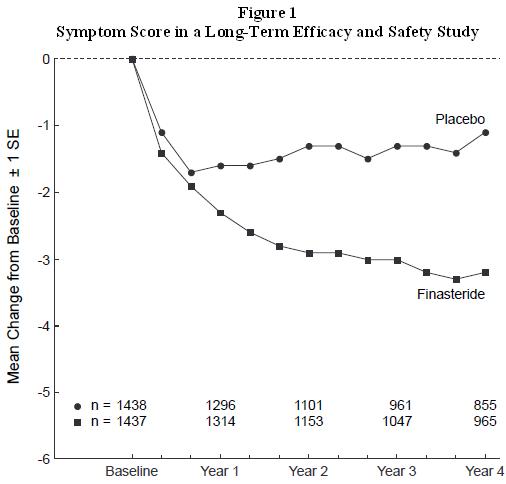
6 ADVERSE REACTIONS The drug-related adverse reactions, reported in ≥1% in patients treated with finasteride and greater than in patients treated with placebo over a 4-year study are: impotence, decreased libido, decreased volume of ejaculate, breast enlargement, breast tenderness and rash (6.1). To report SUSPECTED ADVERSE REACTIONS, contact Hetero Labs Limited at 1-866-495-1995 or FDA at 1-800-FDA-1088 or www.fda.gov/medwatch. 6.1 Clinical Trials Experience Because clinical trials are conducted under widely varying conditions, adverse reaction rates observed in the clinical trials of a drug cannot be directly compared to rates in the clinical trials of another drug and may not reflect the rates observed in clinical practice. 4-Year Placebo-Controlled Study (A Long-Term Efficacy and Safety Study) In a long-term efficacy and safety study, 1524 patients treated with finasteride and 1516 patients treated with placebo were evaluated for safety over a period of 4 years. The most frequently reported adverse reactions were related to sexual function. 3.7% (57 patients) treated with finasteride and 2.1% (32 patients) treated with placebo discontinued therapy as a result of adverse reactions related to sexual function, which are the most frequently reported adverse reactions. Table 1 presents the only clinical adverse reactions considered possibly, probably or definitely drug related by the investigator, for which the incidence on finasteride was ≥1% and greater than placebo over the 4 years of the study. In years 2 to 4 of the study, there was no significant difference between treatment groups in the incidences of impotence, decreased libido and ejaculation disorder. Table 1: Drug-Related Adverse Experiences Year 1 (%) Years 2, 3 and 4* (%) Finasteride Placebo Finasteride Placebo Impotence 8.1 3.7 5.1 5.1 Decreased Libido 6.4 3.4 2.6 2.6 Decreased Volume of Ejaculate 3.7 0.8 1.5 0.5 Ejaculate Disorder 0.8 0.1 0.2 0.1 Breast Enlargement 0.5 0.1 1.8 1.1 Breast Tenderness 0.4 0.1 0.7 0.3 Rash 0.5 0.2 0.5 0.1 *Combined Years 2 to N = 1524 and 1516, finasteride vs placebo, respectively Phase III Studies and 5-Year Open Extensions The adverse experience profile in the 1-year, placebo-controlled, Phase III studies, the 5-year open extensions, and a long-term efficacy and safety study were similar. Medical Therapy of Prostatic Symptoms (MTOPS) Study In the MTOPS study, 3047 men with symptomatic BPH were randomized to receive finasteride 5 mg/day (n=768), doxazosin 4 or 8 mg/day (n=756), the combination of finasteride 5 mg/day and doxazosin 4 or 8 mg/day (n=786), or placebo (n=737) for 4 to 6 years. [See Clinical Studies (14.2).] The incidence rates of drug-related adverse experiences reported by ≥2% of patients in any treatment group in the MTOPS Study are listed in Table 2. The individual adverse effects which occurred more frequently in the combination group compared to either drug alone were: asthenia, postural hypotension, peripheral edema, dizziness, decreased libido, rhinitis, abnormal ejaculation, impotence and abnormal sexual function (see Table 2). Of these, the incidence of abnormal ejaculation in patients receiving combination therapy was comparable to the sum of the incidences of this adverse experience reported for the two monotherapies. Combination therapy with finasteride and doxazosin was associated with no new clinical adverse experience. Four patients in MTOPS reported the adverse experience breast cancer. Three of these patients were on finasteride only and one was on combination therapy. [See Long-Term Data.] The MTOPS Study was not specifically designed to make statistical comparisons between groups for reported adverse experiences. In addition, direct comparisons of safety data between the MTOPS study and previous studies of the single agents may not be appropriate based upon differences in patient population, dosage or dose regimen, and other procedural and study design elements. Table 2: Incidence ≥2% in One or More Treatment Groups Drug-Related Clinical Adverse Experiences in MTOPS Adverse Experience Placebo (N=737) (%) Doxazosin 4 mg or 8 mg* (N=756) (%) Finasteride (N=768) (%) Combination (N=768) (%) Body as a whole Asthenia Headache 7.1 2.3 15.7 4.1 5.3 2.0 16.8 2.3 Cardiovascular Hypotension Postural Hypotension 0.7 8.0 3.4 16.7 1.2 9.1 1.5 17.8 Metabolic and Nutritional Peripheral Edema 0.9 2.6 1.3 3.3 Nervous Dizziness Libido decreased Somnolence 8.1 5.7 1.5 17.7 7.0 3.7 7.4 10.0 1.7 23.2 11.6 3.1 Respiratory Dyspnea Rhinitis 0.7 0.5 2.1 1.3 0.7 1.0 1.9 2.4 Urogenital Abnormal Ejaculation Gynecomastia Impotence Sexual Function Abnormal 2.3 0.7 12.2 0.9 4.5 1.1 14.4 2.0 7.2 2.2 18.5 2.5 14.1 1.5 22.6 3.1 *Doxazosin dose was achieved by weekly titration (1 to 2 to 4 to 8 mg). The final tolerated dose (4 mg or 8 mg) was administered at end-Week 4. Only those patients tolerating at least 4 mg were kept on doxazosin. The majority of patients received the 8-mg dose over the duration of the study. Long-Term Data High-Grade Prostate Cancer The PCPT trial was a 7-year randomized, double-blind, placebo-controlled trial that enrolled 18,882 men ≥55 years of age with a normal digital rectal examination and a PSA ≤3.0 ng/mL. Men received either finasteride 5 mg or placebo daily. Patients were evaluated annually with PSA and digital rectal exams. Biopsies were performed for elevated PSA, an abnormal digital rectal exam, or the end of study. The incidence of Gleason score 8 to 10 prostate cancer was higher in men treated with finasteride (1.8%) than in those treated with placebo (1.1%) [see Indications and Usage (1.3) and Warnings and Precautions (5.2)]. In a 4-year placebo-controlled clinical trial with another 5α-reductase inhibitor (dutasteride, AVODART), similar results for Gleason score 8 to 10 prostate cancer were observed (1% dutasteride vs 0.5% placebo). No clinical benefit has been demonstrated in patients with prostate cancer treated with finasteride. Breast Cancer During the 4- to 6-year placebo- and comparator-controlled MTOPS study that enrolled 3047 men, there were 4 cases of breast cancer in men treated with finasteride but no cases in men not treated with finasteride. During the 4-year, placebo-controlled long-term efficacy and safety study that enrolled 3040 men, there were 2 cases of breast cancer in placebo-treated men but no cases in men treated with finasteride. During the 7-year placebo-controlled Prostate Cancer Prevention Trial (PCPT) that enrolled 18,882 men, there was 1 case of breast cancer in men treated with finasteride, and 1 case of breast cancer in men treated with placebo. The relationship between long-term use of finasteride and male breast neoplasia is currently unknown. Sexual Function There is no evidence of increased sexual adverse experiences with increased duration of treatment with finasteride. New reports of drug-related sexual adverse experiences decreased with duration of therapy. 6.2 Postmarketing Experience The following additional adverse events have been reported in postmarketing experience with finasteride. Because these events are reported voluntarily from a population of uncertain size, it is not always possible to reliably estimate their frequency or establish a causal relationship to drug exposure: - hypersensitivity reactions, such as pruritus, urticaria, and angioedema (including swelling of the lips, tongue, throat, and face) - testicular pain - hematospermia - sexual dysfunction that continued after discontinuation of treatment, including erectile dysfunction, decreased libido and ejaculation disorders (e.g. reduced ejaculate volume). These events were reported rarely in men taking finasteride for the treatment of BPH. Most men were older and were taking concomitant medications and/or had co-morbid conditions. The independent role of finasteride in these events is unknown. - male infertility and/or poor seminal quality were reported rarely in men taking finasteride for the treatment of BPH. Normalization or improvement of poor seminal quality has been reported after discontinuation of finasteride. The independent role of finasteride in these events is unknown. - depression - male breast cancer. The following additional adverse event related to sexual dysfunction that continued after discontinuation of treatment has been reported in postmarketing experience with finasteride at lower doses used to treat male pattern baldness. Because the event is reported voluntarily from a population of uncertain size, it is not always possible to reliably estimate its frequency or establish a causal relationship to drug exposure: - orgasm disorders
Information for Patients
17 PATIENT COUNSELING INFORMATION Advise the patient to read the FDA-approved patient labeling (Patient Information). 17.1 Increased Risk of High-Grade Prostate Cancer Patients should be informed that there was an increase in high-grade prostate cancer in men treated with 5α-reductase inhibitors indicated for BPH treatment, including finasteride tablets, compared to those treated with placebo in studies looking at the use of these drugs to prevent prostate cancer [see Indications and Usage (1.3), Warnings and Precautions (5.2), and Adverse Reactions (6.1)]. 17.2 Exposure of Women-Risk to Male Fetus Physicians should inform patients that females who are pregnant or may potentially be pregnant should not handle crushed or broken finasteride tablets because of the possibility of absorption of finasteride and the subsequent potential risk to the male fetus. Finasteride tablets are coated and will prevent contact with the active ingredient during normal handling, provided that the tablets have not been broken or crushed. If a female who is pregnant or may potentially be pregnant comes in contact with crushed or broken finasteride tablets, the contact area should be washed immediately with soap and water [see Contraindications (4), Warnings and Precautions (5.3), Use in Specific Populations (8.1) and How Supplied/Storage and Handling (16)]. 17.3 Additional Instructions Physicians should inform patients that the volume of ejaculate may be decreased in some patients during treatment with finasteride tablets. This decrease does not appear to interfere with normal sexual function. However, impotence and decreased libido may occur in patients treated with finasteride tablets [see Adverse Reactions (6.1)]. Physicians should instruct their patients to promptly report any changes in their breasts such as lumps, pain or nipple discharge. Breast changes including breast enlargement, tenderness and neoplasm have been reported [see Adverse Reactions (6.1)]. Physicians should instruct their patients to read the patient package insert before starting therapy with finasteride tablets and to reread it each time the prescription is renewed so that they are aware of current information for patients regarding finasteride tablets. Manufactured for: Camber Pharmaceuticals, Inc. Piscataway, NJ 08854 Manufactured by: HETERO TM HETERO LABS LIMITED Jeedimetla, Hyderabad-500 055, India. or Manufactured by: HETERO TM HETERO LABS LIMITED Unit V, Polepally, Jadcherla, Mahaboob Nagar-509 301, India. or Manufactured by: Ascent Pharmaceuticals, Inc. Central Islip, NY 11722 address.jpg
Clinical data sourced from openFDA drug labeling. For complete prescribing information, consult the full drug label.