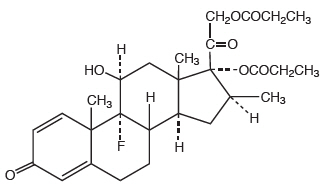
BETAMETHASONE DIPROPIONATE CREAM USP, 0.0005 15 G
Generic: Betamethasone Dipropionate
BETAMETHASONE DIPROPIONATE CREAM USP, 0.0005 15 G
Sign up to see pricing
Licensed pharmacies, clinics, doctor's offices, and veterinary practices get instant account approval
Sign Up — Instant ApprovalDrug Information
Identification
Betamethasone Dipropionate
Betamethasone Dipropionate
Sun Pharmaceutical Industries, Inc.
HUMAN PRESCRIPTION DRUG
Administration
CREAM
TOPICAL
ANDA073552
Active Ingredients
| Ingredient | Strength |
|---|---|
| BETAMETHASONE DIPROPIONATE | .5 mg/g |
Pharmacological Class
Data sourced from openFDA / DailyMed. For full prescribing information, consult the drug label.
Wholesale compliance resources
Clinical Drug Information
Indications & Usage
INDICATIONS AND USAGE Betamethasone dipropionate cream is a medium-potency corticosteroid indicated for relief of the inflammatory and pruritic manifestations of corticosteroid responsive dermatoses in patients 13 years and older.
Dosage & Administration
DOSAGE AND ADMINISTRATION Apply a thin film of betamethasone dipropionate cream USP, 0.05% to the affected skin areas once daily. In some cases, twice-daily dosage may be necessary. Betamethasone dipropionate cream USP, 0.05% should not be used with occlusive dressings.
Adverse Reactions
ADVERSE REACTIONS The following local adverse reactions are reported infrequently when betamethasone dipropionate cream USP, 0.05% is used as recommended in the DOSAGE AND ADMINISTRATION section. These reactions are listed in an approximate decreasing order of occurrence: burning, itching, irritation, dryness, folliculitis, hypertrichosis, acneiform eruptions, hypopigmentation, perioral dermatitis, allergic contact dermatitis, maceration of the skin, secondary infections, skin atrophy, striae and miliaria. Adverse reactions reported to be possibly or probably related to treatment with betamethasone dipropionate cream during a pedatric clinical study include signs of skin atrophy (brusing, shininess). Skin atrophy occurred in 3 of 63 (5%) patients, a 3-year old, a 5-year old, and a 7-year old. Systemic absorption of topical corticosteroids has produced reversible hypothalamic-pituitary-adrenal (HPA) axis suppression, manifestations of Cushing's syndrome, hyperglycemia, and glucosuria in some patients.
Information for Patients
Information for Patients This information is intended to aid in the safe and effective use of this medication. It is not a disclosure of all possible adverse or intended effects. Patients using topical corticosteroids should receive the following information and instructions: This medication is to be used as directed by the physician. It is for external use only. Avoid contact with the eyes. Patients should be advised not to use this medication for any disorder other than that for which it was prescribed. The treated skin area should not be bandaged or otherwise covered or wrapped as to be occlusive. (See DOSAGE AND ADMINISTRATION .) Patients should report any signs of local adverse reactions. Other corticosteroid-containing products should not be used with betamethasone dipropionate cream without first talking to your physician.
Clinical data sourced from openFDA drug labeling. For complete prescribing information, consult the full drug label.