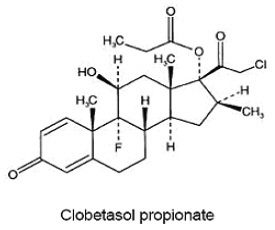
CLOBETASOL PROPIONATE LOTION USP, 0.0005 59 ML
Generic: clobetasol propionate
CLOBETASOL PROPIONATE LOTION USP, 0.0005 59 ML
Sign up to see pricing
Licensed pharmacies, clinics, doctor's offices, and veterinary practices get instant account approval
Sign Up — Instant ApprovalDrug Information
Identification
clobetasol propionate
Clobetasol Propionate
Sun Pharmaceutical Industries, Inc.
HUMAN PRESCRIPTION DRUG
Administration
LOTION
TOPICAL
ANDA200302
Active Ingredients
| Ingredient | Strength |
|---|---|
| CLOBETASOL PROPIONATE | .5 mg/mL |
Pharmacological Class
Data sourced from openFDA / DailyMed. For full prescribing information, consult the drug label.
Wholesale compliance resources
Drug Resources
Clinical Drug Information
Indications & Usage
1 INDICATIONS AND USAGE Clobetasol propionate lotion, 0.05% is a corticosteroid indicated for the relief of the inflammatory and pruritic manifestations of corticosteroid-responsive dermatoses, in patients 18 years of age or older ( 1.1 ). Limitations of Use: Do not use on the face, axillae or groin. ( 1.2 ) Do not use if atrophy is present at the treatment site. ( 1.2 ) Do not use for rosacea or perioral dermatitis. ( 1.2 ) 1.1 Indication Clobetasol propionate lotion, 0.05% is a super-high potent topical corticosteroid formulation indicated for the relief of the inflammatory and pruritic manifestations of corticosteroid-responsive dermatoses only in patients 18 years of age or older. Treatment should be limited to 2 consecutive weeks. For moderate to severe plaque psoriasis, treatment may be extended for an additional 2 weeks for localized lesions (less than 10% body surface area) that have not sufficiently improved after the initial 2-week treatment. Any additional benefits of extending treatment should be weighed against the risk of hypothalamic-pituitary-adrenal (HPA) axis suppression before prescribing for more than 2 weeks. The total dosage should not exceed 50 g (50 mL or 1.75 fl. oz) per week. Patients should be instructed to use clobetasol propionate lotion, 0.05% for the minimum amount of time necessary to achieve the desired results [ see Dosage and Administration (2) ]. Use in patients under 18 years of age is not recommended due to numerically high rates of HPA axis suppression [ see Warnings and Precautions (5.1) and Use in Specific Populations (8.4) ]. 1.2 Limitations of Use Clobetasol propionate lotion, 0.05% should not be used on the face, axillae, or groin and should not be used if there is atrophy at the treatment site. Clobetasol propionate lotion, 0.05% should not be used in the treatment of rosacea or perioral dermatitis.
Dosage & Administration
2 DOSAGE AND ADMINISTRATION Clobetasol propionate lotion, 0.05% is for topical use only, and not for ophthalmic, oral or intravaginal use. Clobetasol propionate lotion, 0.05% should be applied to the affected skin areas twice daily and rubbed in gently and completely. The total dosage should not exceed 50 g (50 mL or 1.75 fl. oz.) per week because of the potential for the drug to suppress the hypothalamic-pituitary-adrenal (HPA) axis. Clobetasol propionate lotion, 0.05% contains a topical corticosteroid; therefore treatment should be limited to 2 consecutive weeks for the relief of the inflammatory and pruritic manifestations of corticosteroid-responsive dermatoses and up to 2 additional weeks in localized lesions (less than 10% body surface area) of moderate to severe plaque psoriasis that have not sufficiently improved after the initial 2 weeks of treatment with clobetasol propionate lotion, 0.05%. Unless directed by physician, clobetasol propionate lotion, 0.05% should not be used with occlusive dressings. Not for oral, ophthalmic, or intravaginal use. ( 2 ) Clobetasol propionate lotion, 0.05% should be applied directly onto the affected skin areas twice daily and rubbed in gently. ( 2 ) Clobetasol propionate lotion, 0.05% contains a super-high potent topical corticosteroid; therefore treatment should be limited to 2 weeks. For moderate to severe plaque psoriasis, treatment may be extended for additional 2 weeks for localized lesions (<10% body surface area) that have not sufficiently improved. ( 2 ) Total dosage should not exceed 50 g (50 mL or 1.75 fl. oz.) per week. ( 2 )
Adverse Reactions
6 ADVERSE REACTIONS The most common adverse reactions (incidence > 1%) are skin atrophy, telangiectasia, discomfort skin and skin dry ( 6.1 ). To report SUSPECTED ADVERSE REACTIONS, contact Taro at 1-866-923-4914 or FDA at 1-800-FDA-1088 or www.fda.gov/medwatch . 6.1 Clinical Trials Experience Because clinical trials are conducted under widely varying conditions, adverse reaction rates observed in the clinical trials of a drug cannot be directly compared to rates in the clinical trials of another drug and may not reflect the rates observed in practice. In controlled, clinical trials with clobetasol propionate lotion, 0.05%, the following adverse reactions have been reported: burning/stinging, skin dryness, irritation, erythema, folliculitis, pruritus, skin atrophy, and telangiectasia. The pooled incidence of local adverse reactions in trials for psoriasis and atopic dermatitis with clobetasol propionate lotion, 0.05% at 1% or greater was: Table 1: Adverse Reactions with Incidence ≥ 1% in Clinical Trials Adverse Reaction Incidence Skin Atrophy 4.2% Telangiectasia 3.2% Discomfort Skin 1.3% Skin Dry 1.0% Most local adverse events were rated as mild to moderate and they are not affected by age, race or gender. Systemic absorption of topical corticosteroids has produced hypothalamic-pituitary-adrenal (HPA) axis suppression, manifestations of Cushing's syndrome, hyperglycemia, and glucosuria in some patients. 6.2 Postmarketing Experience Because these reactions are reported voluntarily from a population of uncertain size, it is not always possible to reliably estimate their frequency or establish a causal relationship to drug exposure. The following adverse reactions have been identified during post-approval use of clobetasol propionate lotion, 0.05%. Endocrine disorders: Cushing's syndrome, Adrenal suppression Skin: Rash, Pain of skin, Skin exfoliation, Skin chapped, Scaling, Induration/papulation, Lichenification. Other: Psoriasis (aggravation), Plaque elevation, Excoriation.
Information for Patients
17 PATIENT COUNSELING INFORMATION See FDA-approved patient labeling (Patient Information) Information for Patients Inform the patient using topical corticosteroids to adhere to the following instructions: This medication is to be used as directed by the physician and should not be used longer than the prescribed time period. This medication should not be used for any disorder other than that for which it was prescribed. Do not use other corticosteroid-containing products while using clobetasol propionate lotion, 0.05%. The treated skin area should not be bandaged, otherwise covered, or wrapped so as to be occlusive unless directed by the physician. Patients should wash their hands after applying the medication. Patients should report any signs of local or systemic adverse reactions to the physician. Patients should inform their physicians that they are using clobetasol propionate lotion, 0.05% if surgery is contemplated. This medication is for external use only. It should not be used on the face, underarms, or groin area, and avoid contact with the eyes and lips. As with other corticosteroids, therapy should be discontinued when control is achieved. If no improvement is seen within 2 weeks, contact the physician. Patients should be informed to not use more than 50 g (50 mL or 1.75 fl. oz.) per week of clobetasol propionate lotion, 0.05%.
Clinical data sourced from openFDA drug labeling. For complete prescribing information, consult the full drug label.