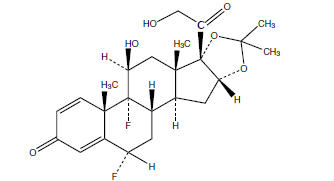
FLUOCINOLONE ACETONIDE TOPICAL BODY OIL 0.0001 118 ML
Generic: Fluocinolone Acetonide
FLUOCINOLONE ACETONIDE TOPICAL BODY OIL 0.0001 118 ML
Sign up to see pricing
Licensed pharmacies, clinics, doctor's offices, and veterinary practices get instant account approval
Sign Up — Instant ApprovalDrug Information
Identification
Fluocinolone Acetonide
Fluocinolone Acetonide
Sun Pharmaceutical Industries, Inc.
HUMAN PRESCRIPTION DRUG
Administration
OIL
TOPICAL
ANDA202368
Active Ingredients
| Ingredient | Strength |
|---|---|
| FLUOCINOLONE ACETONIDE | .11 mg/118.28mL |
Pharmacological Class
Data sourced from openFDA / DailyMed. For full prescribing information, consult the drug label.
Wholesale compliance resources
Drug Resources
Clinical Drug Information
Indications & Usage
1 INDICATIONS AND USAGE Fluocinolone acetonide topical oil is a corticosteroid indicated for the topical treatment of atopic dermatitis in adult patients ( 1.1 ) topical treatment of moderate to severe atopic dermatitis in pediatric patients 3 months and older for up to 4 weeks ( 1.2 ) Limitations of Use: Apply the least amount to cover affected areas. Discontinue when disease is controlled. ( 1.3 ) Do not use in the diaper area. ( 1.3 ) Do not use on the face, axillae, or groin. ( 1.3 , 6.2 , 8.4 ) 1.1 Adult Patients with Atopic Dermatitis Fluocinolone acetonide topical oil is indicated for the topical treatment of atopic dermatitis in adult patients. 1.2 Pediatric Patients with Atopic Dermatitis Fluocinolone acetonide topical oil is indicated for the topical treatment of moderate to severe atopic dermatitis in pediatric patients, 3 months and older for up to 4 weeks. Safety and effectiveness in pediatric patients younger than 3 months of age have not been established. 1.3 Limitations of Use Apply the least amount of fluocinolone acetonide topical oil needed to cover the affected areas. As with other corticosteroids, fluocinolone acetonide topical oil should be discontinued when control of disease is achieved. Contact the physician if no improvement is seen within 2 weeks. Fluocinolone acetonide topical oil should not be applied to the diaper area; diapers or plastic pants may constitute occlusive use. Fluocinolone acetonide topical oil should not be used on the face, axillae, or groin unless directed by the physician. Application to intertriginous areas should be avoided due to the increased risk of local adverse reactions. [ see Adverse Reactions (6) and Use in Specific Populations (8.4) ].
Dosage & Administration
2 DOSAGE AND ADMINISTRATION Fluocinolone acetonide topical oil is not for oral, ophthalmic, or intravaginal use. The dosing of fluocinolone acetonide topical oil is different for adult and pediatric patients. Fluocinolone acetonide topical oil is not for oral, ophthalmic, or intravaginal use. ( 2 ) Adult patients: Apply to affected areas 3 times daily. ( 2.1 ) Pediatric patients: Moisten skin and apply to affected areas twice daily for up to 4 weeks. ( 2.2 ) 2.1 Adult Patients with Atopic Dermatitis Apply fluocinolone acetonide topical oil as a thin film to the affected areas three times daily . 2.2 Pediatric Patients with Atopic Dermatitis Moisten skin and apply fluocinolone acetonide topical oil as a thin film to the affected areas twice daily for up to four weeks .
Adverse Reactions
6 ADVERSE REACTIONS Because clinical trials are conducted under widely varying conditions, adverse reaction rates observed in the clinical trials of a drug cannot be directly compared to rates in the clinical trials of another drug and may not reflect the rates observed in practice. The most common adverse reactions (≥ 5%) were cough (20%), rhinorrhea (13%), pyrexia (10%), telangiectasia (7%), nasopharyngitis (7%), and hypopigmentation (7%). To report SUSPECTED ADVERSE REACTIONS, contact Taro Pharmaceuticals U.S.A., Inc. at 1-866-923-4914, or FDA at 1-800-FDA-1088 or www.fda.gov/medwatch. 6.1 Clinical Studies Experience: Evaluation of Facial Use in Pediatric Subjects An open-label study was conducted in 58 children with moderate to severe atopic dermatitis (2 to 12 years old) to evaluate the safety of fluocinolone acetonide topical oil when applied to the face twice daily for 4 weeks. The following adverse reactions were reported: Incidence of Adverse Reactions (%), N=58 Adverse Reaction (AR) The number of individual adverse reactions reported does not necessarily reflect the number of individual subjects, since one subject could have multiple reporting of an adverse reaction. # of subjects (%) Day 14 Day 28 End of Treatment Day 56 Four Weeks Post Treatment Any AE 15 (26) 6 (10) 7 (12) 7 (12) Telangiectasia 5 (9) 3 (5) 4 (7) 2 (4) Erythema 3 (5) 3 (5) Itching 3 (5) 3 (5) Irritation 3 (5) 3 (5) Burning 3 (5) 3 (5) Hypopigmentation 2 (4) 2 (4) Shiny Skin 1 (2) 1 (2) Secondary atopic dermatitis 1 (2) 1 (2) Papules and pustules 1 (2) 1 (2) Keratosis pilaris 1 (2) 1 (2) Folliculitis 1 (2) 1 (2) Facial herpes simplex 1 (2) 1 (2) Acneiform eruption 1 (2) 1 (2) Ear infection 1 (2) 1 (2) 6.2 Clinical Studies Experience: Evaluation in Pediatric Subjects 3 months to 2 years old An open-label safety study was conducted in 29 children to assess the HPA axis by ACTH stimulation testing following use of fluocinolone acetonide topical oil twice daily for 4 weeks. The following adverse reactions were reported in the study [ See Use in Specific Populations (8.4) ]: Adverse Reactions (%), N=30 Includes one subject who withdrew at Week 2 Adverse Reaction # of subjects (%) Diarrhea 1 (3) Vomiting 1 (3) Pyrexia 3 (10) Abscess 1 (3) Molluscum 1 (3) Nasopharyngitis 2 (7) URI 1 (3) Otitis media 1 (3) Cough 6 (20) Rhinorrhea 4 (13) Atopic dermatitis 1 (3) Eczema 1 (3) Hyperpigmentation 1 (3) Hypopigmentation 2 (7) Rash 1 (3)
Information for Patients
17 PATIENT COUNSELING INFORMATION 17.1 Instructions Fluocinolone acetonide topical oil should be used as directed by the physician. It is for external use only. Avoid contact with the eyes. In case of contact, wash eyes liberally with water. Fluocinolone acetonide topical oil should not be used for any disorder other than that for which it was prescribed. Patients should report any worsening of their skin condition to their physician promptly. Fluocinolone acetonide topical oil should not be applied under occlusion unless directed by the physician. Fluocinolone acetonide topical oil should not be applied to the diaper area as diapers or plastic pants may constitute occlusive use. Fluocinolone acetonide topical oil should not be used on the face, axillae, or groin unless directed by the physician. As with other corticosteroids, therapy should be discontinued when control of disease is achieved. Contact the physician if no improvement is seen within 2 weeks. Do not use other corticosteroid-containing products while using fluocinolone acetonide topical oil without first consulting your physician.
Clinical data sourced from openFDA drug labeling. For complete prescribing information, consult the full drug label.