DROSPIRENONE AND ETHINYL ESTRADIAL 3MG/0.02MG 3X28 TAB
Generic: Drospirenone and Ethinyl Estradiol Tablets
DROSPIRENONE AND ETHINYL ESTRADIAL 3MG/0.02MG 3X28 TAB
Sign up to see pricing
Licensed pharmacies, clinics, doctor's offices, and veterinary practices get instant account approval
Sign Up — Instant ApprovalDrug Information
Identification
Drospirenone and Ethinyl Estradiol Tablets
LORYNA
Xiromed, LLC.
HUMAN PRESCRIPTION DRUG
Administration
KIT
ANDA079221
Data sourced from openFDA / DailyMed. For full prescribing information, consult the drug label.
Wholesale compliance resources
Clinical Drug Information
Indications & Usage
1 INDICATIONS AND USAGE Loryna (drospirenone and ethinyl estradiol tablets) is an estrogen/progestin COC, indicated for use by women to: Prevent pregnancy. ( 1.1 ) Treat symptoms of premenstrual dysphoric disorder (PMDD) for women who choose to use an oral contraceptive for contraception. ( 1.2 ) Treat moderate acne for women at least 14 years old only if the patient desires an oral contraceptive for birth control. ( 1.3 ) 1.1 Oral Contraceptive Loryna (drospirenone and ethinyl estradiol tablets) are indicated for use by women to prevent pregnancy. 1.2 Premenstrual Dysphoric Disorder (PMDD) Loryna is also indicated for the treatment of symptoms of premenstrual dysphoric disorder (PMDD) in women who choose to use an oral contraceptive as their method of contraception. The effectiveness of Loryna for PMDD when used for more than three menstrual cycles has not been evaluated. The essential features of PMDD according to the Diagnostic and Statistical Manual-4th edition (DSM-IV) include markedly depressed mood, anxiety or tension, affective lability, and persistent anger or irritability. Other features include decreased interest in usual activities, difficulty concentrating, lack of energy, change in appetite or sleep, and feeling out of control. Physical symptoms associated with PMDD include breast tenderness, headache, joint and muscle pain, bloating and weight gain. In this disorder, these symptoms occur regularly during the luteal phase and remit within a few days following onset of menses; the disturbance markedly interferes with work or school, or with usual social activities and relationships with others. Diagnosis is made by healthcare providers according to DSM-IV criteria, with symptomatology assessed prospectively over at least two menstrual cycles. In making the diagnosis, care should be taken to rule out other cyclical mood disorders. Loryna has not been evaluated for the treatment of premenstrual syndrome (PMS). 1.3 Acne Loryna tablets are indicated for the treatment of moderate acne vulgaris in women at least 14 years of age, who have no known contraindications to oral contraceptive therapy and have achieved menarche. Drospirenone and ethinyl estradiol tablets should be used for the treatment of acne only if the patient desires an oral contraceptive for birth control.
Dosage & Administration
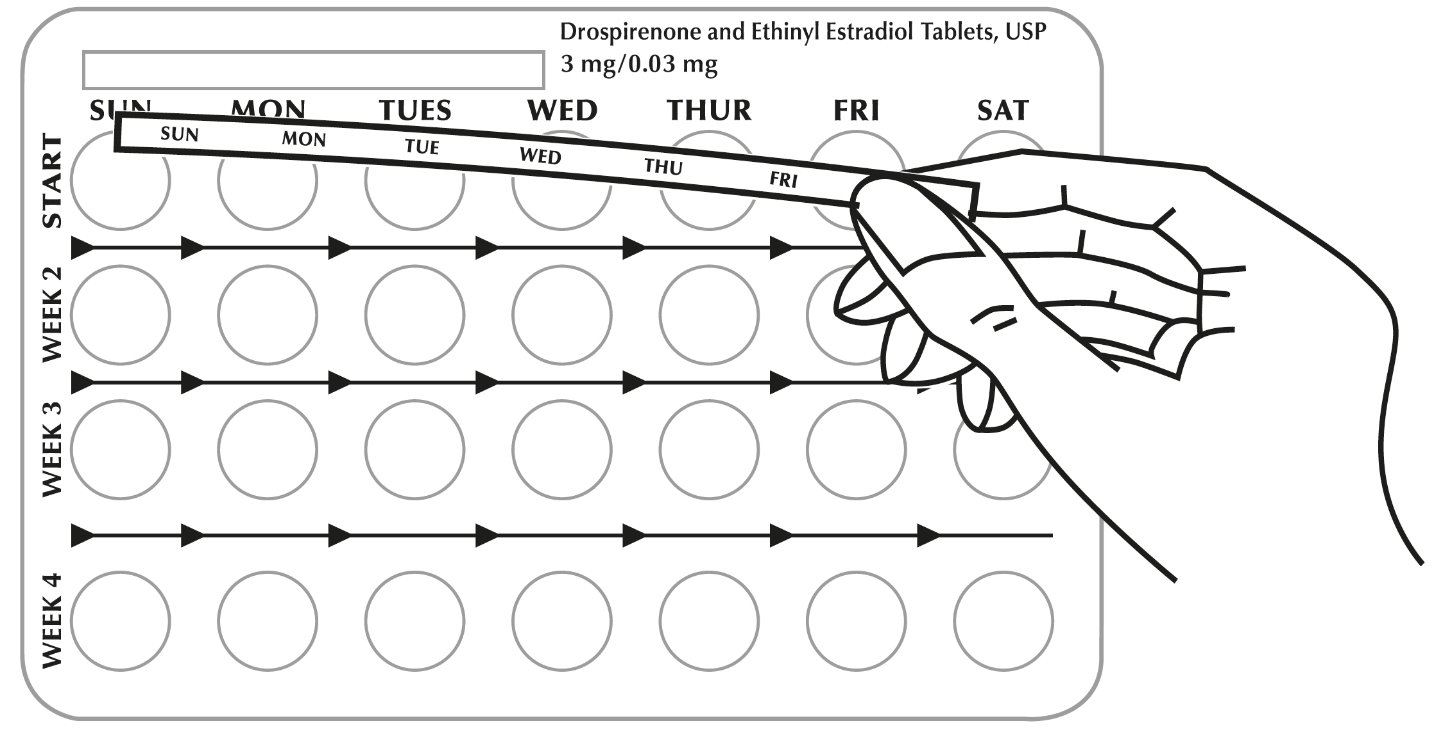
2 DOSAGE AND ADMINISTRATION • Take one tablet daily by mouth at the same time every day. ( 2.1 ) • Tablets must be taken in the order directed on the blister pack. ( 2.1 ) 2.1 How to Take Loryna (drospirenone and ethinyl estradiol tablets) Take one tablet by mouth at the same time every day. The failure rate may increase when pills are missed or taken incorrectly. To achieve maximum contraceptive and PMDD effectiveness, drospirenone and ethinyl estradiol tablets must be taken exactly as directed, in the order directed on the blister pack. Single missed pills should be taken as soon as remembered. 2.2 How to Start Loryna (drospirenone and ethinyl estradiol tablets) Instruct the patient to begin taking Loryna tablets either on the first day of her menstrual period (Day 1 Start) or on the first Sunday after the onset of her menstrual period (Sunday Start). Day 1 Start During the first cycle of Loryna tablets use, instruct the patient to take one peach drospirenone and ethinyl estradiol tablet daily, beginning on Day 1 of her menstrual cycle. (The first day of menstruation is Day 1.) She should take one peach Loryna tablet daily for 24 consecutive days, followed by one white inert tablet daily on Days 25 through 28. Loryna tablets should be taken in the order directed on the package at the same time each day, preferably after the evening meal or at bedtime with some liquid, as needed. Loryna tablets can be taken without regard to meals. If drospirenone and ethinyl estradiol tablets are first taken later than the first day of the menstrual cycle, Loryna tablets should not be considered effective as a contraceptive until after the first 7 consecutive days of product administration. Instruct the patient to use a non-hormonal contraceptive as back-up during the first 7 days. The possibility of ovulation and conception prior to initiation of medication should be considered. Sunday Start During the first cycle of Loryna tablets use, instruct the patient to take one peach Loryna tablet daily, beginning on the first Sunday after the onset of her menstrual period. She should take one peach Loryna tablet daily for 24 consecutive days, followed by one white inert tablet daily on Days 25 through 28. Loryna tablets should be taken in the order directed on the package at the same time each day, preferably after the evening meal or at bedtime with some liquid, as needed. Loryna tablets can be taken without regard to meals. Loryna tablets should not be considered effective as a contraceptive until after the first 7 consecutive days of product administration. Instruct the patient to use a non-hormonal contraceptive as back-up during the first 7 days. The possibility of ovulation and conception prior to initiation of medication should be considered. The patient should begin her next and all subsequent 28-day regimens of Loryna tablets on the same day of the week that she began her first regimen, following the same schedule. She should begin taking her peach tablets on the next day after ingestion of the last white tablet, regardless of whether or not a menstrual period has occurred or is still in progress. Anytime a subsequent cycle of Loryna tablets are started later than the day following administration of the last white tablet, the patient should use another method of contraception until she has taken a peach Loryna tablets daily for seven consecutive days. When switching from a different birth control pill When switching from another birth control pill, Loryna tablets should be started on the same day that a new pack of the previous oral contraceptive would have been started. When switching from a method other than a birth control pill When switching from a transdermal patch or vaginal ring, Loryna tablets should be started when the next application would have been due. When switching from an injection, Loryna tablets should be started when the next dose would have been due. When switching from an intrauterine contraceptive or an implant, Loryna tablets should be started on the day of removal. Withdrawal bleeding usually occurs within 3 days following the last peach tablet. If spotting or breakthrough bleeding occurs while taking Loryna tablets, instruct the patient to continue taking Loryna tablets by the regimen described above. Counsel her that this type of bleeding is usually transient and without significance; however, advise her that if the bleeding is persistent or prolonged, she should consult her healthcare provider. Although the occurrence of pregnancy is low if Loryna tablets are taken according to directions, if withdrawal bleeding does not occur, consider the possibility of pregnancy. If the patient has not adhered to the prescribed dosing schedule (missed one or more active tablets or started taking them on a day later than she should have), consider the possibility of pregnancy at the time of the first missed period and take appropriate diagnostic measures. If the patient has adhered to the prescribed regimen and misses two consecutive periods, rule out pregnancy. Discontinue Loryna tablets if pregnancy is confirmed. The risk of pregnancy increases with each active peach tablet missed. For additional patient instructions regarding missed pills, see the "WHAT TO DO IF YOU MISS PILLS" section in the FDA Approved Patient Labeling . If breakthrough bleeding occurs following missed tablets, it will usually be transient and of no consequence. If the patient misses one or more white tablets, she should still be protected against pregnancy provided she begins taking a new cycle of peach tablets on the proper day. For postpartum women who do not breastfeed or after a second trimester abortion, start Loryna tablets no earlier than 4 weeks postpartum due to the increased risk of thromboembolism. If the patient starts on Loryna tablets postpartum and has not yet had a period, evaluate for possible pregnancy, and instruct her to use an additional method of contraception until she has taken Loryna tablets for 7 consecutive days. 2.3 Advice in Case of Gastrointestinal Disturbances In case of severe vomiting or diarrhea, absorption may not be complete and additional contraceptive measures should be taken. If vomiting occurs within 3 to 4 hours after tablet-taking, this can be regarded as a missed tablet.
Adverse Reactions
6 ADVERSE REACTIONS The following serious adverse reactions with the use of COCs are discussed elsewhere in the labeling: •Serious cardiovascular events and stroke [see BOXED WARNING and WARNINGS AND PRECAUTIONS ( 5.1 ) ] •Vascular events [see WARNINGS AND PRECAUTIONS ( 5.1 ) ] •Liver disease [see WARNINGS AND PRECAUTIONS ( 5.4 ) ] Adverse reactions commonly reported by COC users are: •Irregular uterine bleeding •Nausea •Breast tenderness •Headache The most frequent adverse reactions (≥ 2%) in contraception and acne clinical trials were: headache/migraine (6.7%), menstrual irregularities (4.7%), nausea/vomiting (4.2%), breast pain/tenderness (4.0%) and mood changes (2.2%). ( 6.1 ) The most frequent adverse reactions (≥ 2%) in PMDD clinical trials were: menstrual irregularities (24.9%), nausea (15.8%), headache (13.0%), breast tenderness (10.5%), fatigue (4.2%), irritability (2.8%), decreased libido (2.8%), increased weight (2.5%), and affect lability (2.1%). ( 6.1 ) To report SUSPECTED ADVERSE REACTIONS, contact Xiromed, LLC. At 1-844-XIROMED (844-947-6633) or FDA at 1-800-FDA-1088 or www.fda.gov/medwatch 6.1 Clinical Trials Experience Because clinical trials are conducted under widely varying conditions, adverse reaction rates observed in the clinical trials of a drug cannot be directly compared to rates in the clinical trials of another drug and may not reflect the rates observed in practice. Contraception and Acne Clinical Trials The data provided reflect the experience with the use of drospirenone and ethinyl estradiol in the adequate and well-controlled studies for contraception (N=1,056) and for moderate acne vulgaris (N=536). For contraception, a Phase 3, multicenter, multinational, open-label study was conducted to evaluate safety and efficacy up to one year in 1,027 women aged 17 to 36 who took at least one dose of drospirenone and ethinyl estradiol. A second Phase 3 study was a single center, open-label, active-controlled study to evaluate the effect of 7 28-day cycles of drospirenone and ethinyl estradiol on carbohydrate metabolism, lipids and hemostasis in 29 women aged 18 to 35. For acne, two multicenter, double-blind, randomized, placebo-controlled studies, in 536 women aged 14 to 45 with moderate acne vulgaris who took at least one dose of drospirenone and ethinyl estradiol, evaluated the safety and efficacy during up to 6 cycles. The adverse reactions seen across the 2 indications overlapped, and are reported using the frequencies from the pooled dataset. The most common adverse reactions (≥ 2% of users) were: headache/migraine (6.7%), menstrual irregularities (including vaginal hemorrhage [primarily spotting] and metrorrhagia (4.7%), nausea/vomiting (4.2%), breast pain/tenderness (4%) and mood changes (mood swings, depression, depressed mood and affect lability) (2.2%). PMDD Clinical Trials Safety data from trials for the indication of PMDD are reported separately due to differences in study design and setting in the Contraception and Acne studies as compared to the PMDD clinical program. Two (one parallel and one crossover designed) multicenter, double-blind, randomized, placebo-controlled trials for the secondary indication of treating the symptoms of PMDD evaluated safety and efficacy of drospirenone and ethinyl estradiol during up to 3 cycles among 285 women aged 18–42, diagnosed with PMDD and who took at least one dose of drospirenone and ethinyl estradiol. Common adverse reactions (≥ 2% of users) were: menstrual irregularities (including vaginal hemorrhage [primarily spotting] and metrorrhagia) (24.9%), nausea (15.8%), headache (13.0%), breast tenderness (10.5%), fatigue (4.2%), irritability (2.8%), decreased libido (2.8%), increased weight (2.5%), and affect lability (2.1%). Adverse Reactions (≥1%) Leading to Study Discontinuation: Contraception Clinical Trials Of 1,056 women, 6.6% discontinued from the clinical trials due to an adverse reaction; the most frequent adverse reactions leading to discontinuation were headache/migraine (1.6%) and nausea/vomiting (1.0%). Acne Clinical Trials Of 536 women, 5.4% discontinued from the clinical trials due to an adverse reaction; the most frequent adverse reaction leading to discontinuation was menstrual irregularities (including menometrorrhagia, menorrhagia, metrorrhagia and vaginal hemorrhage) (2.2%) . PMDD Clinical Trials Of 285 women, 11.6% discontinued from the clinical trials due to an adverse reaction; the most frequent adverse reactions leading to discontinuation were: nausea/vomiting (4.6%), menstrual irregularity (including vaginal hemorrhage, menorrhagia, menstrual disorder, menstruation irregular and metrorrhagia) (4.2%), fatigue (1.8%), breast tenderness (1.4%), depression (1.4%), headache (1.1%), and irritability (1.1%). Serious Adverse Reactions Contraception Clinical Trials: migraine and cervical dysplasia Acne Clinical Trials: none reported in the clinical trials PMDD Clinical Trials : cervical dysplasia 6.2 Postmarketing Experience Five studies that compared breast cancer risk between ever-users (current or past use) of COCs and never-users of COCs reported no association between ever use of COCs and breast cancer risk, with effect estimates ranging from 0.90 - 1.12 (Figure 3). Three studies compared breast cancer risk between current or recent COC users (<6 months since last use) and never users of COCs (Figure 3). One of these studies reported no association between breast cancer risk and COC use. The other two studies found an increased relative risk of 1.19 - 1.33 with current or recent use. Both of these studies found an increased risk of breast cancer with current use of longer duration, with relative risks ranging from 1.03 with less than one year of COC use to approximately 1.4 with more than 8-10 years of COC use. Figure 3: Relative Studies of Risk of Breast Cancer with Combined Oral Contraceptives RR = relative risk; OR = odds ratio; HR = hazard ratio. “ever COC” are females with current or past COC use; “never COC use” are females that never used COCs. The following adverse reactions have been identified during post approval use of drospirenone and ethinyl estradiol. Because these reactions are reported voluntarily from a population of uncertain size, it is not always possible to reliably estimate their frequency or establish a causal relationship to drug exposure. Adverse reactions are grouped into System Organ Classes, and ordered by frequency. Vascular disorders: Venous and arterial thromboembolic events (including pulmonary emboli, deep vein thrombosis, cerebral thrombosis, retinal thrombosis, myocardial infarction and stroke), hypertension (including hypertensive crisis) Hepatobiliary disorders: Gallbladder disease, liver function disturbances, liver tumors Immune system disorders: Hypersensitivity (including anaphylactic reaction) Metabolism and nutrition disorders: Hyperkalemia, hypertriglyceridemia, changes in glucose tolerance or effect on peripheral insulin resistance (including diabetes mellitus) Skin and subcutaneous tissue disorders: Chloasma, angioedema, erythema nodosum, erythema multiforme Gastrointestinal disorders: Inflammatory bowel disease Musculoskeletal and connective tissue disorders: Systemic lupus erythematosus image description
Information for Patients
17 PATIENT COUNSELING INFORMATION Advise the patient to read the FDA-approved patient labeling. (Patient Information) •Counsel patients that cigarette smoking increases the risk of serious cardiovascular events from COC use, and that women who are over 35 years old and smoke should not use COCs. •Counsel patients that the increased risk of VTE compared to non-users of COCs is greatest after initially starting a COC or restarting (following a 4-week or greater pill-free interval) the same or a different COC. •Counsel patients about the information regarding the risk of VTE with DRSP-containing COCs compared to COCs that contain levonorgestrel or some other progestins. •Counsel patients that Loryna tablets do not protect against HIV-infection (AIDS) and other sexually transmitted diseases. •Counsel patients on Warnings and Precautions associated with COCs. •Counsel patients that Loryna tablets contain DRSP. Drospirenone may increase potassium. Patients should be advised to inform their healthcare provider if they have kidney, liver or adrenal disease because the use of Loryna tablets in the presence of these conditions could cause serious heart and health problems. They should also inform their healthcare provider if they are currently on daily, long-term treatment (NSAIDs, potassium-sparing diuretics, potassium supplementation, ACE inhibitors, angiotensin-II receptor antagonists, heparin or aldosterone antagonists) for a chronic condition or taking strong CYP3A4 inhibitors. •Inform patients that Loryna tablets are not indicated during pregnancy. If pregnancy occurs during treatment with Loryna tablets, instruct the patient to stop further intake . •Counsel patients to take one tablet daily by mouth at the same time every day. Instruct patients what to do in the event pills are missed. See “WHAT TO DO IF YOU MISS PILLS” section in FDA-APPROVED PATIENT LABELING . •Counsel patients to use a back-up or alternative method of contraception when enzyme inducers are used with COCs. •Counsel patients who are breastfeeding or who desire to breastfeed that COCs may reduce breast milk production. This is less likely to occur if breastfeeding is well established. •Counsel any patient who starts COCs postpartum, and who has not yet had a period, to use an additional method of contraception until she has taken a peach tablet for 7 consecutive days. •Counsel patients that amenorrhea may occur. Rule out pregnancy in the event of amenorrhea in two or more consecutive cycles. LORYNA® is a registered trademark of Xiromed Pharma España, S.L. Manufactured by Laboratorios Leon Farma S.A., Spain For Xiromed, LLC., Florham Park, NJ 07932 Product of Spain PI-114-04 Rev. 07/2023
Clinical data sourced from openFDA drug labeling. For complete prescribing information, consult the full drug label.