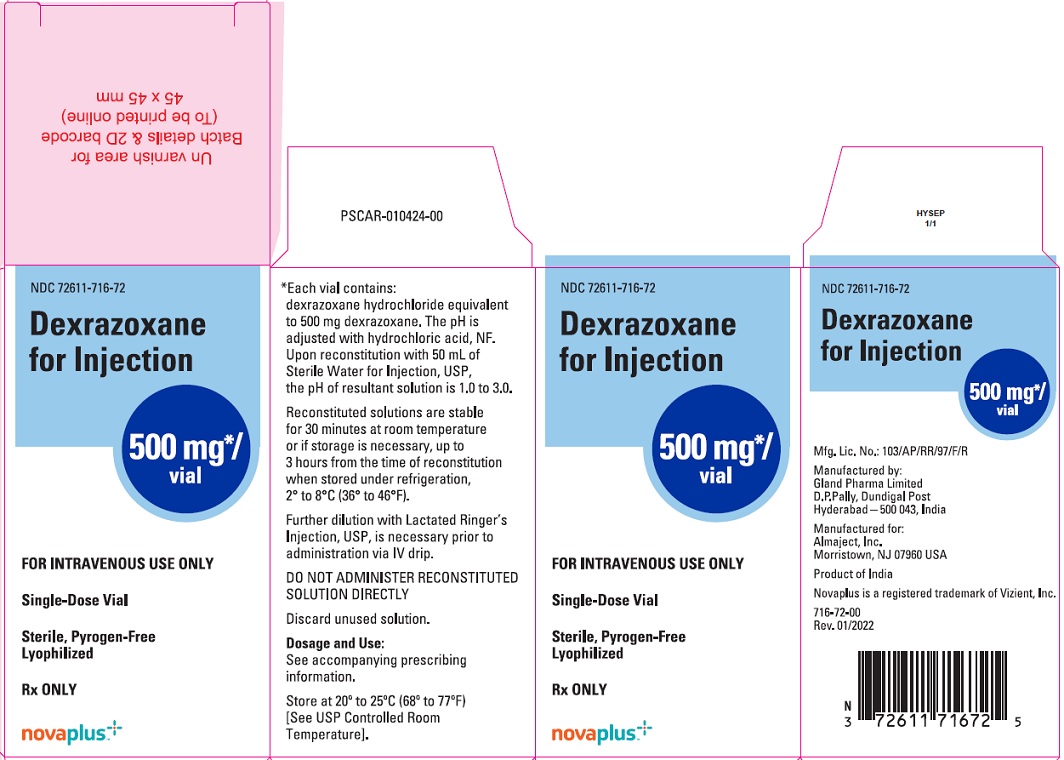
DEXRAZOXANE FOR INJECTION
Generic: Dexrazoxane for Injection
DEXRAZOXANE FOR INJECTION
Sign up to see pricing
Licensed pharmacies, clinics, doctor's offices, and veterinary practices get instant account approval
Sign Up — Instant ApprovalDrug Information
Identification
Dexrazoxane for Injection
Dexrazoxane
Fosun Pharma USA Inc.
HUMAN PRESCRIPTION DRUG
Administration
INJECTION, POWDER, LYOPHILIZED, FOR SOLUTION
INTRAVENOUS
ANDA207321
Active Ingredients
| Ingredient | Strength |
|---|---|
| DEXRAZOXANE HYDROCHLORIDE | 500 mg/50mL |
Pharmacological Class
Data sourced from openFDA / DailyMed. For full prescribing information, consult the drug label.
Wholesale compliance resources
Clinical Drug Information
Indications & Usage
1 INDICATIONS AND USAGE Dexrazoxane for injection is indicated for reducing the incidence and severity of cardiomyopathy associated with doxorubicin administration in women with metastatic breast cancer who have received a cumulative doxorubicin dose of 300 mg/m 2 and who will continue to receive doxorubicin therapy to maintain tumor control. Do not use with the initiation of doxorubicin therapy [see Warnings and Precautions ( 5.2 )] . Dexrazoxane for injection is a cytoprotective agent indicated for reducing the incidence and severity of cardiomyopathy associated with doxorubicin administration in women with metastatic breast cancer who have received a cumulative doxorubicin dose of 300 mg/m 2 and who will continue to receive doxorubicin therapy to maintain tumor control. Do not use dexrazoxane for injection with doxorubicin initiation. ( 1 )
Dosage & Administration
2 DOSAGE AND ADMINISTRATION • Reconstitute vial contents and dilute before use. ( 2.3 ) • Administer dexrazoxane for injection by intravenous infusion over 15 minutes. • DO NOT ADMINISTER VIA AN INTRAVENOUS PUSH. ( 2.1 , 2.3 ) • The recommended dosage ratio of dexrazoxane for injection to doxorubicin is 10:1 (e.g., 500 mg/m 2 dexrazoxane for injection to 50 mg/m 2 doxorubicin). Do not administer doxorubicin before dexrazoxane for injection. ( 2.1 ) • Reduce dose by 50% for patients with creatinine clearance <40 mL/min. ( 2.2 , 8.6 ) 2.1 Recommended Dose Administer dexrazoxane for injection via intravenous infusion over 15 minutes. DO NOT ADMINISTER VIA AN INTRAVENOUS PUSH. The recommended dosage ratio of dexrazoxane for injection to doxorubicin is 10:1 (e.g., 500 mg/m 2 dexrazoxane for injection to 50 mg/m 2 doxorubicin). Do not administer doxorubicin before dexrazoxane for injection. Administer doxorubicin within 30 minutes after the completion of dexrazoxane for injection infusion. 2.2 Dose Modifications Dosing in Patients with Renal Impairment Reduce dexrazoxane for injection dosage in patients with moderate to severe renal impairment (creatinine clearance values less than 40 mL/min) by 50% (dexrazoxane for injection to doxorubicin ratio reduced to 5:1; such as 250 mg/m 2 dexrazoxane for injection to 50 mg/m 2 doxorubicin) [ see Use in Specific Populations ( 8.6 ) and Clinical Pharmacology ( 12.3 )]. Dosing in Patients with Hepatic Impairment Since a doxorubicin dose reduction is recommended in the presence of hyperbilirubinemia, reduce the dexrazoxane for injection dosage proportionately (maintaining the 10:1 ratio) in patients with hepatic impairment. 2.3 Preparation and Administration Preparation and Handling of Infusion Solution Reconstitute dexrazoxane for injection with Sterile Water for Injection, USP. Reconstitute with 25 mL for a dexrazoxane for injection 250 mg vial and 50 mL for a dexrazoxane for injection 500 mg vial to give a concentration of 10 mg/mL. Dilute the reconstituted solution further with Lactated Ringer's Injection, USP to a concentration of 1.3 to 3.0 mg/mL in intravenous infusion bags for intravenous infusion. Following reconstitution with Sterile Water for Injection, USP, dexrazoxane for injection is stable for 30 minutes at room temperature or if storage is necessary, up to 3 hours from the time of reconstitution when stored under refrigeration, 2° to 8°C (36° to 46°F). The pH of the resultant solution is 1.0 to 3.0. DISCARD UNUSED SOLUTIONS. The diluted infusion solutions are stable for one hour at room temperature or if storage is necessary, up to 4 hours when stored under refrigeration, 2° to 8°C (36° to 46°F). The infusion solutions have a pH of 3.5 to 5.5. DISCARD UNUSED SOLUTIONS. Parenteral drug products should be inspected visually for particulate matter and discoloration prior to administration, whenever solution and container permit. Solutions containing a precipitate should be discarded. Use caution when handling and preparing the reconstituted solution. The use of gloves is recommended. If dexrazoxane for injection powder or solutions contact the skin or mucosae, wash exposed area immediately and thoroughly with soap and water. Follow special handling and disposal procedures 1 . Administration Do not mix dexrazoxane for injection with other drugs. Administer the final diluted solution of dexrazoxane for injection by intravenous infusion over 15 minutes before the administration of doxorubicin. DO NOT ADMINISTER VIA AN INTRAVENOUS PUSH. Administer doxorubicin within 30 minutes after the completion of dexrazoxane for injection infusion.
Adverse Reactions
6 ADVERSE REACTIONS In clinical studies, dexrazoxane for injection was administered to patients also receiving chemotherapeutic agents for cancer. Pain on injection was observed more frequently in patients receiving dexrazoxane for injection versus placebo. ( 6.1 ) To report SUSPECTED ADVERSE REACTIONS, contact Fosun Pharma USA Inc. at 1-866-611-3762 or FDA at 1-800-FDA-1088 or www.fda.gov/medwatch . 6.1 Clinical Trials Experience Because clinical trials are conducted under widely varying conditions, the adverse reaction rates observed cannot be directly compared to rates in other trials and may not reflect the rates observed in clinical practice. The adverse reaction profile described in this section was identified from randomized, placebo-controlled, double-blind studies in patients with metastatic breast cancer who received the combination of the FAC chemotherapy regimen with or without dexrazoxane for injection. The dose of doxorubicin was 50 mg/m 2 in each of these trials. Treatment was administered every three weeks until disease progression or cardiac toxicity. Patients in clinical trials who received FAC with dexrazoxane for injection experienced more severe leukopenia, granulocytopenia, and thrombocytopenia than patients receiving FAC without dexrazoxane for injection [see Warnings and Precautions ( 5.1 )]. Table 1 below lists the incidence of adverse reactions for patients receiving FAC with either dexrazoxane for injection or placebo in the breast cancer studies. Adverse experiences occurring during courses 1 through 6 are displayed for patients receiving dexrazoxane for injection or placebo with FAC beginning with their first course of therapy (columns 1 and 3, respectively). Adverse experiences occurring at course 7 and beyond for patients who received placebo with FAC during the first six courses and who then received either dexrazoxane for injection or placebo with FAC are also displayed (columns 2 and 4, respectively). The adverse reactions listed below in Table.1 demonstrate that the frequency of adverse reaction “Pain on Injection” has been greater for dexrazoxane for injection arm, as compared to placebo. Table 1 Adverse Reaction Percentage (%) of Breast Cancer Patients With Adverse Reaction FAC + Dexrazoxane for Injection FAC + Placebo Courses 1- 6 N = 413 Courses ≥ 7 N = 102 Courses 1- 6 N = 458 Courses ≥ 7 N = 99 Alopecia 94 100 97 98 Nausea 77 51 84 60 Vomiting 59 42 72 49 Fatigue/Malaise 61 48 58 55 Anorexia 42 27 47 38 Stomatitis 34 26 41 28 Fever 34 22 29 18 Infection 23 19 18 21 Diarrhea 21 14 24 7 Pain on Injection 12 13 3 0 Sepsis 17 12 14 9 Neurotoxicity 17 10 13 5 Streaking/Erythema 5 4 4 2 Phlebitis 6 3 3 5 Esophagitis 6 3 7 4 Dysphagia 8 0 10 5 Hemorrhage 2 3 2 1 Extravasation 1 3 1 2 Urticaria 2 2 2 0 Recall Skin Reaction 1 1 2 0
Information for Patients
17 PATIENT COUNSELING INFORMATION Myelosuppression Treatment with dexrazoxane for injection is associated with leukopenia, neutropenia, and thrombocytopenia. Perform hematological monitoring [see Warnings and Precautions ( 5.1 )]. Embryo-Fetal Toxicity Advise female patients of the potential risk to a fetus and to inform their healthcare provider of a known or suspected pregnancy. Advise females of reproductive potential to use effective contraception during treatment with dexrazoxane for injection and for 6 months after the last dose. Advise male patients with female partners of reproductive potential to use effective contraception during treatment with dexrazoxane for injection and for 3 months after the last dose [see Warnings and Precautions ( 5.5 ) and Use in Specific Populations ( 8.1 , 8.3 )]. Lactation Advise women not to breastfeed during treatment with dexrazoxane for injection and for 2 weeks after the last dose [see Use in Specific Populations ( 8.2 )]. Infertility Advise males of reproductive potential that dexrazoxane for injection may impair fertility [see Use in Specific Populations ( 8.3 )]. Distributed by: Fosun Pharma USA Inc. Princeton, NJ 08540 Made in India Revised: June 2025 1313000321-02
Clinical data sourced from openFDA drug labeling. For complete prescribing information, consult the full drug label.