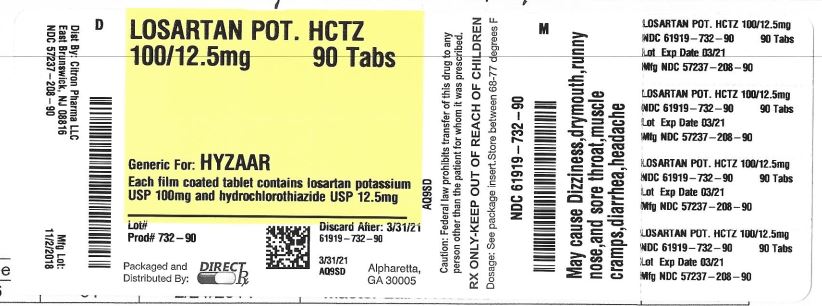
LOSARTAN HCTZ 100MG/25MG 90 TAB
Generic: losartan potassium and hydrochlorothiazide
LOSARTAN HCTZ 100MG/25MG 90 TAB
Sign up to see pricing
Licensed pharmacies, clinics, doctor's offices, and veterinary practices get instant account approval
Sign Up — Instant ApprovalDrug Information
Identification
losartan potassium and hydrochlorothiazide
Losartan Potassium and Hydrochlorothiazide
Jubilant Cadista Pharmaceuticals Inc.
HUMAN PRESCRIPTION DRUG
Administration
TABLET, FILM COATED
ORAL
ANDA201845
Active Ingredients
| Ingredient | Strength |
|---|---|
| HYDROCHLOROTHIAZIDE | 25 mg/1 |
| LOSARTAN POTASSIUM | 100 mg/1 |
Pharmacological Class
Data sourced from openFDA / DailyMed. For full prescribing information, consult the drug label.
Wholesale compliance resources
Clinical Drug Information
Indications & Usage
1 INDICATIONS AND USAGE Losartan potassium and hydrochlorothiazide is a combination of losartan, an angiotensin II receptor blocker (ARB) and hydrochlorothiazide, a diuretic indicated for: Treatment of hypertension, to lower blood pressure. Lowering blood pressure reduces the risk of fatal and nonfatal cardiovascular events, primarily strokes and myocardial infarctions. ( 1.1 ) Reduction of the risk of stroke in patients with hypertension and left ventricular hypertrophy. There is evidence that this benefit does not apply to Black patients. ( 1.2 ) 1.1 Hypertension Losartan potassium and hydrochlorothiazide is indicated for the treatment of hypertension, to lower blood pressure. Lowering blood pressure lowers the risk of fatal and non-fatal cardiovascular (CV) events, primarily strokes and myocardial infarction. These benefits have been seen in controlled trials of antihypertensive drugs from a wide variety of pharmacologic classes including losartan and hydrochlorothiazide. Control of high blood pressure should be part of comprehensive cardiovascular risk management, including, as appropriate, lipid control, diabetes management, antithrombotic therapy, smoking cessation, exercise, and limited sodium intake. Many patients will require more than 1 drug to achieve blood pressure goals. For specific advice on goals and management, see published guidelines, such as those of the National High Blood Pressure Education Program’s Joint National Committee on Prevention, Detection, Evaluation, and Treatment of High Blood Pressure (JNC). Numerous antihypertensive drugs, from a variety of pharmacologic classes and with different mechanisms of action, have been shown in randomized controlled trials to reduce cardiovascular morbidity and mortality, and it can be concluded that it is blood pressure reduction, and not some other pharmacologic property of the drugs, that is largely responsible for those benefits. The largest and most consistent cardiovascular outcome benefit has been a reduction in the risk of stroke, but reductions in myocardial infarction and cardiovascular mortality also have been seen regularly. Elevated systolic or diastolic pressure causes increased cardiovascular risk, and the absolute risk increase per mmHg is greater at higher blood pressures, so that even modest reductions of severe hypertension can provide substantial benefit. Relative risk reduction from blood pressure reduction is similar across populations with varying absolute risk, so the absolute benefit is greater in patients who are at higher risk independent of their hypertension (for example, patients with diabetes or hyperlipidemia), and such patients would be expected to benefit from more aggressive treatment to a lower blood pressure goal. Some antihypertensive drugs have smaller blood pressure effects (as monotherapy) in Black patients, and many antihypertensive drugs have additional approved indications and effects (e.g., on angina, heart failure, or diabetic kidney disease). These considerations may guide selection of therapy. This fixed dose combination is not indicated for initial therapy of hypertension, except when the hypertension is severe enough that the value of achieving prompt blood pressure control exceeds the risk of initiating combination therapy in these patients [see Clinical Studies (14) and Dosage and Administration (2.1) ]. Losartan potassium and hydrochlorothiazide may be administered with other antihypertensive agents. 1.2 Hypertensive Patients with Left Ventricular Hypertrophy Losartan potassium and hydrochlorothiazide is indicated to reduce the risk of stroke in patients with hypertension and left ventricular hypertrophy, but there is evidence that this benefit does not apply to Black patients. [See Use in Specific Populations (8.6) , Clinical Pharmacology (12.3) , and Dosage and Administration (2.2) .]
Dosage & Administration
2 DOSAGE AND ADMINISTRATION Hypertension • Usual starting dose: 50/12.5 mg once daily. ( 2.1 ) • Titrate as needed to a maximum dose of 100/25 mg. ( 2.1 ) Hypertensive Patients with Left Ventricular Hypertrophy • Not controlled on monotherapy: Initiate with 50/12.5 mg. Titrate as needed to a maximum of 100/25 mg. ( 2.2 ) 2.1 Hypertension The usual starting dose of losartan potassium and hydrochlorothiazide is 50/12.5 (losartan 50 mg/hydrochlorothiazide 12.5 mg) once daily. The dosage can be increased after 3 weeks of therapy to a maximum of 100/25 (losartan 100 mg/hydrochlorothiazide 25 mg) once daily as needed to control blood pressure [see Clinical Studies (14.2) ]. Initiate a patient whose blood pressure is not adequately controlled with losartan 50 mg monotherapy with losartan potassium and hydrochlorothiazide 50/12.5 once daily. If blood pressure remains uncontrolled after about 3 weeks of therapy, the dosage may be increased to two tablets of losartan potassium and hydrochlorothiazide 50/12.5 once daily or one tablet of losartan potassium and hydrochlorothiazide 100/25 once daily. Initiate a patient whose blood pressure is not adequately controlled with losartan 100 mg monotherapy with losartan potassium and hydrochlorothiazide 100/12.5 (losartan 100 mg/hydrochlorothiazide 12.5 mg) once daily. If blood pressure remains uncontrolled after about 3 weeks of therapy, increase the dose to two tablets of losartan potassium and hydrochlorothiazide 50/12.5 once daily or one tablet of losartan potassium and hydrochlorothiazide 100/25 once daily. Initiate a patient whose blood pressure is inadequately controlled with hydrochlorothiazide 25 mg once daily, or is controlled but who experiences hypokalemia with this regimen, on losartan potassium and hydrochlorothiazide 50/12.5 once daily, reducing the dose of hydrochlorothiazide without reducing the overall expected antihypertensive response. Evaluate the clinical response to losartan potassium and hydrochlorothiazide 50/12.5 and, if blood pressure remains uncontrolled after about 3 weeks of therapy, increase the dose to two tablets of losartan potassium and hydrochlorothiazide 50/12.5 once daily or one tablet of losartan potassium and hydrochlorothiazide 100/25 once daily. 2.2 Hypertensive Patients with Left Ventricular Hypertrophy In patients whose blood pressure is not adequately controlled on 50 mg losartan potassium, initiate treatment with losartan potassium and hydrochlorothiazide 50/12.5. If additional blood pressure reduction is needed, increase the dose to losartan potassium and hydrochlorothiazide 100/12.5, followed by losartan potassium and hydrochlorothiazide 100/25. For further blood pressure reduction add other antihypertensives [see Clinical Studies (14) ] .
Adverse Reactions
6 ADVERSE REACTIONS Most common adverse reactions (incidence ≥2% and greater than placebo) are dizziness, upper respiratory infection, cough, and back pain. ( 6.1 ) To report SUSPECTED ADVERSE REACTIONS, contact Jubilant Cadista Pharmaceuticals Inc. at 1-800-313-4623 or FDA at 1-800-FDA-1088 or www.fda.gov/medwatch. 6.1 Clinical Trials Experience Because clinical trials are conducted under widely varying conditions, adverse reaction rates observed in the clinical trials of a drug cannot be directly compared to rates in the clinical trials of another drug and may not reflect the rates observed in practice. Losartan potassium-hydrochlorothiazide has been evaluated for safety in 858 patients treated for essential hypertension and 3889 patients treated for hypertension and left ventricular hypertrophy. Most adverse reactions have been mild and transient in nature and have not required discontinuation of therapy. In controlled clinical trials, discontinuation of therapy due to clinical adverse events was required in only 2.8% and 2.3% of patients treated with the combination and placebo, respectively. In these double-blind controlled clinical trials, adverse reactions occurring in greater than 2% of subjects treated with losartan-hydrochlorothiazide and at a greater rate than placebo were: back pain (2.1% vs 0.6%), dizziness (5.7% vs 2.9%), and upper respiratory infection (6.1% vs 4.6%). The following additional adverse reactions have been reported in clinical trials with losartan potassium and hydrochlorothiazide and/or the individual components: Blood and the lymphatic system disorders: Anemia, aplastic anemia, hemolytic anemia, leukopenia, agranulocytosis. Metabolism and nutrition disorders: Anorexia, hyperglycemia, hyperuricemia, electrolyte imbalance including hyponatremia and hypokalemia. Psychiatric disorders: Insomnia, restlessness. Nervous system disorders: Dysgeusia, headache, migraine, paraesthesias. Eye disorders: Xanthopsia, transient blurred vision. Cardiac disorders: Palpitation, tachycardia. Vascular disorders: Dose-related orthostatic effects, necrotizing angiitis (vasculitis, cutaneous vasculitis). Respiratory, thoracic and mediastinal disorders: Nasal congestion. Gastrointestinal disorders: Dyspepsia, abdominal pain, gastric irritation, cramping, nausea, vomiting, pancreatitis, sialoadenitis. Hepato-biliary disorders: Jaundice (intrahepatic cholestatic jaundice). Skin and subcutaneous tissue disorders: Rash, pruritus, purpura, toxic epidermal necrolysis, urticaria, photosensitivity, cutaneous lupus erythematosus. Musculoskeletal and connective tissue disorders: Muscle cramps, muscle spasm. Renal and urinary disorders: Glycosuria, renal dysfunction, interstitial nephritis, renal failure. Reproductive system and breast disorders: Erectile dysfunction/impotence. General disorders and administration site conditions: Chest pain, malaise, weakness. Investigations: Liver function abnormalities. Cough Persistent dry cough has been associated with ACE-inhibitor use and in practice can be a cause of discontinuation of ACE-inhibitor therapy. Two prospective, parallel-group, double-blind, randomized, controlled trials were conducted to assess the effects of losartan on the incidence of cough in hypertensive patients who had experienced cough while receiving ACE-inhibitor therapy. Patients who had typical ACE-inhibitor cough when challenged with lisinopril, whose cough disappeared on placebo, were randomized to losartan 50 mg, lisinopril 20 mg, or either placebo (one study, n=97) or 25 mg hydrochlorothiazide (n=135). The double-blind treatment period lasted up to 8 weeks. The incidence of cough is shown in Table 1 below. Table 1: Study 1* HCTZ Losartan Lisinopril Cough 25% 17% 69% Study 2† Placebo Losartan Lisinopril Cough 35% 29% 62% * Demographics = (89% Caucasian, 64% female) † Demographics = (90% Caucasian, 51% female) These studies demonstrate that the incidence of cough associated with losartan therapy, in a population that all had cough associated with ACE-inhibitor therapy, is similar to that associated with hydrochlorothiazide or placebo therapy. Cases of cough, including positive re-challenges, have been reported with the use of losartan in postmarketing experience. 6.2 Postmarketing Experience The following adverse reactions have been identified during post-approval use of losartan potassium and hydrochlorothiazide. Because these reactions are reported voluntarily from a population of uncertain size, it is not always possible to estimate their frequency reliably or to establish a causal relationship to drug exposure. Digestive: Hepatitis has been reported rarely in patients treated with losartan. Hematologic: Thrombocytopenia. Hypersensitivity: Angioedema, including swelling of the larynx and glottis, causing airway obstruction and/or swelling of the face, lips, pharynx, tongue and/or swelling of the intestine. Vasculitis, including Henoch-Schönlein purpura; anaphylactic reactions which can present as respiratory distress (including pneumonitis and pulmonary edema). Musculoskeletal: Rhabdomyolysis. Skin: Erythroderma. Non-melanoma Skin Cancer: Hydrochlorothiazide is associated with an increased risk of non-melanoma skin cancer. In a study conducted in the Sentinel System, increased risk was predominantly for squamous cell carcinoma (SCC) and in white patients taking large cumulative doses. The increased risk for SCC in the overall population was approximately 1 additional case per 16,000 patients per year, and for white patients taking a cumulative dose of ≥50,000mg the risk increase was approximately 1 additional SCC case for every 6,700 patients per year.
Information for Patients
17 PATIENT COUNSELING INFORMATION Advise the patient to read the FDA-approved patient labeling (Patient Information). Pregnancy: Advise female patients of childbearing age about the consequences of exposure to losartan potassium and hydrochlorothiazide during pregnancy. Discuss treatment options with women planning to become pregnant. Tell patients to report pregnancies to their physicians as soon as possible [see Warnings and Precautions (5.1) and Use in Specific Populations (8.1) ]. Symptomatic Hypotension: Advise patients that lightheadedness can occur, especially during the first days of therapy, and to report this symptom to a healthcare provider. Inform patients that dehydration from inadequate fluid intake, excessive perspiration, vomiting, or diarrhea may lead to an excessive fall in blood pressure. If syncope occurs, advise patients to contact their healthcare provider [see Warnings and Precautions (5.2) ] . Potassium Supplements: Advise patients not to use potassium supplements or salt substitutes containing potassium without consulting their healthcare provider [see Drug Interactions (7.1) ] . Acute Myopia and Secondary Angle-closure Glaucoma: Advise patients to discontinue losartan potassium and hydrochlorothiazide and seek immediate medical attention if they experience symptoms of acute myopia or secondary angle-closure glaucoma [see Warnings and Precautions (5.6) ]. Non-melanoma Skin Cancer: Instruct patients taking hydrochlorothiazide to protect skin from the sun and undergo regular skin cancer screening. Marketed by: Jubilant Cadista Pharmaceuticals Inc. Yardley, PA 19067, USA Rev. # 07/2025
Clinical data sourced from openFDA drug labeling. For complete prescribing information, consult the full drug label.