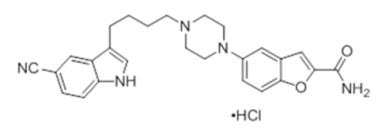
VILAZODONE 40MG 30 TAB
Generic: Vilazodone Hydrochloride
VILAZODONE 40MG 30 TAB
Sign up to see pricing
Licensed pharmacies, clinics, doctor's offices, and veterinary practices get instant account approval
Sign Up — Instant ApprovalDrug Information
Identification
Vilazodone Hydrochloride
Vilazodone Hydrochloride
Accord Healthcare Inc.
HUMAN PRESCRIPTION DRUG
Administration
TABLET
ORAL
ANDA208209
Active Ingredients
| Ingredient | Strength |
|---|---|
| VILAZODONE HYDROCHLORIDE | 40 mg/1 |
Data sourced from openFDA / DailyMed. For full prescribing information, consult the drug label.
Wholesale compliance resources
Clinical Drug Information
Indications & Usage
1 INDICATIONS AND USAGE Vilazodone hydrochloride tablets are indicated for the treatment of major depressive disorder (MDD) in adults [see Clinical Studies ( 14 )] . Vilazodone hydrochloride tablets are indicated for the treatment of major depressive disorder (MDD) in adults ( 1 ).
Dosage & Administration
2 DOSAGE AND ADMINISTRATION Recommended target dosage: 20 mg to 40 mg once daily with food ( 2.1 , 12.3 ) To titrate: start with initial dosage of 10 mg once daily for 7 days, followed by 20 mg once daily. The dose may be increased up to 40 mg once daily after a minimum of 7 days between dosage increases ( 2.1 ) Prior to initiating vilazodone hydrochloride tablets, screen for bipolar disorder ( 2.2 , 5.4 ) When discontinuing vilazodone hydrochloride tablets, reduce dosage gradually ( 2.4 , 5.5 ) 2.1 Dosage for Treatment of Major Depressive Disorder The recommended target dosage for vilazodone hydrochloride tablets is 20 mg to 40 mg orally once daily with food [see Clinical Pharmacology ( 12.3 ), Clinical Studies ( 14 )] . To achieve the target dosage, titrate vilazodone hydrochloride tablets as follows: Start with an initial dosage of 10 mg once daily with food for 7 days, Then increase to 20 mg once daily with food. The dose may be increased up to 40 mg once daily with food after a minimum of 7 days between dosage increases. If a dose is missed, it should be taken as soon as the patient remembers. If it is almost time for the next dose, the patient should skip the missed dose and take the next dose at the regular time. Two doses should not be taken at the same time. 2.2 Screen for Bipolar Disorder Prior to Starting Vilazodone Hydrochloride Tablets Prior to initiating treatment with vilazodone hydrochloride tablets or another antidepressant, screen patients for a personal or family history of bipolar disorder, mania, or hypomania [see Warnings and Precautions ( 5.4 )]. 2.3 Switching to or from a Monoamine Oxidase Inhibitor Antidepressant At least 14 days must elapse between discontinuation of a monoamine oxidase inhibitor (MAOI) antidepressant and initiation of vilazodone hydrochloride tablets. In addition, at least 14 days must elapse after stopping vilazodone hydrochloride tablets before starting an MAOI antidepressant [see Contraindications ( 4 ), Warnings and Precautions ( 5.2 )]. 2.4 Dosage Adjustments with CYP3A4 Inhibitors or Inducers Patients receiving concomitant CYP3A4 inhibitors: During concomitant use of a strong CYP3A4 inhibitor (e.g., itraconazole, clarithromycin, voriconazole), the vilazodone hydrochloride tablets dose should not exceed 20 mg once daily. The original vilazodone hydrochloride tablets dose level, can be resumed when the CYP3A4 inhibitor is discontinued [see Drug Interactions ( 7 )] . Patients receiving concomitant CYP3A4 inducers: Based on clinical response, consider increasing the dosage of vilazodone hydrochloride tablets by 2-fold, up to a maximum 80 mg once daily, over 1 to 2 weeks in patients taking strong CYP3A4 inducers (e.g., carbamazepine, phenytoin, rifampin) for greater than 14 days. If CYP3A4 inducers are discontinued, gradually reduce the vilazodone hydrochloride tablets dosage to its original level over 1 to 2 weeks [see Drug Interactions ( 7 )] . 2.5 Discontinuing Treatment with Vilazodone Hydrochloride Tablets Adverse reactions may occur upon discontinuation of vilazodone hydrochloride tablets [see Warnings and Precautions ( 5.5 )] . A gradual reduction in dosage rather than abrupt cessation is recommended whenever possible. Vilazodone hydrochloride tablets should be down tapered from the 40 mg once daily dose to 20 mg once daily for 4 days, followed by 10 mg once daily for 3 days. Patients taking vilazodone hydrochloride tablets 20 mg once daily should be tapered to 10 mg once daily for 7 days.
Adverse Reactions
6 ADVERSE REACTIONS The following adverse reactions are discussed in greater detail in other sections of the labeling: Suicidal Thoughts and Behaviors in Adolescents, and Young Adults [see Warnings and Precautions ( 5.1 )]. Serotonin Syndrome [see Warnings and Precautions ( 5.2 )] Increased Risk of Bleeding [see Warnings and Precautions ( 5.3 )]. Activation of Mania or Hypomania [see Warnings and Precautions ( 5.4 )]. Discontinuation Syndrome [see Warnings and Precautions ( 5.5 )]. Seizures [see Warnings and Precautions ( 5.6 )]. Angle-Closure Glaucoma [see Warnings and Precautions ( 5.7 )] Hyponatremia [see Warnings and Precautions ( 5.8 )] Sexual Dysfunction [see Warnings and Precautions ( 5.9 )]. Most common adverse reactions (incidence ≥ 5% and at least twice the rate of placebo): diarrhea, nausea, vomiting, and insomnia ( 6 ). To report SUSPECTED ADVERSE REACTIONS, contact Accord Healthcare Inc. at 1-866-941-7875 or FDA at 1-800-FDA-1088 or www.fda.gov/medwatch 6.1 Clinical Trials Experience Because clinical trials are conducted under widely varying conditions and varying lengths of time, adverse reaction rates observed in the clinical trials of a drug cannot be directly compared to rates in the clinical studies of another drug and may not reflect rates observed in practice. The most commonly observed adverse reactions in vilazodone hydrochloride-treated patients with major depressive disorder (MDD) in placebo-controlled studies (incidence ≥ 5% and at least twice the rate of placebo) were diarrhea, nausea, vomiting, and insomnia. Patient Exposure The safety of vilazodone hydrochloride was evaluated in 3,007 patients (18 to 70 years of age) diagnosed with MDD who participated in clinical studies, representing 676 patient-years of exposure. In an open-label 52 week study at 40 mg daily, 599 patients were exposed to vilazodone hydrochloride for a total of 348 patient-years. The adverse reaction information presented below was derived from studies of vilazodone hydrochloride tablets 20 mg and 40 mg daily in patients with MDD including: Four placebo-controlled 8 to 10-week studies in 2,233 patients, including 1,266 vilazodone hydrochloride-treated patients; and An open-label 52-week study of 599 vilazodone hydrochloride-treated patients. These studies included a titration period of 10 mg daily for 7 days, followed by 20 mg daily for 7 days or to 40 mg daily over 2 weeks. In these clinical trials, vilazodone hydrochloride tablets were administered with food. Adverse reactions reported as reasons for discontinuation of treatment In these studies, 7.3% of the vilazodone hydrochloride-treated patients discontinued treatment due to an adverse reaction, compared with 3.5% of placebo-treated patients. The most common adverse reaction leading to discontinuation in at least 1% of the vilazodone hydrochloride-treated patients in the placebo-controlled studies was nausea (1.4%). Common adverse reactions in placebo-controlled MDD studies Table 2 shows the incidence of common adverse reactions occurring in ≥ 2% of vilazodone hydrochloride-treated patients and greater than the rate of placebo-treated patients in MDD Studies. There were no dose-related adverse reactions between 20 mg and 40 mg reported. Table 2: Common Adverse Reactions Occurring in ≥2% of Vilazodone hydrochloride-treated Patients and Greater than the Rate of Placebo-treated Patients 1 Includes abdominal discomfort, abdominal pain upper, and abdominal pain. 2 Includes headache and tension headache 3 Includes restlessness, akathisia, and restless legs syndrome Sexual adverse reactions are presented in Table 3 System Organ Class Preferred Term Placebo N=967 Vilazodone hydrochloride 20 mg/day N=288 Vilazodone hydrochloride 40 mg/day N=978 Gastrointestinal disorders Diarrhea 10% 26% 29% Nausea 7% 22% 24% Dry mouth 5% 8% 7% Vomiting 2% 4% 5% Abdominal pain 1 3% 7% 4% Dyspepsia 2% 2% 3% Flatulence 1% 3% 3% Gastroenteritis 1% 1% 2% Abdominal distension 1% 2% 1% Nervous system disorders Headache 2 14% 15% 14% Dizziness 5% 6% 8% Somnolence 2% 4% 5% Paresthesia 1% 1% 2% Psychiatric disorders Insomnia 2% 7% 6% Abnormal dreams 2% 2% 3% Restlessness 3 1% 2% 3% General disorders Fatigue 3% 4% 3% Cardiac disorders Palpitations <1% 1% 2% Metabolism and nutrition disorders Increased appetite 1% 1% 3% Musculoskeletal and connective tissue disorders Arthralgia 1% 2% 1% Investigations Increased weight 1% 1% 2% Sexual adverse reactions Table 3: Common Sexual Adverse Reactions Occurring in ≥ 2% of Vilazodone Hydrochloride-treated Patients and Greater than the Rate of Placebo-Treated Patients − Not applicable *Includes abnormal orgasm and anorgasmia Males Females Preferred Term Placebo N=416 Vilazodone hydrochloride 20 mg/day N=122 Vilazodone hydrochloride 40 mg/day N=417 Placebo N=551 Vilazodone hydrochloride 20 mg/day N=166 Vilazodone hydrochloride 40 mg/day N=561 Abnormal Orgasm * <1% 2% 2% 0% 1% 1% Erectile dysfunction 1% 0% 3% - - - Libido decreased <1% 3% 4% <1% 2% 2% Ejaculation disorder 0% 1% 2% - - - Other adverse reactions observed in clinical studies The following list does not include reactions: 1) already listed in previous tables or elsewhere in labeling, 2) for which a drug cause was remote, 3) which were so general as to be uninformative, 4) which were not considered to have significant clinical implications, or 5) which occurred at a rate equal to or less than placebo. Reactions are categorized by body system according to the following definitions: frequent adverse reactions are those occurring in at least 1/100 patients; infrequent adverse reactions are those occurring in 1/100 to 1/1000 patients; rare reactions are those occurring in fewer than 1/1000 patients: Cardiac disorders: infrequent: ventricular extrasystoles Eye disorders: infrequent: dry eye, vision blurred, rare: cataracts Nervous System: frequent: sedation, tremor; infrequent: migraine Psychiatric disorders: infrequent: panic attack Skin and subcutaneous tissue disorders: infrequent: hyperhidrosis, night sweats 6.2 Postmarketing Experience The following adverse reactions have been identified during post-approval use of vilazodone hydrochloride tablets. Because these reactions are reported voluntarily from a population of uncertain size, it is not always possible to estimate their frequency or establish a causal relationship to drug exposure. Reports of adverse reactions temporally associated with vilazodone hydrochloride that have been received since market introduction and that are not listed above include the following: General Disorders and Administration Site Conditions: irritability Nervous System Disorders: sleep paralysis Psychiatric Disorders: hallucinations, suicide attempt, suicidal ideation Skin and subcutaneous tissue disorders: rash, generalized rash, urticaria, drug eruption Gastrointestinal System: acute pancreatitis Respiratory, Thoracic and Mediastinal Disorders: anosmia, hyposmia
Information for Patients
17 PATIENT COUNSELING INFORMATION Advise the patient to read the FDA-approved patient labeling ( Medication Guide ). Suicidal Thoughts and Behaviors Advise patients and caregivers to look for the emergence of suicidality, especially early during treatment and when the dosage is adjusted up or down and instruct them to report such symptoms to the healthcare provider [see Boxed Warning and Warnings and Precautions ( 5.1 )] . Dosage and Administration Instruct patients to take vilazodone hydrochloride tablets with food and to follow prescribed dosage instructions [see Dosage and Administration ( 2.1, 2.3, 2.4, 2.5 )] . Serotonin Syndrome Caution patients about the risk of serotonin syndrome, particularly with the concomitant use of vilazodone hydrochloride with other serotonergic drugs including triptans, tricyclic antidepressants, opioids, lithium, tryptophan, buspirone, amphetamines, and St. John’s Wort, and with drugs that impair metabolism of serotonin (in particular, MAOIs, both those intended to treat psychiatric disorders and also others, such as linezolid). Patients should contact their health care provider or report to the emergency room if they experience signs or symptoms of serotonin syndrome [see Warnings and Precautions ( 5.2 ) and Drug Interactions ( 7 )] . Increased Risk of Bleeding Inform patients about the concomitant use of vilazodone hydrochloride tablets with aspirin, NSAIDs, other antiplatelet drugs, warfarin, or other anticoagulants because the combined use of drugs that interfere with serotonin reuptake (e.g., vilazodone hydrochloride) and these medications has been associated with an increased risk of bleeding. Advise them to inform their health care providers if they are taking or planning to take any prescription or over-the-counter medications that increase the risk of bleeding [see Warnings and Precautions ( 5.3 )] . Activation of Mania/Hypomania Advise patients and their caregivers to observe for signs of activation of mania/hypomania and instruct them to report such symptoms to the healthcare provider [see Warnings and Precautions ( 5.4 )] . Discontinuation Syndrome Advise patients not to abruptly discontinue vilazodone hydrochloride tablets and to discuss any tapering regimen with their healthcare provider. Adverse reactions can occur when vilazodone hydrochloride tablets are discontinued [see Warnings and Precautions ( 5.5 )] . Seizures Caution patients about using vilazodone hydrochloride tablets if they have a history of a seizure disorder [see Warnings and Precautions ( 5.6 )]. Sexual Dysfunction Advise patients that use of vilazodone hydrochloride tablets may cause symptoms of sexual dysfunction in both male and female patients. Inform patients that they should discuss any changes in sexual function and potential management strategies with their healthcare provider [see Warnings and Precautions ( 5.9 )]. Allergic Reactions Advise patients to notify their healthcare provider if they develop an allergic reaction such as rash, hives, swelling, or difficulty breathing [see Adverse Reactions( 6.2 )]. Concomitant Medications Advise patients to inform their health care providers if they are taking, or plan to take any prescription or over-the-counter medications since there is a potential for interactions [see Drug Interactions ( 7.1 )] . Pregnancy Advise pregnant women to notify their healthcare provider if they become pregnant or intend to become pregnant during treatment with vilazodone hydrochloride [see Use in Specific Populations ( 8.1 )] . Advise patients that vilazodone hydrochloride use late in pregnancy may lead to an increased risk for neonatal complications requiring prolonged hospitalization, respiratory support, tube feeding, and/or persistent pulmonary hypertension of the newborn (PPHN) [see Use in Specific Populations ( 8.1 )] . Advise patients that there is a pregnancy exposure registry that monitors pregnancy outcomes in women exposed to vilazodone hydrochloride during pregnancy [see Use in Specific Populations ( 8.1 )] . Medication guide available at www.accordhealthcare.us/medication-guides All trademarks are the property of their respective owners. Manufactured for: Accord Healthcare, Inc., 8041 Arco Corporate Drive, Suite 200, Raleigh, NC 27617, USA. Manufactured by: Intas Pharmaceuticals Limited, Plot No.: 457, 458, Village – Matoda, Bavla Road, Ta. – Sanand, Dist.- Ahmedabad – 382 210, INDIA 10 5678 2 6024023 Issued June 2024
Clinical data sourced from openFDA drug labeling. For complete prescribing information, consult the full drug label.