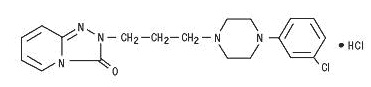
TRAZODONE 100MG 1000 TAB
Generic: Trazodone Hydrochloride
TRAZODONE 100MG 1000 TAB
Sign up to see pricing
Licensed pharmacies, clinics, doctor's offices, and veterinary practices get instant account approval
Sign Up — Instant ApprovalDrug Information
Identification
Trazodone Hydrochloride
Trazodone Hydrochloride
Zydus Pharmaceuticals USA Inc.
HUMAN PRESCRIPTION DRUG
Administration
TABLET
ORAL
ANDA205253
Active Ingredients
| Ingredient | Strength |
|---|---|
| TRAZODONE HYDROCHLORIDE | 100 mg/1 |
Pharmacological Class
Data sourced from openFDA / DailyMed. For full prescribing information, consult the drug label.
Wholesale compliance resources
Clinical Drug Information
Indications & Usage
1 INDICATIONS AND USAGE Trazodone is a selective serotonin reuptake inhibitor indicated for the treatment of major depressive disorder (MDD) ( 1 ). Trazodone hydrochloride tablets are indicated for the treatment of major depressive disorder (MDD) in adults.
Dosage & Administration
2 DOSAGE AND ADMINISTRATION Starting dose: 150 mg in divided doses daily. May be increased by 50 mg per day every three to four days. Maximum dose: 400 mg per day in divided doses ( 2 ). Trazodone hydrochloride tablets should be taken shortly after a meal or light snack ( 2 ). Tablets should be swallowed whole or broken in half along the score line, and should not be chewed or crushed ( 2 ). When discontinued, gradual dose reduction is recommended ( 2 ). 2.1 Dose Selection An initial dose of 150 mg/day in divided doses is suggested. The dosage should be initiated at a low-dose and increased gradually, noting the clinical response and any evidence of intolerance. Occurrence of drowsiness may require the administration of a major portion of the daily dose at bedtime or a reduction of dosage. The dose may be increased by 50 mg/day every 3 to 4 days. The maximum dose for outpatients usually should not exceed 400 mg/day in divided doses. Inpatients (i.e., more severely depressed patients) may be given up to but not in excess of 600 mg/day in divided doses. Once an adequate response has been achieved, dosage may be gradually reduced, with subsequent adjustment depending on therapeutic response. 2.2 Important Administration Instructions Trazodone hydrochloride tablets can be swallowed whole or administered as a half tablet by breaking the tablet along the score line. Trazodone hydrochloride tablets should be taken shortly after a meal or light snack. 2.3 Screen for Bipolar Disorder Prior to Starting Trazodone Prior to initiating treatment with trazodone hydrochloride tablets or another antidepressant, screen patients for a personal or family history of bipolar disorder, mania, or hypomania [see Warnings and Precautions ( 5.7 )]. 2.4 Switching to or from Monoamine Oxidase Inhibitor Antidepressant At least 14 days must elapse between discontinuation of a monoamine oxidase inhibitor (MAOI) antidepressant and initiation of trazodone hydrochloride tablets. In addition, at least 14 days must elapse after stopping trazodone hydrochloride tablets before starting an MAOI antidepressant [see Contraindications ( 4 ), Warnings and Precautions ( 5.2 )]. 2.5 Dosage Recommendations for Concomitant Use with Strong CYP3A4 Inhibitors or Inducers Coadministration with Strong CYP3A4 Inhibitors Consider reducing trazodone dose based on tolerability when trazodone is coadministered with a strong CYP3A4 inhibitor [see Drug Interactions ( 7.1 )]. Coadministration with Strong CYP3A4 Inducers Consider increasing trazodone dose based on therapeutic response when trazodone is coadministered with a strong CYP3A4 inducer [see Drug Interactions ( 7.1 )]. 2.6 Discontinuation of Treatment with Trazodone Adverse reactions may occur upon discontinuation of trazodone [See Warnings and Precautions ( 5.8 )]. Gradually reduce the dosage rather than stopping trazodone abruptly whenever possible.
Adverse Reactions
6 ADVERSE REACTIONS Most common adverse reactions (incidence ≥ 5% and twice that of placebo) are: edema, blurred vision, syncope, drowsiness, fatigue, diarrhea, nasal congestion, weight loss ( 6 ). To report SUSPECTED ADVERSE REACTIONS, contact Zydus Pharmaceuticals (USA) Inc. at 1-877-993-8779 or FDA at 1-800-FDA-1088 or www.fda.gov/medwatch. The following serious adverse reactions are described elsewhere in the labeling: Suicidal Thoughts and Behavior in Children, Adolescents and Young Adults [see Boxed Warning and Warnings and Precautions ( 5.1 )] Serotonin Syndrome [see Warnings and Precautions ( 5.2 )] Cardiac Arrythmias [see Warnings and Precautions ( 5.3 )] Orthostatic Hypotension and Syncope [see Warnings and Precautions ( 5.4 )] Increased Risk of Bleeding [see Warnings and Precautions ( 5.5 )] Priapism [see Warnings and Precautions ( 5.6 )] Activation of Mania or Hypomania [see Warnings and Precautions ( 5.7 )] Discontinuation Syndrome [see Warnings and Precautions ( 5.8 )] Potential for Cognitive and Motor Impairment [see Warnings and Precautions ( 5.9 )] Angle-Closure Glaucoma [see Warnings and Precautions ( 5.10 )] Hyponatremia [see Warnings and Precautions ( 5.11 )] 6.1 Clinical Trials Experience Because clinical trials are conducted under widely varying conditions, adverse reaction rates observed in the clinical trials of a drug cannot be directly compared to rates in the clinical trials of another drug and may not reflect the rates observed in practice. Table 2 Common Adverse Reactions Occurring in ≥ 2% of Trazodone-treated Patients and Greater than the Rate of Placebo-Treated Patients as Observed in Controlled Clinical Studies Inpatients Outpatients Trazodone Placebo Trazodone Placebo N=142 N=95 N=157 N=158 Allergic Skin Condition/Edema 3% 1% 7% 1% Autonomic Blurred Vision 6% 4% 15% 4% Constipation 7% 4% 8% 6% Dry Mouth 15% 8% 34% 20% Cardiovascular Hypertension 20% 1% 1% * Hypotension 7% 1% 4% 0 Syncope 3% 2% 5% 1% CNS Confusion 5% 0 6% 8% Decreased Concentration 3% 2% 1% 0 Disorientation 2% 0 * 0 Dizziness/Light-Headedness 20% 5% 28% 15% Drowsiness 24% 6% 41% 20% Fatigue 11% 4% 6% 3% Headache 10% 5% 20% 16% Nervousness 15% 11% 6% 8% Gastrointestinal Abdominal/Gastric Disorder 4% 4% 6% 4% Diarrhea 0 1% 5% 1% Nausea/Vomiting 10% 1% 13% 10% Musculoskeletal Aches/Pains 6% 3% 5% 3% Neurological Incoordination 5% 0 2% * Tremors 3% 1% 5% 4% Other Eyes Red/Tired/Itching 3% 0 0 0 Head Full-Heavy 3% 0 0 0 Malaise 3% 0 0 0 Nasal/Sinus Congestion 3% 0 6% 3% Weight Gain 1% 0 5% 2% Weight Loss * 3% 6% 3% Other adverse reactions occurring at an incidence of <2% with the use of trazodone hydrochloride in the controlled clinical studies: akathisia, allergic reaction, anemia, chest pain, delayed urine flow, early menses, flatulence, hallucinations/delusions, hematuria, hypersalivation, hypomania, impaired memory, impaired speech, impotence, increased appetite, increased libido, increased urinary frequency, missed periods, muscle twitches, numbness, paresthesia, retrograde ejaculation, shortness of breath, and tachycardia/palpitations. Occasional sinus bradycardia has occurred in long-term studies. 6.2 Postmarketing Experience The following adverse reactions have been identified during post-approval use of trazodone. Because these reactions are reported voluntarily from a population of uncertain size, it is not always possible to estimate their frequency or establish a causal relationship to drug exposure: Blood and lymphatic system disorders: hemolytic anemia, leukocytosis Cardiac disorders: cardiospasm, congestive heart failure, conduction block, orthostatic hypotension and syncope, palpitations, bradycardia, atrial fibrillation, myocardial infarction, cardiac arrest, arrhythmia, ventricular ectopic activity, including ventricular tachycardia and QT prolongation. Prolonged QT interval, torsade de pointes, and ventricular tachycardia have been reported at doses of 100 mg per day or less [see Warnings and Precautions ( 5.3 )]. Endocrine disorders: inappropriate ADH syndrome Eye disorders: diplopia Gastrointestinal disorders: increased salivation, nausea/vomiting General disorders and administration site conditions: chills, edema, unexplained death, weakness Hepatobiliary disorders: cholestasis, jaundice, hyperbilirubinemia, liver enzyme alterations Investigations: increased amylase Metabolism and nutrition disorders: methemoglobinemia Nervous system disorders: aphasia, ataxia, cerebrovascular accident, extrapyramidal symptoms, grand mal seizures, paresthesia, tardive dyskinesia, vertigo Psychiatric disorders: abnormal dreams, agitation, anxiety, hallucinations, insomnia, paranoid reaction, psychosis, stupor Renal and urinary disorders: urinary incontinence, urinary retention Reproductive system and breast disorders: breast enlargement or engorgement, clitorism, lactation, priapism [see Warnings and Precautions ( 5.6 )] Respiratory, thoracic and mediastinal disorders: apnea Skin and subcutaneous tissue disorders: alopecia, hirsutism, leukonychia, pruritus, psoriasis, rash, urticaria Vascular disorders: vasodilation
Information for Patients
17 PATIENT COUNSELING INFORMATION Advise the patient to read the FDA-approved patient labeling (Medication Guide). Suicidal Thoughts and Behaviors Advise patients and caregivers to look for the emergence of suicidality, especially early during treatment and when the dosage is adjusted up or down and instruct them to report such symptoms to the healthcare provider [ see Box Warning and Warnings and Precautions ( 5.1 ) ]. Dosage and Administration Advise patients that trazodone hydrochloride tablets should be taken shortly after a meal or light snack. Advise patients regarding the importance of following dosage titration instructions [see Dosage and Administration ( 2 )] . Serotonin Syndrome Caution patients about the risk of serotonin syndrome, particularly with the concomitant use of trazodone hydrochloride tablets with other serotonergic drugs including triptans, tricyclic antidepressants, fentanyl, lithium, tramadol, tryptophan, buspirone, St. John's Wort, and with drugs that impair metabolism of serotonin (in particular, MAOIs, both those intended to treat psychiatric disorders and also others, such as linezolid). Patients should contact their health care provider or report to the emergency room if they experience signs or symptoms of serotonin syndrome [see Warnings and Precautions ( 5.2 ) and Drug Interactions ( 7 )] . Activation of Mania/Hypomania Advise patients and their caregivers to observe for signs of activation of mania/hypomania and instruct them to report such symptoms to the healthcare provider [see Warnings and Precautions ( 5.7 )] . Increased Risk of Bleeding Inform patients about the concomitant use of trazodone hydrochloride tablets with aspirin, NSAIDs, other antiplatelet drugs, warfarin, or other anticoagulants because the combined use of drugs that interfere with serotonin reuptake and these medications has been associated with an increased risk of bleeding. Advise them to inform their health care providers if they are taking or planning to take any prescription or over-the-counter medications that increase the risk of bleeding [see Warnings and Precautions ( 5.5 )] . Discontinuation Syndrome Advise patients not to abruptly discontinue trazodone hydrochloride tablets and to discuss any tapering regimen with their healthcare provider. Adverse reactions can occur when trazodone hydrochloride tablets are discontinued [see Warnings and Precautions ( 5.8 )]. Concomitant Medications Advise patients to inform their health care providers if they are taking, or plan to take any prescription or over-the-counter medications since there is a potential for interactions [see Drug Interactions ( 7.1 )]. Pregnancy Advise patients to notify their healthcare provider if they become pregnant or intend to become pregnant during therapy with trazodone hydrochloride tablets. Advise patients that there is a pregnancy exposure registry that monitors pregnancy outcomes in women exposed to trazodone hydrochloride tablets during pregnancy [see Use in Special Populations ( 8.1 )] .
Clinical data sourced from openFDA drug labeling. For complete prescribing information, consult the full drug label.