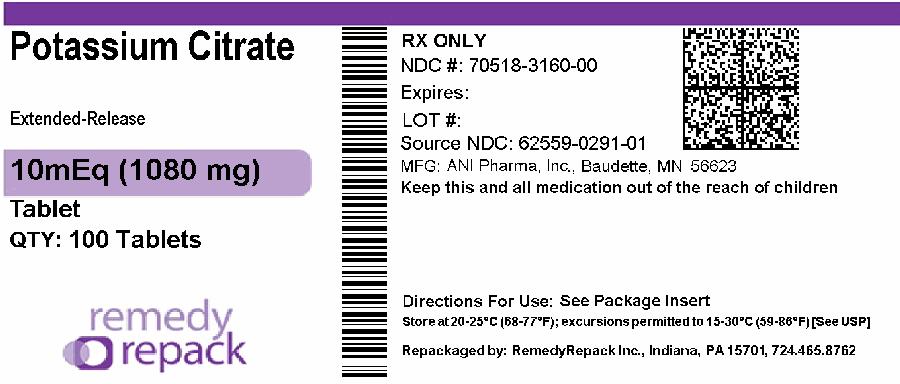
POTASSIUM CITRATE ER 5MEQ 100 TABS
Generic: POTASSIUM CITRATE
POTASSIUM CITRATE ER 5MEQ 100 TABS
Sign up to see pricing
Licensed pharmacies, clinics, doctor's offices, and veterinary practices get instant account approval
Sign Up — Instant ApprovalDrug Information
Identification
POTASSIUM CITRATE
POTASSIUM CITRATE EXTENDED RELEASE
Strides Pharma Inc.
HUMAN PRESCRIPTION DRUG
Administration
TABLET
ORAL
ANDA206813
Active Ingredients
| Ingredient | Strength |
|---|---|
| POTASSIUM CITRATE | 5 meq/1 |
Pharmacological Class
Data sourced from openFDA / DailyMed. For full prescribing information, consult the drug label.
Wholesale compliance resources
Drug Resources
Clinical Drug Information
Indications & Usage
1 INDICATIONS AND USAGE Potassium citrate is a citrate salt of potassium indicated for the management of: • Renal tubular acidosis (RTA) with calcium stones (1.1) • Hypocitraturic calcium oxalate nephrolithiasis of any etiology (1.2) • Uric acid lithiasis with or without calcium stones (1.3) 1.1 Renal Tubular Acidosis (RTA) with Calcium Stones Potassium citrate is indicated for the management of renal tubular acidosis [see Clinical Studies (14.1)] . 1.2 Hypocitraturic Calcium Oxalate Nephrolithiasis of any Etiology Potassium citrate is indicated for the management of Hypocitraturic calcium oxalate nephrolithiasis [see Clinical Studies (14.2)] . 1.3 Uric Acid Llithiasis with or without Calcium Stones Potassium citrate is indicated for the management of Uric acid lithiasis with or without calcium stones [see Clinical Studies (14.3)] .
Dosage & Administration
2 DOSAGE AND ADMINISTRATION Objective: To restore normal urinary citrate (greater than 320 mg/day and as close to the normal mean of 640 mg/day as possible), and to increase urinary pH to a level of 6.0 to 7.0. • Severe hypocitraturia (urinary citrate 150 mg/day): therapy should be initiated at 30 mEq per day; a dose of 15 mEq two times per day or 10 mEq three times per day with meals or within 30 minutes after meals or bedtime snack (2.3) 2.1 Dosing Instructions Treatment with extended release potassium citrate should be added to a regimen that limits salt intake (avoidance of foods with high salt content and of added salt at the table) and encourages high fluid intake (urine volume should be at least two litres per day). The objective of treatment with potassium citrate extended-release tablets is to provide potassium citrate in sufficient dosage to restore normal urinary citrate (greater than 320 mg/day and as close to the normal mean of 640 mg/day as possible), and to increase urinary pH to a level of 6.0 or 7.0. Monitor serum electrolytes (sodium, potassium, chloride and carbon dioxide), serum creatinine and complete blood counts every four months and more frequently in patients with cardiac disease, renal disease or acidosis. Perform electrocardiograms periodically. Treatment should be discontinued if there is hyperkalemia, a significant rise in serum creatinine or a significant fall in blood hematocrit or hemoglobin. 2.2 Severe Hypocitraturia In patients with severe hypocitraturia (urinary citrate 150 mg/day) therapy should be initiated at 30 mEq/day (15 mEq two times/day or 10 mEq three times/day with meals or within 30 minutes after meals or bedtime snack). Twenty-four hour urinary citrate and/or urinary pH measurements should be used to determine the adequacy of the initial dosage and to evaluate the effectiveness of any dosage change. Doses of Potassium citrate extended-release tablets greater than 100 mEq/day have not been studied and should be avoided.
Adverse Reactions
6 ADVERSE REACTIONS Some patients may develop minor gastrointestinal complaints such as abdominal discomfort, vomiting, diarrhea, loose bowel movements or nausea. These may be alleviated by taking the dose with meals or snacks or by reducing the dosage (6.1) To report SUSPECTED ADVERSE REACTIONS, contact Strides Pharma Inc. at 1-877-244-9825 or FDA at 1-800-FDA-1088 or www.fda.gov/medwatch 6.1 Postmarketing Experience Some patients may develop minor gastrointestinal complaints during potassium citrate therapy, such as abdominal discomfort, vomiting, diarrhea, loose bowel movements or nausea. These symptoms are due to the irritation of the gastrointestinal tract, and may be alleviated by taking the dose with meals or snacks, or by reducing the dosage. Patients may find intact matrices in their feces.
Information for Patients
17 PATIENT COUNSELING INFORMATION 17.1 Administration of Drug Tell patients to take each dose without crushing, chewing or sucking the tablet. Tell patients to take this medicine only as directed. This is especially important if the patient is also taking both diuretics and digitalis preparations. Tell patients to check with the doctor if there is trouble swallowing tablets or if the tablet seems to stick in the throat. Tell patients to check with the doctor at once if tarry stools or other evidence of gastrointestinal bleeding is noticed. Tell patients that their doctor will perform regular blood tests and electrocardiograms to ensure safety. Manufactured by: Strides Pharma Science Ltd. Puducherry – 605014, India Distributed by: Strides Pharma Inc. Bridgewater, NJ 08807 Revised: 07/2025
Clinical data sourced from openFDA drug labeling. For complete prescribing information, consult the full drug label.