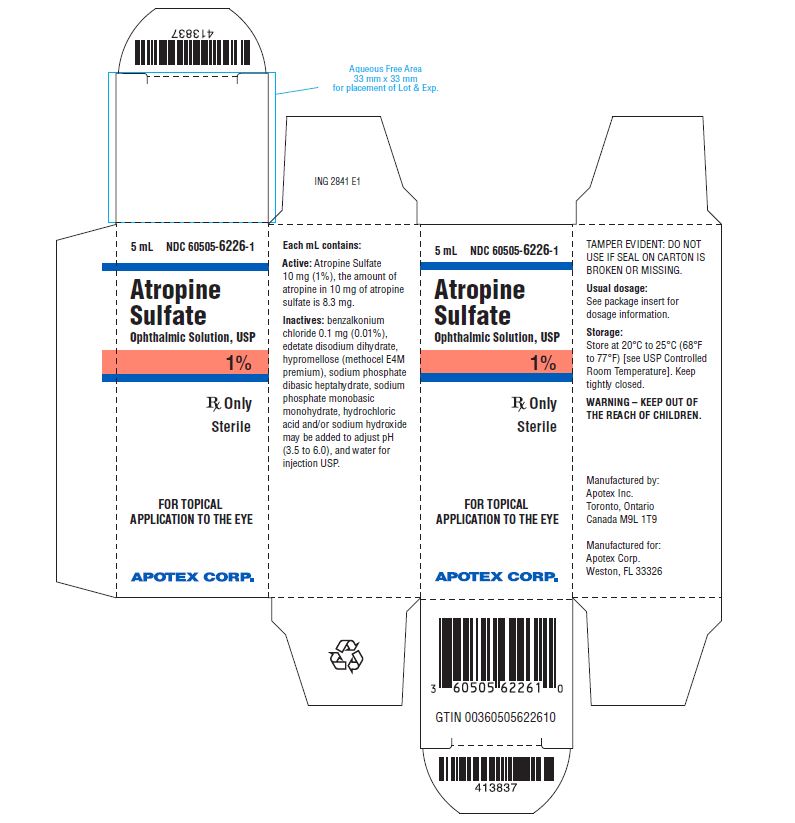
ATROPINE SULFATE 1% 2ML
Generic: Atropine Sulfate
ATROPINE SULFATE 1% 2ML
Sign up to see pricing
Licensed pharmacies, clinics, doctor's offices, and veterinary practices get instant account approval
Sign Up — Instant ApprovalDrug Information
Identification
Atropine Sulfate
Atropine
Apotex Corp.
HUMAN PRESCRIPTION DRUG
Administration
SOLUTION/ DROPS
OPHTHALMIC
ANDA215624
Active Ingredients
| Ingredient | Strength |
|---|---|
| ATROPINE SULFATE | 10 mg/mL |
Pharmacological Class
Data sourced from openFDA / DailyMed. For full prescribing information, consult the drug label.
Wholesale compliance resources
Drug Resources
Clinical Drug Information
Indications & Usage
1. INDICATIONS AND USAGE Atropine sulfate ophthalmic solution, 1% is indicated in adults and pediatric patients aged three (3) months and older for: Atropine is an anticholinergic agent indicated in adults and pediatric patients aged three (3) months and older for: Cycloplegia ( 1.1 ) Mydriasis ( 1.2 ) Penalization of the healthy eye in the treatment of amblyopia ( 1.3 ) 1.1 Cycloplegia 1.2 Mydriasis 1.3 Penalization of the Healthy Eye in the Treatment of Amblyopia
Dosage & Administration
2. DOSAGE AND ADMINISTRATION Apply 1 drop topically to the cul-de-sac of the conjunctiva, forty minutes prior to the intended maximal dilation time ( 2 ) In adults and pediatric patients 3 years and older, doses may be repeated up to twice daily as needed. ( 2 ) Apply 1 drop topically to the cul-de-sac of the conjunctiva, forty minutes prior to the intended maximal dilation time. In adults and pediatric patients aged 3 years and older, doses may be repeated up to twice daily as needed.
Adverse Reactions
6. ADVERSE REACTIONS The following serious adverse reactions are described below and elsewhere in the labeling: Photophobia and Blurred Vision [See Warnings and Precautions ( 5.1 )] Elevation in Blood Pressure [See Warnings and Precautions ( 5.2 )] The following adverse reactions were identified in clinical studies or postmarketing reports following use of atropine sulfate ophthalmic solution. Because these reactions are reported voluntarily from a population of uncertain size, it is not always possible to reliably estimate their frequency or establish a causal relationship to drug exposure. Most common adverse reactions that have been reported are eye pain and stinging on administration, blurred vision, photophobia, decreased lacrimation, increased heart rate and blood pressure. ( 6 ) To report SUSPECTED ADVERSE REACTIONS, contact Apotex Corp. at 1-800-706-5575 or FDA at 1-800-FDA-1088 or www.fda.gov/medwatch 6.1 Ocular Adverse Reactions Eye pain and stinging occurs upon instillation. Other commonly occurring adverse reactions include, blurred vision, photophobia, superficial keratitis and decreased lacrimation. Allergic reactions such as papillary conjunctivitis, contact dermatitis, and lid edema may also occur less commonly. 6.2 Systemic Adverse Reactions Systemic effects of atropine are related to its anti-muscarinic activity. Systemic adverse events reported include dryness of skin, mouth, and throat from decreased secretions from mucus membranes; restlessness, irritability or delirium from stimulation of the central nervous system; tachycardia; flushed skin of the face and neck.
Information for Patients
17. PATIENT COUNSELING INFORMATION Risk of Contamination Advise patients not to touch the dropper tip to the eye, eyelids, or any other surface as this may contaminate the solution. Keep the bottle tightly closed. Instillation Site Pain Advise patients that drops will sting upon instillation. Sensitivity to Light and Blurred Vision Advise patients that they will experience sensitivity to light and blurred vision which may last for a couple of weeks. Manufactured By Manufactured For Apotex Inc. Apotex Corp. Toronto, Ontario Weston, Florida Canada M9L 1T9 USA 33326 Revised: March 2026 Rev. 5
Clinical data sourced from openFDA drug labeling. For complete prescribing information, consult the full drug label.