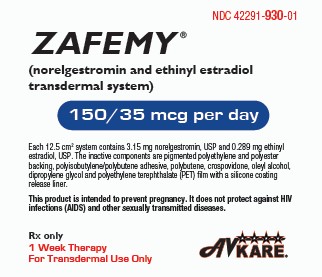
ZAFEMY AP 150-35MCG/24HR 3
Generic: Norelgestromin and Ethinyl Estradiol
ZAFEMY AP 150-35MCG/24HR 3
Sign up to see pricing
Licensed pharmacies, clinics, doctor's offices, and veterinary practices get instant account approval
Sign Up — Instant ApprovalDrug Information
Identification
Norelgestromin and Ethinyl Estradiol
ZAFEMY
Amneal Pharmaceuticals LLC
HUMAN PRESCRIPTION DRUG
Administration
PATCH
TRANSDERMAL
ANDA213950
Active Ingredients
| Ingredient | Strength |
|---|---|
| ETHINYL ESTRADIOL | 35 ug/d |
| NORELGESTROMIN | 150 ug/d |
Data sourced from openFDA / DailyMed. For full prescribing information, consult the drug label.
Wholesale compliance resources
Clinical Drug Information
Indications & Usage
1 INDICATIONS AND USAGE ZAFEMY is indicated for the prevention of pregnancy in women with a body mass index (BMI) < 30 kg/m 2 for whom a combined hormonal contraceptive is appropriate. Limitations of Use: ZAFEMY may be less effective in preventing pregnancy in women who weigh 198 lbs (90 kg) or more. ZAFEMY is contraindicated for use in women with BMI ≥ 30 kg/m 2 [see Contraindications (4) , Warnings and Precautions (5.1) and Clinical Studies (14) ]. ZAFEMY ® is an estrogen/progestin combination hormonal contraceptive (CHC), indicated for the prevention of pregnancy in women with a BMI < 30 kg/m 2 for whom a combined hormonal contraceptive is appropriate. (1) Limitations of Use : ZAFEMY may be less effective in preventing pregnancy in women at or above 198 lbs (90 kg). ( 1 , 4 , 14 )
Dosage & Administration
2 DOSAGE AND ADMINISTRATION To achieve maximum contraceptive effectiveness, ZAFEMY must be used exactly as directed. Complete instructions to facilitate patient counseling on proper system usage may be found in the FDA-Approved Patient Labeling. ZAFEMY uses a 28-day (four-week) cycle. Apply a new patch to the upper outer arm, abdomen, buttock or back each week for three weeks (21 total days). Week Four is patch-free. (2.1, 2.3) Apply each new patch on the same day of the week. Wear only one patch at a time. (2.1) Do not cut or alter the patch in any way. (2.1) 2.1 How to Use ZAFEMY The ZAFEMY transdermal system uses a 28-day (four-week) cycle. A new patch is applied each week for three weeks (21 total days). Week Four is patch-free. Withdrawal bleeding is expected during this time. Every new patch should be applied on the same day of the week. This day is known as the “Patch Change Day.” For example, if the first patch is applied on a Monday, all subsequent patches should be applied on a Monday. Only one patch should be worn at a time. Do not cut, damage or alter the ZAFEMY patch in any way. If the ZAFEMY patch is cut, damaged or altered in size, contraceptive efficacy may be impaired. On the day after Week Four ends, a new four-week cycle is started by applying a new patch. Under no circumstances should there be more than a seven-day patch-free interval between dosing cycles. 2.2 How to Start Using ZAFEMY There are multiple options for starting the ZAFEMY patch, and the woman should choose the option that is most appropriate (see Table 1): Table 1: Instructions for Administration Starting ZAFEMY patch in women with no current use of hormonal contraception The woman has two options for starting the patch and she should choose the option that is right for her: First Day Start The woman should apply her first patch during the first 24 hours of her menstrual period. If a patch is applied after the first 24 hours of menstruation, non-hormonal back-up contraception (such as condoms and spermicide, or diaphragm and spermicide) is needed for the first 7 days of the first cycle only. The woman should apply a new patch each week for three weeks (21 total days). Every new patch should be applied on the same day of the week. This day is known as the “Patch Change Day.” For example, if the first patch is applied on a Monday, all subsequent patches should be applied on a Monday. Only one patch should be worn at a time. No patch is worn during Week Four (the “Patch-Free Week”). Withdrawal bleeding is expected during this time. On the day after Week 4 ends, a new 4-week cycle is started by applying a new patch. Under no circumstances should there be more than a 7-day patch-free interval between dosing cycles. Sunday Start The woman should apply her first patch on the first Sunday after her menstrual period begins. With this option, a non-hormonal backup method of birth control, such as a condom and spermicide or diaphragm and spermicide, is needed for the first 7 days of the first cycle only. If her period starts on a Sunday, the first patch should be applied that day, and no backup contraception is needed. Switching from another contraceptive method Oral combination hormonal contraception (oral CHC) If the woman is switching from the pill to ZAFEMY patch, she should complete her current pill cycle and apply the first ZAFEMY patch on the day she would normally start her next pill If she does not get her period within a week after taking the last active pill, she should check with her healthcare professional to be sure that she is not pregnant, but she may go ahead and start ZAFEMY patch for contraception. If the patch is applied more than a week after taking the last active pill, she should use a non-hormonal back-up contraception (such as condoms and spermicide, or diaphragm and spermicide) concurrently for the first 7 days of patch use. Transdermal system If the woman is switching from another contraceptive transdermal system to ZAFEMY patch, she should complete the current transdermal system cycle and apply the first ZAFEMY patch on the day the next transdermal system cycle would normally start. If she does not get her period within a week after removing the last transdermal system, she should check with her healthcare professional to be sure that she is not pregnant, but she may go ahead and start ZAFEMY patch for contraception. If ZAFEMY patch is applied more than a week after removal of the last patch, non-hormonal back-up contraception (such as condoms and spermicide, or diaphragm and spermicide) should be used concurrently for the first 7 days of patch use. Vaginal ring If the woman is switching from the vaginal ring to ZAFEMY patch, she should complete her current vaginal ring cycle and apply the first ZAFEMY patch on the day she would normally insert her next vaginal ring. If she does not get her period within a week after removing the last vaginal ring, she should check with her healthcare professional to be sure that she is not pregnant, but she may go ahead and start ZAFEMY patch for contraception. If the patch is applied more than a week after removal of the last vaginal ring, she should use a non-hormonal back-up contraception (such as condoms and spermicide, or diaphragm and spermicide) concurrently for the first 7 days of patch use. Injection If the woman is switching from an injection contraceptive to ZAFEMY patch, she should apply the first ZAFEMY patch on the day the next injection would normally occur. Intrauterine system (IUS) If the woman is switching from an intrauterine system to ZAFEMY patch, she should apply the first ZAFEMY patch on the day of IUS removal. If the IUS is not removed on the first day of the menstrual cycle, non-hormonal backup contraception (such as condoms and spermicide, or diaphragm and spermicide) should be used concurrently for the first 7 days of patch use. Implant If the woman is switching from an implant to ZAFEMY patch, she should apply the first ZAFEMY patch on the day of implant removal. Progestin-only pill If the woman is switching from a progestin-only pill to ZAFEMY patch, she should apply the first ZAFEMY patch on the day the next progestin-only pill cycle would normally start. Use after Childbirth Start contraceptive therapy with ZAFEMY in women who elect not to breastfeed no sooner than 4 weeks after childbirth due to increased risk of thromboembolism. If a woman begins using ZAFEMY postpartum, and has not yet had a period, consider the possibility of ovulation and conception occurring prior to use of ZAFEMY, and instruct her to use an additional method of contraception, such as a condom and spermicide or diaphragm and spermicide, for the first seven days [see Warnings and Precautions (5.1) and Pregnancy (8.1) ] . Use after Abortion or Miscarriage After an abortion or miscarriage that occurs in the first trimester, ZAFEMY may be started immediately. An additional method of contraception is not needed if ZAFEMY is started immediately. If use of ZAFEMY is not started within 5 days following a first trimester abortion, the woman should follow the instructions for a woman starting ZAFEMY for the first time. In the meantime she should be advised to use a non-hormonal contraceptive method. Ovulation may occur within 10 days of an abortion or miscarriage. Start ZAFEMY no earlier than 4 weeks after a second trimester abortion or miscarriage, due to the increased risk of thromboembolic disease [see Contraindications (4) and Warnings and Precautions (5.1) ] . 2.3 How to Apply ZAFEMY CHOOSING A PLACE ON THE BODY TO PUT THE PATCH The patch may be placed on the upper outer arm, abdomen, buttock or back in a place where it won’t be rubbed by tight clothing. For example, it should not be placed under the waistband of clothing. The patch should not be placed on the breasts, on cut or irritated skin, or on the same location as the previous patch. Before applying the patch: The woman should make sure the skin is clean and dry. She should not use lotions, creams, oils, powders, or make-up at the patch site. It may cause the patch to fail to stick properly or to become loose. HOW TO APPLY THE PATCH The woman should tear open the pouch at the top edge. She should peel open the foil pouch that contains the patch and its clear plastic cover. She should gently remove the patch and its plastic cover together from the pouch, being careful not to separate the patch from the clear plastic cover. Using a fingernail, the woman should peel away half of the clear plastic. She should avoid touching the sticky surface with her fingers. The woman should apply the sticky side of the patch on the skin she has cleaned and dried. She should then remove the other half of the clear plastic and attach the entire patch to her skin. The woman should press firmly on the patch with the palm of her hand for 10 seconds, making sure that the whole patch adheres to her skin. She should run her fingers over the entire surface area to smooth out any “wrinkles” around the outer edges of the patch. The woman should check her patch every day to make sure all edges are sticking correctly. WHEN TO CHANGE THE ZAFEMY PATCH The patch works for seven days (one week). The woman should apply a new patch on the same day each week (her Patch Change Day) for 3 weeks in a row. She must make sure she has removed her old patch prior to applying the new patch. During Week 4, she DOES NOT wear a patch. She must make sure she removes her old patch. (Her period should begin during this week.) Following Week 4, she repeats the cycle of three weekly applications followed by a patch-free week. WHAT IF THE PATCH BECOMES LOOSE OR FALLS OFF? The patch must stick securely to the skin to work properly. If the ZAFEMY patch becomes partially or completely detached and remains detached, insufficient drug delivery occurs. The woman should not try to reapply a patch if it is no longer sticky, if it has become stuck to itself or another surface, or if it has other material stuck to it. If a patch edge lifts up: The woman should press down firmly on the patch with the palm of her hand for 10 seconds, making sure that the whole patch adheres to her skin. She should run her fingers over the entire surface area to smooth out any “wrinkles” around the edges of the patch. If her patch does not stick completely, she should remove it and apply a replacement patch. She should not tape or wrap the patch to her skin or reapply a patch that is partially adhered to clothing. If the patch has been off or partially off: For less than 1 Day, she should try to reapply it. If the patch does not adhere completely, she should apply a new patch immediately. (No backup contraception is needed and her Patch Change Day will stay the same). For more than 1 Day or if she is not sure for how long, she may not be protected from pregnancy. To reduce this risk, she should apply a new patch and start a new 4-week cycle. She will now have a new Patch Change Day and MUST USE NON-HORMONAL BACKUP CONTRACEPTION (such as a condom and spermicide or diaphragm and spermicide) for the first week of her new cycle. IF THE WOMAN FORGETS TO CHANGE HER PATCH at the start of any patch cycle (Week One/Day 1): SHE MAY NOT BE PROTECTED FROM PREGNANCY. She should apply the first patch of her new cycle as soon as she remembers. There is now a new “Patch Change Day” and a new “Day 1.” The woman must use back-up contraception, such as a condom and spermicide or diaphragm and spermicide, for the first week of the new cycle. in the middle of the patch cycle (Week Two/Day 8 or Week Three/Day 15), for one or two days (up to 48 hours), she should apply a new patch immediately. The next patch should be applied on the usual “Patch Change Day.” No back-up contraception is needed. for more than two days (48 hours or more), SHE MAY NOT BE PROTECTED FROM PREGNANCY. She should stop the current contraceptive cycle and start a new four-week cycle immediately by putting on a new patch. There is now a new “Patch Change Day” and a new “Day 1.” The woman must use back-up contraception for one week. at the end of the patch cycle (Week Four/Day 22), If the woman forgets to remove her patch, she should take it off as soon as she remembers. The next cycle should be started on the usual “Patch Change Day,” which is the day after Day 28. No back-up contraception is needed. Under no circumstances should there be more than a seven-day patch-free interval between cycles. If there are more than seven patch-free days, THE WOMAN MAY NOT BE PROTECTED FROM PREGNANCY and back-up contraception, such as a condom and spermicide or diaphragm and spermicide, must be used for seven days. As with combined oral contraceptives, the risk of ovulation increases with each day beyond the recommended drug-free period. If she has had intercourse during such an extended patch-free interval, consider the possibility of pregnancy. Change Day Adjustment If the woman wishes to change her Patch Change Day, she should complete her current cycle, removing the third ZAFEMY patch on the correct day. During the patch-free week, she may select an earlier Patch Day Change by applying a new ZAFEMY patch on the desired day. In no case should there be more than 7 consecutive patch-free days. Breakthrough Bleeding or Spotting In the event of unscheduled or breakthrough bleeding or spotting (bleeding that occurs on the days that ZAFEMY is worn), treatment should be continued. If unscheduled bleeding persists longer than a few cycles, consider causes other than ZAFEMY. If the woman does not have scheduled or withdrawal bleeding (bleeding that should occur during the patch-free week), she should resume treatment on the next scheduled Change Day. If ZAFEMY has been used correctly, the absence of withdrawal bleeding is not necessarily an indication of pregnancy. Nevertheless, consider the possibility of pregnancy, especially if absence of withdrawal bleeding occurs in 2 consecutive cycles. Discontinue ZAFEMY if pregnancy is confirmed. In Case of Skin Irritation If patch use results in uncomfortable irritation, the patch may be removed and a new patch may be applied to a different location until the next Change Day. Only one patch should be worn at a time. Additional Instructions for Dosing Unscheduled bleeding, spotting, and amenorrhea are frequent reasons for patients discontinuing hormonal contraceptives. In case of breakthrough bleeding, as in all cases of irregular bleeding from the vagina, consider nonfunctional causes. In case of undiagnosed persistent or recurrent abnormal bleeding from the vagina, take adequate diagnostic measures to rule out pregnancy or malignancy. If pathology has been excluded, time or a change to another method of contraception may solve the problem. Use of Hormonal Contraceptives in the Event of a Missed Menstrual Period If the woman has not adhered to the prescribed schedule, consider the possibility of pregnancy at the time of the first missed period. Discontinue use of ZAFEMY if pregnancy is confirmed. If the woman has adhered to the prescribed regimen and misses one period, she should continue using her contraceptive patches. However, if she has adhered to the prescribed regimen, misses one period and has symptoms associated with pregnancy, rule out pregnancy. Discontinue ZAFEMY use if pregnancy is confirmed. If the woman has adhered to the prescribed regimen and misses two consecutive periods, rule out pregnancy. Discontinue ZAFEMY use if pregnancy is confirmed. Where to put patch Usage Illustration 1 Usage Illustration 2 Usage Illustration 3 Usage Illustration 4
Adverse Reactions
6 ADVERSE REACTIONS The following serious adverse reactions with the use of combination hormonal contraceptives, including ZAFEMY, are discussed elsewhere in the labeling: Serious cardiovascular events and stroke [see Boxed Warning and Warnings and Precautions (5.1) ] Vascular events, including venous and arterial thromboembolic events [see Warnings and Precautions (5.1) ] Liver disease [see Warnings and Precautions (5.3) ] Adverse reactions commonly reported by users of combination hormonal contraceptives are: Irregular uterine bleeding Nausea Breast tenderness Headache The most frequent adverse reactions reported during clinical trials (≥ 5%) were breast symptoms, nausea/vomiting, headache, application site disorder, abdominal pain, dysmenorrhea, vaginal bleeding and menstrual disorders, and mood, affect and anxiety disorders. (6.1) To report SUSPECTED ADVERSE REACTIONS, contact Amneal Pharmaceuticals at 1-877-835-5472 or FDA at 1-800-FDA-1088 or www.fda.gov/medwatch . 6.1 Clinical Trials Experience Because clinical trials are conducted under widely varying conditions, adverse reaction rates observed in the clinical trials of a drug cannot be directly compared to rates in the clinical trials of another drug and may not reflect the rates observed in clinical practice. The data described below reflect exposure to ZAFEMY in 3,330 sexually active women (3,322 of whom had safety data) who participated in three Phase 3 clinical trials designed to evaluate contraceptive efficacy and safety. These subjects received six or 13 cycles of contraception (ZAFEMY or an oral contraceptive comparator in 2 of the trials). The women ranged in age from 18 to 45 years and were predominantly white (91%). The most common adverse reactions (≥ 5%) reported during clinical trials were breast symptoms, nausea/vomiting, headache, application site disorder, abdominal pain, dysmenorrhea, vaginal bleeding and menstrual disorders, and mood, affect and anxiety disorders. The most common events leading to discontinuation were application site reaction, breast symptoms (including breast discomfort, engorgement and pain), nausea and/or vomiting, headache and emotional lability. Adverse drug reactions reported by ≥ 2.5% of ZAFEMY-treated subjects in these trials are shown in Table 3. Table 3: Adverse Drug Reactions Reported by ≥ 2.5% of ZAFEMY-treated Subjects in Three Phase 3 Clinical Trials System/Organ Class* Adverse reaction ZAFEMY (n=3,322) Reproductive system and breast disorders Breast symptoms † 22.4% Dysmenorrhea 7.8% Vaginal bleeding and menstrual disorders † 6.4% Gastrointestinal disorders Nausea 16.6% Abdominal pain † 8.1% Vomiting 5.1% Diarrhea 4.2% Nervous system disorders Headache 21.0% Dizziness 3.3% Migraine 2.7% General disorders and administration site conditions Application site disorder † 17.1% Fatigue 2.6% Psychiatric disorders Mood, affect and anxiety disorders † 6.3% Skin and subcutaneous tissue disorders Acne 2.9% Pruritus 2.5% Infections and infestations Vaginal yeast infection † 3.9% Investigations Weight increased 2.7% * MedDRA version 10.0 † Represents a bundle of similar terms Additional adverse drug reactions that occurred in < 2.5% of ZAFEMY-treated subjects in the above clinical trials datasets are: Gastrointestinal disorders: Abdominal distension General disorders and administration site conditions: Fluid retention 1 , malaise Hepatobiliary disorders: Cholecystitis Investigations: Blood pressure increased, lipid disorders 1 Musculoskeletal and connective tissue disorders: Muscle spasms Psychiatric disorders: Insomnia, libido decreased, libido increased Reproductive system and breast disorders: Galactorrhea, genital discharge, premenstrual syndrome, uterine spasm, vaginal discharge, vulvovaginal dryness Respiratory, thoracic and mediastinal disorders: Pulmonary embolism Skin and subcutaneous tissue disorders: Chloasma, dermatitis contact, erythema, skin irritation 1 Represents a bundle of similar terms 6.2 Postmarketing Experience Five studies that compared breast cancer risk between ever-users (current or past use) of COCs and never-users of COCs reported no association between ever use of COCs and breast cancer risk, with effect estimates ranging from 0.90 to 1.12 (Figure 2). Three studies compared breast cancer risk between current or recent COC users (<6 months since last use) and never users of COCs (Figure 2). One of these studies reported no association between breast cancer risk and COC use. The other two studies found an increased relative risk of 1.19 to 1.33 with current or recent use. Both of these studies found an increased risk of breast cancer with current use of longer duration, with relative risks ranging from 1.03 with less than one year of COC use to approximately 1.4 with more than 8 to 10 years of COC use. Figure 2: RR = relative risk; OR = odds ratio; HR = hazard ratio. “ever COC” are females with current or past COC use; “never COC use” are females that never used COCs. The following adverse reactions (Table 4) have been identified during post-approval use of ZAFEMY. Because these reactions are reported voluntarily from a population of uncertain size, it is not always possible to reliably estimate their frequency or establish a causal relationship to drug exposure. Table 4: Alphabetical List of Adverse Drug Reactions Identified During Postmarketing Experience with ZAFEMY by System Organ Class* System Organ Class Adverse Drug Reactions Cardiac disorders Myocardial infarction † Endocrine disorders Hyperglycemia, insulin resistance Eye disorders Contact lens intolerance or complication Gastrointestinal disorders Colitis General disorders and administration site conditions Application site reaction † , edema † Hepatobiliary disorders Blood cholesterol abnormal, cholelithiasis, cholestasis, hepatic lesion, jaundice cholestatic, low density lipoprotein increased Immune system disorders Allergic reaction † , urticaria Investigations Blood glucose abnormal, blood glucose decreased Metabolism and nutrition disorders Increased appetite Neoplasms benign, malignant and unspecified (Incl. cysts and polyps) Breast cancer † , cervix carcinoma, hepatic adenoma, hepatic neoplasm Nervous system disorders Dysgeusia, migraine with aura Psychiatric disorders Anger, emotional disorder, frustration, irritability Reproductive system and breast disorders Breast mass, cervical dysplasia, fibroadenoma of breast, menstrual disorder † , suppressed lactation, uterine leiomyoma Skin and subcutaneous tissues disorders Alopecia, eczema, erythema multiforme, erythema nodosum, photosensitivity reaction, pruritus generalized, rash † , seborrheic dermatitis, skin reaction Vascular disorders Arterial thrombosis † , cerebrovascular accident † , deep vein thrombosis † , hemorrhage intracranial † , hypertension, hypertensive crisis, pulmonary embolism † , thrombosis † * MedDRA version 10.0 † Represents a bundle of similar terms 1
Information for Patients
17 PATIENT COUNSELING INFORMATION See FDA-approved patient labeling ( Patient Information and Instructions for Use ) 17.1 General Counsel patients about the following information: Cigarette smoking increases the risk of serious cardiovascular events from combined hormonal contraceptive use, and that women who are over 35 years old and smoke should not use combined hormonal contraceptives. The use of CHCs increases the risk of VTE. However, pregnancy increases the risk of VTE as much or more than the use of CHCs. The risk of VTE in women using CHCs is 3 to 12 cases per 10,000 woman-years. The risk of VTE is highest during the first year of use of CHCs and when restarting hormonal contraception after a break of 4 weeks or longer. The risk of thromboembolic disease due to CHCs gradually disappears after use is discontinued. ZAFEMY does not protect against HIV infection (AIDS) and other sexually transmitted infections. The Warnings and Precautions associated with combined hormonal contraceptives. ZAFEMY is not to be used during pregnancy; if pregnancy occurs during use of ZAFEMY, instruct the patient to stop further use. Apply a single patch the same day every week (Weeks 1 through 3). Instruct patients what to do in the event a patch is missed. See “WHAT IF I FORGET TO CHANGE MY PATCH?” section in FDA-Approved Patient Labeling . Use a back-up or alternative method of contraception when enzyme inducers are used with ZAFEMY. Combined hormonal contraceptives may reduce breast milk production; this is less likely to occur if breastfeeding is well established. Women who start combined hormonal contraceptives postpartum, and who have not yet had a period, should use an additional method of contraception until they have used a patch for 7 consecutive days. Amenorrhea may occur. Consider pregnancy in the event of amenorrhea. Rule out pregnancy in the event of amenorrhea in two or more consecutive cycles, amenorrhea in one cycle if the woman has not adhered to the dosing schedule, or if associated with symptoms of pregnancy, such as morning sickness or unusual breast tenderness. If the ZAFEMY patch becomes partially or completely detached and remains detached, insufficient drug delivery occurs. A patch should not be re-applied if it is no longer sticky, becomes stuck to itself or another surface, has other material stuck to it, or has become loose or fallen off before. If a patch cannot be re-applied, a new patch should be applied immediately. Supplemental adhesives or wraps should not be used. A woman may not be protected from pregnancy if a patch is partially or completely detached for ≥24 hours (or if the woman is not sure how long the patch has been detached). She should start a new cycle immediately by applying a new patch. Back-up contraception, such as a condom and spermicide or diaphragm and spermicide, must be used for the first week of the new cycle. All trademarks are the property of their respective owners. Distributed by: Amneal Pharmaceuticals LLC Bridgewater, NJ 08807 Rev. 04-2022-04
Clinical data sourced from openFDA drug labeling. For complete prescribing information, consult the full drug label.