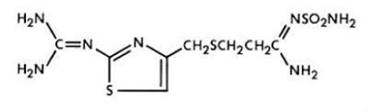
FAMOTIDINE 40MG TAB 1000CT
Generic: Famotidine
FAMOTIDINE 40MG TAB 1000CT
Sign up to see pricing
Licensed pharmacies, clinics, doctor's offices, and veterinary practices get instant account approval
Sign Up — Instant ApprovalDrug Information
Identification
Famotidine
Famotidine
Zydus Pharmaceuticals USA Inc.
HUMAN PRESCRIPTION DRUG
Administration
TABLET, FILM COATED
ORAL
ANDA216441
Active Ingredients
| Ingredient | Strength |
|---|---|
| FAMOTIDINE | 40 mg/1 |
Pharmacological Class
Data sourced from openFDA / DailyMed. For full prescribing information, consult the drug label.
Wholesale compliance resources
Drug Resources
Clinical Drug Information
Indications & Usage
1 INDICATIONS AND USAGE Famotidine tablets are indicated in adult and pediatric patients 40 kg and greater for the treatment of: active duodenal ulcer (DU). active gastric ulcer (GU). symptomatic nonerosive gastroesophageal reflux disease (GERD). erosive esophagitis due to GERD, diagnosed by biopsy. Famotidine tablets are indicated in adults for the: treatment of pathological hypersecretory conditions (e.g., Zollinger-Ellison syndrome, multiple endocrine neoplasias). reduction of the risk of duodenal ulcer recurrence. Famotidine is a histamine-2 (H 2 ) receptor antagonist indicated ( 1 ): In adult and pediatric patients 40 kg and greater for the treatment of: active duodenal ulcer (DU). active gastric ulcer. symptomatic nonerosive gastroesophageal reflux disease (GERD). erosive esophagitis due to GERD, diagnosed by biopsy. In adults for the: treatment of pathological hypersecretory conditions (e.g., Zollinger-Ellison syndrome, multiple endocrine neoplasias). reduction of the risk of DU recurrence.
Dosage & Administration
2 DOSAGE AND ADMINISTRATION Indication Recommended Dosage (2.1) Adult and Pediatric Patients 40 kg and greater Active DU 40 mg once daily; or 20 mg twice daily Active Gastric Ulcer 40 mg once daily GERD 20 mg twice daily Erosive Esophagitis 20 mg twice daily; or 40 mg twice daily Adults Pathological Hypersecretory Conditions 20 mg every 6 hours; adjust to patient needs; maximum 160 mg every 6 hours Risk Reduction of DU Recurrence 20 mg once daily See full prescribing information for complete dosing information, including dosing in renal impairment and recommended treatment duration. ( 2.1 , 2.2 ) Administration ( 2.3 ): Take once daily before bedtime or twice daily in the morning and before bedtime with or without food. 2.1 Recommended Dosage Table 1 shows the recommended dosage of famotidine 20 mg and 40 mg tablets in adult and pediatric patients weighing 40 kg and greater with normal renal function. The use of famotidine 20 mg and 40 mg tablets is not recommended in pediatric patients weighing less than 40 kg because the lowest available strength (20 mg) exceeds the recommended dose for these patients. Use another famotidine formulation for pediatric patients weighing less than 40 kg. Table 1 Recommended Dosage and Duration of Famotidine Tablets in Adult and Pediatric Patients 40 kg and Greater with Normal Renal Function a Both dosages demonstrated effectiveness in clinical trials [see Clinical Studies ( 14 )]. b In clinical trials, the majority of patients healed within 4 weeks. For patients who do not heal after 4 weeks, consider an additional 2 weeks to 4 weeks of treatment [see Clinical Studies ( 14.1 )]. c Longer treatment durations have not been studied in clinical trials [see Clinical Studies ( 14.1 , 14.2 , 14.3 )]. d In pediatric patients, the safety and effectiveness of famotidine have not been established for the reduction of the risk of duodenal ulcer recurrence or for treatment of pathological hypersecretory conditions [see Use in Specific Populations ( 8.4 )]. Indication Recommended Dosage Recommended Duration Active duodenal ulcer (DU) 40 mg once daily; or 20 mg twice daily a Up to 8 weeks b,c Active gastric ulcer 40 mg once daily Up to 8 weeks c Symptomatic nonerosive GERD 20 mg twice daily Up to 6 weeks c Erosive esophagitis diagnosed by endoscopy 20 mg twice daily; or 40 mg twice daily a Up to 12 weeks Pathological hypersecretory conditions d Starting dosage: 20 mg every 6 hours; adjust dosage to individual patient needs Maximum dosage 160 mg every 6 hours As clinically indicated Reduction of the risk of DU recurrence d 20 mg once daily 1 year c or as clinically indicated 2.2 Dosage in Renal Impairment Dosage adjustments of famotidine are recommended for patients with moderate to severe renal impairment (creatinine clearance less than 60 mL/min) [see Use in Specific Populations ( 8.6 )]. Table 2 shows the recommended maximum dosage of famotidine 20 mg or 40 mg tablets for patients with renal impairment, by indication. Use the lowest effective dose. Some dosage adjustments may require switching to other formulations of famotidine (e.g., oral suspension, lower dose tablet). Table 2 Recommended Maximum Dosage of Famotidine Tablets in Adult and Pediatric Patients 40 kg and Greater with Moderate and Severe Renal Impairment a An alternate dosage regimen is 10 mg once daily. Since 20 mg or 40 mg tablet strength cannot be used for this dosage regimen, use an alternate famotidine formulation. b Dosage adjustments for renal impairment are provided for both dosing regimens (20 mg twice daily and 40 mg twice daily) which showed effectiveness for the treatment of erosive esophagitis in clinical trials [see Clinical Studies ( 14.4 )] . c In pediatric patients, the safety and effectiveness of famotidine have not been established for the reduction of the risk of duodenal ulcer recurrence or for treatment of pathological hypersecretory conditions [see Use in Specific Populations ( 8.4 )] . d Doses required to treat pathological hypersecretory conditions may exceed the maximum doses evaluated in patients with impaired renal function. The risk for increased adverse reactions in renally impaired patients treated with famotidine for pathological hypersecretory conditions is unknown. e Recommended dosage regimen is 10 mg every other day. Since 20 mg or 40 mg tablet strength cannot be used for this dosage regimen, use an alternate famotidine formulation. Indication Recommended Maximum Dosages Creatinine clearance 30 mL/minute to 60 mL/minute Creatinine clearance less than 30 mL/minute Active duodenal ulcer (DU) 20 mg once daily; or 40 mg every other day 20 mg every other day a Active gastric ulcer 20 mg once daily; or 40 mg every other day 20 mg every other day a Symptomatic nonerosive GERD 20 mg once daily 20 mg every other day a Erosive esophagitis diagnosed by endoscopy b 20 mg once daily; or 40 mg every other day b 20 mg every other day a,b 40 mg once daily b 20 mg once daily b Pathological hypersecretory conditions c Avoid use d Reduction of the risk of DU recurrence c 20 mg every other day a (see footnote) e 2.3 Administration Instructions Take famotidine tablets once daily before bedtime or twice daily in the morning and before bedtime, as recommended. Famotidine tablets may be taken with or without food [see Clinical Pharmacology ( 12.3 )]. Famotidine tablets may be given with antacids.
Adverse Reactions
6 ADVERSE REACTIONS The most common adverse reactions are: headache, dizziness, constipation and diarrhea. ( 6.1 ) To report SUSPECTED ADVERSE REACTIONS, contact Zydus Pharmaceuticals (USA) Inc. at 1-877-993-8779 at 1-800-321-4576 or FDA at 1-800-FDA-1088 or www.fda.gov/medwatch. 6.1 Clinical Trial Experience Because clinical trials are conducted under widely varying conditions, adverse reaction rates observed in the clinical trials of a drug cannot be directly compared to rates in the clinical trials of another drug and may not reflect the rates observed in practice. Famotidine was studied in 7 US and international placebo- and active-controlled trials in approximately 2,500 patients [see Clinical Studies ( 14 )] . A total of 1,442 patients were treated with famotidine, including 302 treated with 40 mg twice daily, 456 treated with 20 mg twice daily, 461 treated with 40 mg once daily and 396 treated with 20 mg once daily. The population was 17 years to 91 years old, fairly well distributed between gender and race; however, the predominant race treated was Caucasian. The following adverse reactions occurred in greater than or equal to 1% of famotidine-treated patients: headache, dizziness and constipation. The following other adverse reactions were reported in less than 1% of patients in clinical trials: Body as a Whole: fever, asthenia, fatigue Cardiovascular: palpitations Gastrointestinal: elevated liver enzymes, vomiting, nausea, abdominal discomfort, anorexia, dry mouth Hematologic: thrombocytopenia Hypersensitivity: orbital edema, rash, conjunctival injection, bronchospasm Musculoskeletal: musculoskeletal pain, arthralgia Nervous System/Psychiatric: seizure, hallucinations, depression, anxiety, decreased libido, insomnia, somnolence Skin: pruritus, dry skin, flushing Special Senses: tinnitus, taste disorder Other: impotence 6.2 Postmarketing Experience The following adverse reactions have been identified during post-approval use of famotidine. Because these reactions are reported voluntarily from a population of uncertain size, it is not always possible to reliably estimate their frequency or establish a causal relationship to drug exposure. Cardiovascular: arrhythmia, AV block, prolonged QT interval Gastrointestinal: cholestatic jaundice, hepatitis Hematologic: agranulocytosis, pancytopenia, leukopenia Hypersensitivity: anaphylaxis, angioedema, facial edema, urticaria Musculoskeletal: rhabdomyolysis, muscle cramps Nervous System/Psychiatric: confusion, agitation, paresthesia Respiratory: interstitial pneumonia Skin: toxic epidermal necrolysis/Stevens-Johnson syndrome
Information for Patients
17 PATIENT COUNSELING INFORMATION Central Nervous System (CNS) Adverse Reactions Advise elderly patients and those with moderate and severe renal impairment of the risk of CNS adverse reactions, including confusion, delirium, hallucinations, disorientation, agitation, seizures and lethargy [see Warnings and Precautions ( 5.1 )] . Report symptoms immediately to a healthcare provider. QT Prolongation Advise patients with moderate and severe renal impairment of the risk of QT interval prolongation [see Use in Specific Populations ( 8.6 )] . Report new cardiac symptoms, such as palpitations, fainting and dizziness or lightheadedness immediately to a healthcare provider. Administration Advise patients: Take famotidine tablets once daily before bedtime or twice daily in the morning and before bedtime, as recommended. Famotidine tablets may be taken with or without food. Famotidine tablets may be given with antacids. Call your doctor for medical advice about side effects. You may report side effects to FDA at 1-800-FDA-1088. For more information, go to MedicalAffairs@zydususa.com or Tel. 1-877-993-8779.
Clinical data sourced from openFDA drug labeling. For complete prescribing information, consult the full drug label.