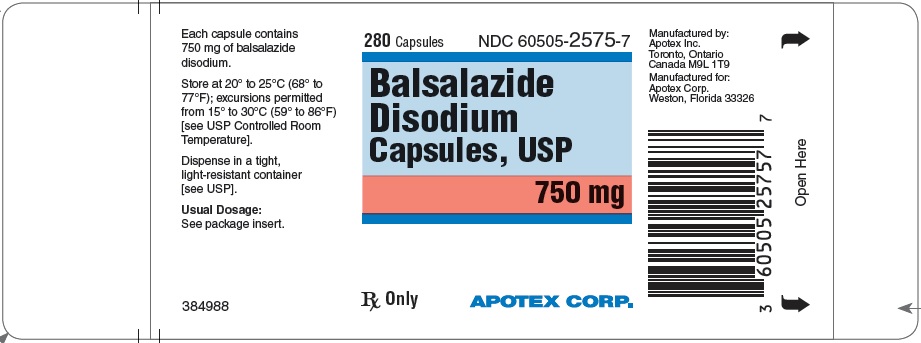
BALSALAZIDE 750MG CAP 280
Generic: Balsalazide Disodium
BALSALAZIDE 750MG CAP 280
Sign up to see pricing
Licensed pharmacies, clinics, doctor's offices, and veterinary practices get instant account approval
Sign Up — Instant ApprovalDrug Information
Identification
Balsalazide Disodium
Balsalazide Disodium
Apotex Corp.
HUMAN PRESCRIPTION DRUG
Administration
CAPSULE
ORAL
ANDA077883
Active Ingredients
| Ingredient | Strength |
|---|---|
| BALSALAZIDE DISODIUM | 750 mg/1 |
Pharmacological Class
Data sourced from openFDA / DailyMed. For full prescribing information, consult the drug label.
Wholesale compliance resources
Drug Resources
Clinical Drug Information
Indications & Usage
1 INDICATIONS AND USAGE Balsalazide disodium capsules are indicated for the treatment of mildly to moderately active ulcerative colitis in patients 5 years of age and older. Limitations of Use Safety and effectiveness of balsalazide beyond 8 weeks in pediatric patients 5 years to 17 years of age and 12 weeks in adults have not been established. Balsalazide is an aminosalicylate indicated for the treatment of mildly to moderately active ulcerative colitis in patients 5 years of age and older. ( 1 ) Limitations of Use: Safety and effectiveness of balsalazide beyond 8 weeks in children (ages 5 to 17 years) and 12 weeks in adults have not been established. ( 1 )
Dosage & Administration
2 DOSAGE AND ADMINISTRATION Administration Instructions Evaluate renal function before initiating therapy with balsalazide disodium capsules. ( 2.1) Swallow capsules whole. Do not cut, break, crush or chew. ( 2.1 ) For patients who cannot swallow intact capsules, the capsules may be opened and sprinkled on applesauce, then chewed and swallowed immediately. ( 2.1 ) Teeth and/or tongue staining may occur when administered sprinkled on applesauce. ( 2.1 ) Drink an adequate amount of fluids. ( 2.1 , 5.8 ) Take balsalazide disodium capsules with or without food. ( 2.1 ) Dosage Adults: The recommended dosage is 2.25 g (three 750 mg capsules) three times daily for 8 weeks. Some adult patients required treatment for up to 12 weeks in clinical trials. ( 2.2 ) Pediatric Patients 5 Years to 17 Years of Age: The recommended dosage is either: 2.25 g (three 750 mg capsules) three times for up to 8 weeks. OR: 750 mg (one capsule) three times daily for up to 8 weeks. ( 2.2 ) 2.1 Important Preparation and Administration Instructions Evaluate renal function before initiating therapy with balsalazide disodium capsules [see Warnings and Precaution (5.1) ]. Swallow balsalazide disodium capsules whole. Do not cut, break, crush or chew the capsules. For patients who cannot swallow intact capsules, balsalazide disodium capsules may also be administered by opening the capsule and sprinkling the capsule contents on applesauce. If the capsules are opened for sprinkling, color variation of the powder inside the capsules ranges from orange to yellow and is expected due to color variation of the active pharmaceutical ingredient. Place a small amount (approximately 10 mL) of applesauce into a clean container. Carefully open the capsules. Sprinkle the capsule contents on the applesauce. Mix the capsule contents with the applesauce. The contents may be chewed, if necessary. Consume the entire amount of applesauce mixture immediately. Do not store the applesauce mixture for future use. Teeth and/or tongue staining may occur in some patients when administered sprinkled on applesauce. Drink an adequate amount of fluids [see Warnings and Precautions ( 5.8 )]. Take balsalazide disodium capsules with or without food [see Clinical Pharmacology ( 12.3 )]. 2.2 Recommended Dosage in Adults and Pediatric Patients 5 Years to 17 Years of Age Adults The recommended dosage in adults is 2.25 g (three 750 mg capsules) three times daily for up to 8 weeks. Some patients in the adult clinical trials required treatment for up to 12 weeks. Pediatric Patients 5 Years to 17 Years of Age The recommended dosage in pediatric patients 5 years to 17 years of age is either : 2.25 g (three 750 mg capsules) three times daily for up to 8 weeks; OR: 750 mg (one capsule) three times daily for up to 8 weeks. Use of balsalazide in the pediatric population for more than 8 weeks has not been evaluated in clinical trials [see Clinical Studies ( 14 )] .
Adverse Reactions
6 ADVERSE REACTIONS The following clinically significant adverse reactions are described elsewhere in labeling: Renal Impairment [see Warnings and Precautions ( 5.1 )] Mesalamine-Induced Acute Intolerance Syndrome [see Warnings and Precautions ( 5.2 )] Hypersensitivity Reactions [see Warnings and Precautions ( 5.3 )] Hepatic Failure [see Warnings and Precautions ( 5.4 )] Severe Cutaneous Adverse Reactions [see Warnings and Precautions ( 5.5 )] Upper Gastrointestinal Tract Obstruction [see Warnings and Precautions ( 5.6 )] Photosensitivity [see Warnings and Precautions ( 5.7 )] Nephrolithiasis [see Warnings and Precautions ( 5.8 )] Most common adverse reactions (≥3%) are: headache, abdominal pain, diarrhea, nausea, vomiting, respiratory infection, and arthralgia. Adverse reactions in pediatric patients were similar. ( 6.1 ) To report SUSPECTED ADVERSE REACTIONS, contact Apotex at 1-800-706-5575 or FDA at 1-800-FDA-1088 or www.fda.gov/medwatch. 6.1 Clinical Trials Experience Because clinical trials are conducted under widely varying conditions, adverse reaction rates observed in the clinical trials of a drug cannot be directly compared to rates in the clinical trials of another drug and may not reflect the rates observed in practice. Adult Ulcerative Colitis During clinical development, 259 adult patients with active ulcerative colitis were exposed to 6.75 g/day balsalazide in 4 controlled trials. In the 4 controlled clinical trials patients receiving a balsalazide dose of 6.75 g/day most frequently reported the following adverse reactions: headache (8%), abdominal pain (6%), diarrhea (5%), nausea (5%), vomiting (4%), respiratory infection (4%), and arthralgia (4%). Withdrawal from therapy due to adverse reactions was comparable among patients on balsalazide and placebo. Adverse reactions reported by 1% or more of patients who participated in the 4 well-controlled, Phase 3 trials are presented by treatment group (Table 1). The number of placebo patients (35), however, is too small for valid comparisons. Some adverse reactions, such as abdominal pain, fatigue, and nausea were reported more frequently in women than in men. Abdominal pain, rectal bleeding, and anemia can be part of the clinical presentation of ulcerative colitis. Table 1: Adverse Reactions Occurring in ≥ 1 % of Adult Balsalazide Patients in Controlled Trials* Adverse Reaction Balsalazide Capsules 6.75 g/day [N=259] Placebo [N=35] Abdominal pain Diarrhea Arthralgia Rhinitis Insomnia Fatigue Flatulence Fever Dyspepsia Pharyngitis Coughing Anorexia Urinary tract infection Myalgia Flu-like disorder Dry mouth Cramps Constipation 16 (6%) 14 (5%) 9 (4%) 6 (2%) 6 (2%) 6 (2%) 5 (2%) 5 (2%) 5 (2%) 4 (2%) 4 (2%) 4 (2%) 3 (1%) 3 (1%) 3 (1%) 3 (1%) 3 (1%) 3 (1%) 1 (3%) 1 (3%) 0% 0% 0% 0% 0% 0% 0% 0% 0% 0% 0% 0% 0% 0% 0% 0% *Adverse reactions occurring in at least 1 % of balsalazide patients which were less frequent than placebo for the same adverse reaction were not included in the table. Pediatric Ulcerative Colitis In a clinical trial in 68 pediatric patients aged 5 to 17 years with mildly to moderately active ulcerative colitis who received 6.75 g/day or 2.25 g/day balsalazide disodium for 8 weeks, the most frequently reported adverse reactions were headache (15%), abdominal pain upper (13%), abdominal pain (12%), vomiting (10%), diarrhea (9%), colitis ulcerative (6%), nasopharyngitis (6%), and pyrexia (6%) [see Table 2] . One patient who received balsalazide disodium 6.75 g/day and 3 patients who received balsalazide disodium 2.25 g/day discontinued treatment because of adverse reactions. In addition, 2 patients in each dose group discontinued because of a lack of efficacy. Adverse reactions reported by 3% or more of pediatric patients within either treatment group in the Phase 3 trial are presented in Table 2. Table 2: Treatment-Emergent Adverse Reactions Reported by ≥3% of Patients in Either Treatment Group in a Controlled Study of 68 Pediatric Patients balsalazide disodium Adverse Reaction 6.75 g/day [N=33] 2.25 g/day [N=35] Total [N=68] Headache 5 (15%) 5 (14%) 10 (15%) Abdominal pain upper 3 (9%) 6 (17%) 9 (13%) Abdominal pain 4 (12%) 4 (11%) 8 (12%) Vomiting 1 (3%) 6 (17%) 7 (10%) Diarrhea 2 (6%) 4 (11%) 6 (9%) Colitis ulcerative 2 (6%) 2 (6%) 4 (6%) Nasopharyngitis 3 (9%) 1 (3%) 4 (6%) Pyrexia 0 (0%) 4 (11%) 4 (6%) Hematochezia 0 (0%) 3 (9%) 3 (4%) Nausea 0 (0%) 3 (9%) 3 (4%) Influenza 1 (3%) 2 (6%) 3 (4%) Fatigue 2 (6%) 1 (3%) 3 (4%) Stomatitis 0 (0%) 2 (6%) 2 (3%) Cough 0 (0%) 2 (6%) 2 (3%) Pharyngolaryngeal pain 2 (6%) 0 (0%) 2 (3%) Dysmenorrhea 2 (6%) 0 (0%) 2 (3%) 6.2 Postmarketing Experience The following adverse reactions have been identified during post-approval use of balsalazide, or other products which contain or are metabolized to mesalamine. Because these reactions are reported voluntarily from a population of uncertain size, it is not always possible to reliably estimate their frequency or establish a causal relationship to drug exposure. Cardiovascular and Vascular: Myocarditis, pericarditis, vasculitis [see Warnings and Precautions ( 5.3 )] Respiratory: pleural effusion, pneumonia (with and without eosinophilia), alveolitis, pleurisy/pleuritis Renal : renal failure, interstitial nephritis, nephrolithiasis [see Warnings and Precautions ( 5.1 , 5.8 )] Urine discoloration occurring ex-vivo caused by contact of mesalamine, including inactive metabolite, with surfaces or water treated with hypochlorite-containing bleach Gastrointestinal: pancreatitis Dermatologic: pruritus, alopecia Hepatic: hepatotoxicity, elevated liver function tests (SGOT/AST, SGPT/ALT, GGT, LDH, alkaline phosphatase, bilirubin), jaundice, cholestatic jaundice, cirrhosis, hepatocellular damage including liver necrosis and liver failure, Kawasaki-like syndrome including hepatic dysfunction Skin: SJS/TEN, DRESS, and AGEP [see Warnings and Precautions ( 5.5 )]
Information for Patients
17 PATIENT COUNSELING INFORMATION Renal Impairment Inform patients that balsalazide disodium capsules may decrease their renal function, especially if they have known renal impairment or are taking nephrotoxic drugs, including NSAIDs, and periodic monitoring of renal function will be performed while they are on therapy. Advise patients to complete all blood tests ordered by their healthcare provider [see Warnings and Precautions ( 5.1 ), Drug Interactions ( 7.1 )]. Mesalamine-Induced Acute Intolerance Syndrome and Other Hypersensitivity Reactions Inform patients of the signs and symptoms of hypersensitivity reactions. Instruct patients to stop taking balsalazide disodium capsules and report to their healthcare provider if they experience new or worsening symptoms of Acute Intolerance Syndrome (cramping, abdominal pain, bloody diarrhea, fever, headache, and rash) or other symptoms suggestive of mesalamine-induced hypersensitivity [see Warnings and Precautions ( 5.2 , 5.3 )]. Hepatic Failure Inform patients with known liver disease of the signs and symptoms of worsening liver function and advise them to report to their healthcare provider if they experience such signs or symptoms [see Warnings and Precautions ( 5.4 )]. Severe Cutaneous Adverse Reactions Inform patients of the signs and symptoms of severe cutaneous adverse reactions. Instruct patients to stop taking balsalazide disodium capsules and report to their healthcare provider at first appearance of a severe cutaneous adverse reaction or other sign of hypersensitivity [see Warnings and Precautions ( 5.5 )]. Upper Gastrointestinal Tract Obstruction Advise patients to contact their healthcare provider if they experience signs and symptoms of upper gastrointestinal tract obstruction [see Warnings and Precautions ( 5.6 )]. Photosensitivity Advise patients with pre-existing skin conditions to avoid sun exposure, wear protective clothing, and use a broad-spectrum sunscreen when outdoors [see Warnings and Precautions ( 5.7 )]. Nephrolithiasis Instruct patients to drink an adequate amount of fluids during treatment in order to minimize the risk of kidney stone formation and to contact their healthcare provider if they experience signs or symptoms of a kidney stone (e.g., severe side or back pain, blood in the urine) [see Warnings and Precautions ( 5.8 )]. Blood Disorders Inform elderly patients and those taking azathioprine or 6-mercaptopurine of the risk for blood disorders and the need for periodic monitoring of complete blood cell counts and platelet counts while on therapy. Advise patients to complete all blood tests ordered by their healthcare provider [see Drug Interactions ( 7.2 ), Use in Specific Populations ( 8.5 )]. Administration Instruct patients: Swallow balsalazide disodium capsules whole. Do not cut, break, crush or chew the capsules. For patients who cannot swallow intact capsules, balsalazide disodium capsules may also be administered by opening the capsule and sprinkling the capsule contents on applesauce. If the capsules are opened for sprinkling, color variation of the powder inside the capsules ranges from orange to yellow and is expected due to color variation of the active pharmaceutical ingredient. Place a small amount (approximately 10 mL) of applesauce into a clean container. Carefully open the capsules. Sprinkle the capsule contents on the applesauce. Mix the capsule contents with the applesauce. The contents may be chewed, if necessary. Consume the entire amount of applesauce mixture immediately. Do not store the applesauce mixture for future use. Teeth and/or tongue staining may occur in some patients who use balsalazide disodium capsules in sprinkle form with food. Drink an adequate amount of fluids. Take balsalazide disodium capsules without regard to meals [see Clinical Pharmacology ( 12.3 )] . Urine may become discolored reddish-brown while taking balsalazide disodium capsules when it comes in contact with surfaces or water treated with hypochlorite-containing bleach. If discolored urine is observed, advise patients to observe their urine flow. Report to the healthcare provider only if urine is discolored on leaving the body, before contact with any surface or water (e.g., in the toilet). APOTEX INC. BALSALAZIDE DISODIUM CAPSULES, USP 750 mg Manufactured by Manufactured for Apotex Inc. Apotex Corp. Toronto, Ontario Weston, Florida Canada M9L 1T9 USA 33326 Revision: 13
Clinical data sourced from openFDA drug labeling. For complete prescribing information, consult the full drug label.