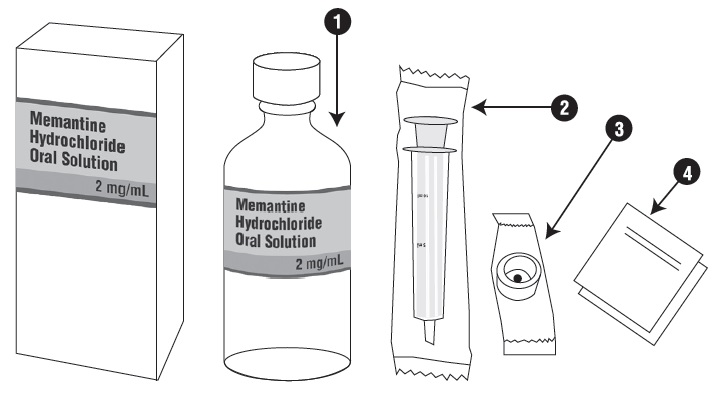
MEMANTINE HCL 2MG 360 ML
Generic: memantine hydrochloride
MEMANTINE HCL 2MG 360 ML
Sign up to see pricing
Licensed pharmacies, clinics, doctor's offices, and veterinary practices get instant account approval
Sign Up — Instant ApprovalDrug Information
Identification
memantine hydrochloride
MEMANTINE
Apotex Corp.
HUMAN PRESCRIPTION DRUG
Administration
SOLUTION
ORAL
ANDA209955
Active Ingredients
| Ingredient | Strength |
|---|---|
| MEMANTINE HYDROCHLORIDE | 2 mg/mL |
Pharmacological Class
Data sourced from openFDA / DailyMed. For full prescribing information, consult the drug label.
Wholesale compliance resources
Clinical Drug Information
Indications & Usage
1 INDICATIONS AND USAGE Memantine hydrochloride oral solution is indicated for the treatment of moderate to severe dementia of the Alzheimer's type. Memantine hydrochloride oral solution is an N-methyl-D-aspartate (NMDA) receptor antagonist indicated for the treatment of moderate to severe dementia of the Alzheimer's type. ( 1 )
Dosage & Administration
2 DOSAGE AND ADMINISTRATION The recommended starting dose of memantine hydrochloride oral solution is 5 mg (2.5 mL) once daily. The dose should be increased in 5 mg increments to 10 mg/day (2.5 mL twice daily), 15 mg/day (2.5 mL and 5 mL as separate doses), and 20 mg/day (5 mL twice daily). The minimum recommended interval between dose increases is one week. The dosage shown to be effective in controlled clinical trials is 20 mg/day (5 mL twice daily). Dosing Titration Schedule Total daily dose Strength per dose (mg) Starting Dose 5 mg 5 mg Dose after week 1 10 mg 5 mg (first daily dose) 5 mg (second daily dose) Dose after week 2 15 mg 5 mg (first daily dose) 10 mg (second daily dose) Dose after week 3 20 mg 10 mg (first daily dose) 10 mg (second daily dose) Memantine hydrochloride oral solution can be taken with or without food. If a patient misses a single dose of memantine hydrochloride oral solution, that patient should not double up on the next dose. The next dose should be taken as scheduled. If a patient fails to take memantine hydrochloride oral solution for several days, dosing may need to be resumed at lower doses and retitrated as described above. Do not mix memantine hydrochloride oral solution with any other liquid. Memantine hydrochloride oral solution is administered with a plastic dispensing syringe and a press-in bottle adapter. The supplied syringe should be used to withdraw the correct volume of oral solution and the oral solution should be slowly squirted into the corner of the patient's mouth. May be taken with or without food ( 2 ) Initial dose is 5 mg (2.5 mL) once daily. Increase dose in 5 mg increments to a maintenance dose of 10 mg (5 mL) twice daily. A minimum of 1 week of treatment with the previous dose should be observed before increasing the dose. ( 2 ) Severe renal impairment: recommended dose is 5 mg (2.5 mL) twice daily. ( 2 ) Special Populations Renal Impairment A target dose of 5 mg (2.5 mL) twice daily is recommended in patients with severe renal impairment (creatinine clearance of 5 to 29 mL/min based on the Cockcroft-Gault equation). Hepatic Impairment Memantine hydrochloride oral solution should be administered with caution to patients with severe hepatic impairment [see Clinical Pharmacology ( 12.3 )] .
Adverse Reactions
6 ADVERSE REACTIONS Most common adverse reactions (≥ 5% and greater than placebo) are dizziness, headache, confusion and constipation. ( 6.1 ) To report SUSPECTED ADVERSE REACTIONS, contact Apotex Corp. at 1-800-667-4708 or FDA at 1-800-FDA-1088 or www.fda.gov/medwatch . 6.1 Clinical Trials Experience Memantine hydrochloride oral solution was evaluated in eight double-blind placebo-controlled trials involving a total of 1,862 dementia (Alzheimer's disease, vascular dementia) patients (940 patients treated with memantine hydrochloride oral solution and 922 patients treated with placebo) for a treatment period up to 28 weeks. Because clinical trials are conducted under widely varying conditions, adverse reaction rates observed in the clinical trials of a drug cannot be directly compared to rates in the clinical trials of another drug and may not reflect the rates observed in clinical practice. Adverse Events Leading to Discontinuation In placebo-controlled trials in which dementia patients received doses of memantine hydrochloride oral solution up to 20 mg/day, the likelihood of discontinuation because of an adverse reaction was the same in the memantine hydrochloride oral solution group (10.1%) as in the placebo group (11.5%). No individual adverse reaction was associated with the discontinuation of treatment in 1% or more of memantine hydrochloride oral solution-treated patients and at a rate greater than placebo. Most Common Adverse Reactions In double-blind placebo-controlled trials involving dementia patients, the most common adverse reactions (incidence ≥ 5% and higher than placebo) in patients treated with memantine hydrochloride oral solution were dizziness, headache, confusion and constipation. Table 1 lists all adverse reactions that occurred in at least 2% of patients treated with memantine hydrochloride oral solution and at an incidence greater than placebo. Table 1: Adverse Reactions Reported in Controlled Clinical Trials in at Least 2% of Patients Receiving Memantine Hydrochloride Oral Solution and at a Higher Frequency than Placebo-treated Patients Adverse Reaction Placebo (N = 922) % Memantine Hydrochloride Oral Solution (N = 940) % Body as a Whole Fatigue 1 2 Pain 1 3 Cardiovascular System Hypertension 2 4 Central and Peripheral Nervous System Dizziness 5 7 Headache 3 6 Gastrointestinal System Constipation 3 5 Vomiting 2 3 Musculoskeletal System Back pain 2 3 Psychiatric Disorders Confusion 5 6 Somnolence 2 3 Hallucination 2 3 Respiratory System Coughing 3 4 Dyspnea 1 2 The overall profile of adverse reactions and the incidence rates for individual adverse reactions in the subpopulation of patients with moderate to severe Alzheimer's disease were not different from the profile and incidence rates described above for the overall dementia population. Seizures Memantine hydrochloride oral solution has not been systematically evaluated in patients with a seizure disorder. In clinical trials of memantine hydrochloride oral solution, seizures occurred in 0.2% of patients treated with memantine hydrochloride oral solution and 0.5% of patients treated with placebo. 6.2 Postmarketing Experience The following adverse reactions have been identified during post-approval use of memantine. Because these reactions are reported voluntarily from a population of uncertain size, it is not always possible to reliably estimate their frequency or establish a causal relationship to drug exposure. These reactions include: Blood and Lymphatic System Disorders - agranulocytosis, leukopenia (including neutropenia), pancytopenia, thrombocytopenia, thrombotic thrombocytopenic purpura. Cardiac Disorders - cardiac failure congestive. Gastrointestinal Disorders - pancreatitis. Hepatobiliary Disorders - hepatitis. Psychiatric Disorders - suicidal ideation. Renal and Urinary Disorders - acute renal failure (including increased creatinine and renal insufficiency). Skin Disorders - Stevens Johnson syndrome.
Information for Patients
17 PATIENT COUNSELING INFORMATION See FDA-approved patient labeling ( Patient Information and Instructions for Use ). To assure safe and effective use of memantine hydrochloride oral solution, the following information and instructions provided in the patient information section should be discussed with patients and caregivers. Patients/caregivers should be instructed to follow the dose titration schedule provided by their physician or healthcare professional for memantine hydrochloride oral solution. If a patient misses a single dose of memantine hydrochloride oral solution, that patient should not double up on the next dose. The next dose should be taken as scheduled. If a patient fails to take memantine hydrochloride oral solution for several days, dosing should not be resumed without consulting that patient's healthcare professional. Patients/caregivers should be instructed on how to use the memantine hydrochloride oral solution dosing device. They should be made aware of the patient instruction sheet that is enclosed with the product. Patients/caregivers should be instructed to address any questions on the usage of the solution to their physician or pharmacist. All Product/Brand names are the trademarks of their respective owners. Manufactured by: Manufactured for: Apotex Inc. Apotex Corp. Toronto, Ontario Weston, FL Canada M9L 1T9 33326 March 2017
Clinical data sourced from openFDA drug labeling. For complete prescribing information, consult the full drug label.